[Analysis] Jeonnam's 36-Year Quest for a Medical School: Is It Headed for Collapse Without a Breakthrough?
Mokpo National University Accepts, Suncheon National University Rejects: Integration Heads Toward Collapse
Medical School and University Hospital Location Dispute Reaches Dead End
Remaining Options: Dramatic Agreement or Separate Applications
One of the most long-standing aspirations in the Jeonnam and Gwangju regions—the establishment of a national medical school and university hospital—has once again hit a major obstacle. This is because the planned integration of Mokpo National University and Suncheon National University, which has been pursued conditional on founding a national medical school, is now effectively on the verge of collapse.
When Suncheon National University refused to accept the final compromise proposed by the Jeonnam-Gwangju Grand Transition Planning Committee, which serves as the transition committee for Min Hyung-bae, Mayor of the Jeonnam Gwangju Integrated Special City, the committee declared on July 14 that it would not engage in any further mediation.
With only autonomous agreement between the two universities remaining as a possibility, and just a few days left, prospects for a dramatic settlement are widely viewed as slim.
This situation goes beyond a mere failed attempt at university integration. It is a culmination of the 36-year struggle to bring a medical school to the western region, the ongoing demand to expand medical infrastructure in the eastern region, and, notably, marks the first regional conflict to erupt since the launch of the Jeonnam-Gwangju Integrated Special City—underscoring the significant repercussions.

The Core of the Conflict: The Medical School and University Hospital
Mokpo National University and Suncheon National University had agreed in November last year to integrate, contingent upon the establishment of a national medical school. At the time, there was high anticipation that a united approach would bolster their competitiveness in the nationwide bid to host a new medical school. However, the two institutions ultimately failed to find common ground on the critical issue of how to allocate the medical school and university hospital.
Since the 1990s, the Mokpo area has demanded the establishment of a medical school and university hospital to address inadequate healthcare services, particularly for severe cases that must otherwise be transferred to Gwangju or the Seoul metropolitan area—a challenge compounded by the archipelagic nature of the southwestern region. The Suncheon area, meanwhile, has argued that both a university hospital and medical school are needed locally as well, pointing to its population size, the industrial accident risks at the Yeosu National Industrial Complex, and growing medical demand in the eastern region.
Both sides present valid justifications, but at the heart of the matter is the question of where to locate the sole national medical school. The transition committee's final proposal called for establishing the unified university headquarters and the medical school in Mokpo, while first constructing a 500-bed university hospital in Suncheon and later building an additional university hospital in Mokpo, in a "one university, two hospitals" arrangement.
Mokpo National University accepted this compromise, but Suncheon National University rejected it. From Suncheon's perspective, housing both the university headquarters and the medical school in Mokpo raised concerns that the Suncheon campus would be relegated to the status of a regional branch. The assessment was also made that a university hospital without an affiliated medical school would not drive local development or enhance competitiveness.
The End of Mediation: Integration Set for Failure
The problem now lies in the timeline. According to the transition committee, a university integration application must be submitted to the Ministry of Education by July 20 in order for the unified national medical school to open by 2030. After this, the application process for medical school capacity slots is due to take place in August.
However, the likelihood that the two universities will reach a new agreement in the few remaining days appears slim, especially as the committee has effectively withdrawn, significantly weakening the momentum for negotiations.
Bak Hyang, Head of Health and Welfare at the Grand Transition Planning Committee, made it clear on this day that "no new mediation plan reflecting additional demands from any particular university will be presented." This is being interpreted as a virtual ultimatum: if the universities fail to reach an agreement, responsibility will rest with them.

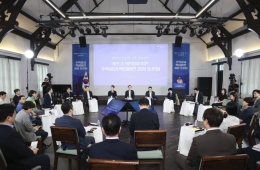
Min Hyungbae, Mayor of Jeonnam Gwangju Integrated Metropolitan City, stated at the town hall meeting held on the 9th at the Namak Government Complex that if no consensus is reached by the 13th regarding the integration discussions of the medical schools of Mokpo National University and Suncheon National University, he will withdraw from the talks. Photo by Shim Jinseok
View original imageThe Biggest Victims: The Local Residents
Critics now point out that the greatest victims in this situation are ultimately the local residents.
The City of Mokpo and the Mokpo City Council, in a joint statement, protested that "the 36-year hope of protecting the right to life and health of the residents of the western region has once again gone unrealized." National Assemblyman Kim One also sharply criticized the situation, saying, "The 36-year aspiration of Mokpo citizens now faces the risk of collapse as a result of Suncheon National University's stubbornness."
The circumstances are not different in the eastern region. Suncheon, Yeosu, and Gwangyang have all experienced long-standing issues related to the lack of advanced general hospitals. Workers at the Yeosu National Industrial Complex have consistently called for the establishment of an effective system to address industrial accidents, yet recent developments have pushed these hopes further into uncertainty.
As a result, both the western and eastern regions are seeking to expand medical infrastructure. However, faced with the constraint of limited resources—medical school slots and university hospitals—a zero-sum competition has unfolded, and the damage is falling squarely on the shoulders of local residents.
The Way Forward: What Comes Next?
In the aftermath of the failed integration, several scenarios are being floated within the region.
One possibility is that a dramatic agreement will be reached by July 20, leading to both university integration and the simultaneous founding of a medical school. This would be the ideal outcome, though its likelihood appears low.
Another option is for each university to independently apply for a new medical school, or for other institutions to join the bid. However, as the Ministry of Education had initially intended to award the project to a merged university with capacity for 100 students, the odds of selection for individual applicants remain highly uncertain.
Hot Picks Today
 "A Friend Saying 'I Actually Made 200 Million Won with SK hynix' Feels Like Four Weeks' Worth of Pain?"
- "After the Rush to Samsung and Hynix, Goldman Sachs Points to Causes of Sharp KOSPI Decline"
- "I'll Give You an Extra 1.4 Million Won a Month, But..." Major Firms Make Bold Moves, Even Conservative Japan Is Stirred
- "My Mouth Won't Open... Consult a Lawyer": The Rapid Spread of "Leave of Absence Proxy" Services in Japan
- 'What’s Going On With Daiso Sunscreen?' Viral YouTube Claims "30 Million Won Clinical Trial" — The Truth Behind the 'Below SPF' Controversy [Why&Next]
An official from the Jeonnam-Gwangju Integrated Special City stated, "There has been much time and effort invested, but the differences in perspectives between regions and universities were substantial. For now, finding a clear solution is not easy. If the bid is reopened, circumstances may change, but we hope for a breakthrough before then."
© The Asia Business Daily. All rights reserved. Unauthorized AI training and use prohibited.