From “MPE” to “RM-MPE”: Securing Raw Materials Is the Key to Critical Mineral Supply Chain Competitiveness
"Raw Materials Worth Seven, Technology Worth Three"
Emphasizing the Importance of Securing Raw Materials
Calls for Expanding Recycling and Strategic Stockpiling
Amid deepening instability in critical mineral supply chains, experts have suggested that Korea should advance beyond the current material, parts, and equipment (MPE) industrial strategy by adopting a broader “raw materials, materials, parts, and equipment (RM-MPE)” approach that includes raw material procurement.
Hongin Kim, Director of the Resource Utilization Research Division at the Korea Institute of Geoscience and Mineral Resources, stated at the “Policy Forum on Stabilizing Critical Mineral Supply Chains and Fostering the Recycling Industry” held at the National Assembly Members' Office Building in Yeouido, Seoul, on the morning of the 14th, “While ‘MPE’ was previously the focus, we are now entering the era of ‘RM-MPE’ that incorporates raw materials. To stabilize the supply chain of critical minerals, securing raw materials must be managed as a national strategy.”

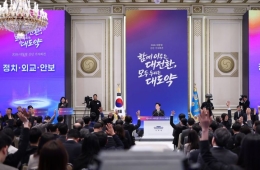
Hongin Kim, Director of the Resource Utilization Research Headquarters at the Korea Institute of Geoscience and Mineral Resources, is delivering a keynote presentation at the policy forum on "Stabilizing the Supply Chain of Critical Minerals and Fostering the Recycling Industry" held on the morning of the 14th at the National Assembly Members' Office Building in Yeouido, Seoul. Photo by Oh Sehee's office
View original imageDirector Kim explained that, although Korea’s technological capabilities in advanced industries such as batteries and semiconductors are largely established, industrial competitiveness is now determined by competition to secure raw materials. “The battery industry is highly dependent on raw materials,” he said. “Technological capability alone is not enough to ensure competitiveness; building a stable raw materials supply chain is essential.”
He particularly pointed out the severe dependency on China for rare earth elements. “China accounts for about 60% of global rare earth mining, over 90% of separation and refining, and more than 93% of permanent magnet production,” he explained. “The United States, Japan, and Europe are accelerating efforts to restructure supply chains to reduce dependency on China.”
The domestic situation is also challenging. Korea’s self-sufficiency rate for critical metals is only about 0.4%, meaning nearly all critical minerals are imported, and dependence on China for graphite and rare earths is especially high.
To stabilize supply chains, Director Kim emphasized the need to foster the recycling industry. “In the recycling sector, there is a saying that ‘raw materials are worth seven, technology is worth three’, highlighting the importance of stable waste resource procurement,” he said. “Although we have advanced technology, many commercialization efforts struggle due to a lack of raw materials.”
He added, “Expanding the use of recycled materials, supporting demonstration projects, establishing early warning systems for supply chains, expanding strategic stockpiles, and creating an industrial ecosystem through public-private cooperation are all necessary steps to build a stable supply chain for critical minerals.”

On the 14th, officials attending the "Policy Forum on Stabilizing Core Mineral Supply Chains and Promoting the Recycling Industry," held at the National Assembly Members' Office Building in Yeouido, Seoul, are taking a commemorative photo. Photo by Oh Sehee's Office
View original imageKyungkeun Yoo, a professor at Korea Maritime & Ocean University, stressed that, since approximately 80% of the 200 domestic recycling companies are small and medium-sized enterprises, measures must be implemented to ensure stable raw materials sourcing, technology development, facility investment, financial and workforce support, and systems to respond to regulations.
During the subsequent general discussion, participants reached a consensus that critical mineral recycling should be fostered as a manufacturing industry that produces critical minerals domestically, rather than merely as a waste management sector. They proposed establishing an industrial ecosystem encompassing raw material recovery, preprocessing, refining, and materialization, all linked to end-user demand. They also suggested expanding policy-based financing, technology development, demonstration and certification, facility investment, and market support.
Sehee Oh, a lawmaker from the Democratic Party of Korea and the forum organizer, stated, “We must foster the recycling industry as a core sector that supports national resource security, not merely as a waste treatment industry. We will continue to listen to feedback from the field and carefully address needed regulatory improvements and legislative/budgetary tasks so that small and medium-sized recycling companies can grow as a pillar of a stable critical mineral supply chain.”
Hot Picks Today
 "Don't Say 'Americano' Anymore" After the Uproar... Now a Surge in 'Patriotic Spending' Sweeps Canada
- "114-Year-Old Mother Who Loves Bread Porridge; Eldest Daughter Is 94"… Japan’s Centenarian Population Surpasses 100,000
- "Weight Dropped Rapidly... Anyone Can Get It Easily": Why a Woman in Her 20s Quit Mountzaro After Losing 6kg in a Month
- "That Teacher Is from Harvard"... Surge of Master's and PhD Holders in Chinese Schools as Monthly Pay Tops 1 Million Won
- 'Pronounced Dead,' Now Boiling Again... Chinese Millennials and Gen Z Seek 'Premium Ramen'
The forum was co-hosted by Representative Oh, who is also the Chairperson of the Democratic Party’s National Small Business Committee, and lawmakers Hye Ryeon Baek, Eonju Lee, Won Yi Kim, and Jaebong Song. The Korea Institute for Advancement of Technology served as the event’s organizer.
© The Asia Business Daily. All rights reserved. Unauthorized AI training and use prohibited.