Oh Se-hoon Proposes Real Estate Market Normalization Measures to Government... Redevelopment, Rental Businesses Included
At July 14 Cabinet Meeting Presided Over by President
Eight Key Proposals for 'Normalizing Seoul's Real Estate Market'
Institutional Reforms Suggested for Market Stabilization
Calls for Additional Policies to Alleviate Housing Hardships for Genuine Consumers
On July 14, Seoul Mayor Oh Se-hoon held a press briefing at Seoul City Hall after attending his first Cabinet meeting presided over by President Lee Jae-myung since the launch of the ninth popularly-elected administration, where he announced three major policy areas and eight key policy tasks submitted to the government for normalizing Seoul's real estate market.

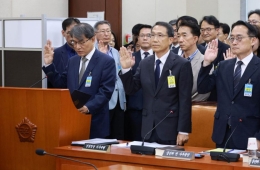
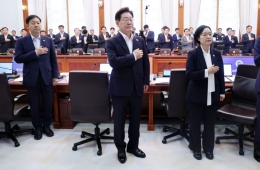
Seoul Mayor Oh Se-hoon is giving a greeting at the Cabinet meeting chaired by President Lee Jae-myung at the Blue House on the 14th. Photo by Yonhap News Agency Blue House Correspondents
View original imageAt the Cabinet meeting, Mayor Oh had planned to deliver to President Lee topics mainly related to redevelopment projects, including relocation loans, transfer of union membership status, and relaxation of rules for rental business operators. However, when he asked, "May the mayor of Seoul say a few words?" Prime Minister Han Sung-sook did not give him an opportunity to speak, so he submitted his suggestions in writing.
The document submitted by the Seoul Metropolitan Government, titled "Real Estate Market Issue Analysis and Proposals to the Government," was also handed over to related ministries including the Blue House, the Ministry of Land, Infrastructure and Transport, the Financial Services Commission, and the Ministry of Economy and Finance.
In the submitted material, Seoul City argued that regulation-centered policies alone have limitations in stabilizing the real estate market and protecting real demand, based on an analysis of recent market trends. The suggestions focused on improving systems in three areas: private redevelopment projects, private rentals, and the taxation system. The proposal was designed to restore conditions for orderly progress in redevelopment projects, strengthen the functions of private rental business operators, and ease the burden on genuine consumers, thereby resolving market instability and providing a sustainable foundation for housing supply.
By category, for private redevelopment projects, the city proposed the following: raising the loan-to-value (LTV) ratio on relocation loans to 70 percent, easing restrictions on transferring union membership status, and relaxing the legal upper limit on floor area ratio for private redevelopment schemes by a factor of 1.2. In the private rental sector, the city called for easing LTV restrictions for purchasable rental business operators, exempting combined holdings from comprehensive real estate tax, and introducing an institutional corporate private rental program. Regarding the tax system, proposals included keeping the fair market value ratio unchanged, maintaining the current long-term holding special deduction, and adjusting property and comprehensive real estate tax bases to reflect inflation.
Seoul City also conducted a comprehensive review of the impacts of government real estate policy and concluded that regulation-centered approaches have deepened housing insecurity in Seoul. As of May, the sale price of Seoul apartments had climbed 11 percent year-on-year. The upward trend continued even after the government’s October 15 measures last year, which expanded regulatory zones and land transaction permit areas to cover all of Seoul. This price increase spread beyond the Gangnam district to other areas including Yeongdeungpo, Gangseo, Gwanak, Dongjak, Seongbuk, and Seongdong districts.
Meanwhile, the jeonse (long-term deposit rental) price of Seoul apartments rose by 6.8 percent, marking the highest rate of increase in the past 11 years. The proportion of contract renewals also expanded to 55.4 percent as of June this year, which Seoul City analyzed as a sign that housing mobility among residents has been further constrained.

Seoul City not only cited objective statistics but also presented case studies of policy-induced difficulties faced by a wide range of people on the ground, such as young people, newlyweds, single-home owners, and long-term private landlords. In some areas, monthly rent for small studios, which are typically occupied by young people without housing, has risen by as much as 100 percent; competition for the Goduk Arteon Happy Housing project for newlyweds reached a record high of 1,253 to 1. The city diagnosed that the hardships of real demand consumers are now structural problems.
Additionally, it was pointed out that single-home owners who rent out their homes due to work relocation and live elsewhere cannot easily sell their homes, as non-cash buyers are unable to purchase such properties even if they are listed for sale.
Hot Picks Today
 "I'll Give You an Extra 1.4 Million Won a Month, But..." Major Firms Make Bold Moves, Even Conservative Japan Is Stirred
- Samsung Electronics and Google Join Forces, Leading Stock Plunges 17%... Will 140 Giant Companies Reshape the Coin Market? [Bitcoin Now]
- "After the Rush to Samsung and Hynix, Goldman Sachs Points to Causes of Sharp KOSPI Decline"
- "Over 130 Million Won Lost Per Person" Warning... The Disease Threatening Even Those in Their 30s and 40s
- "Risked His Life for Views"... Influencer Jumps Off High-Rise Apartment
Mayor Oh Se-hoon said, "Supply is essential for market stability, and only then can young people and working-class citizens regain the ability to plan for their futures," adding, "Because housing policy is the area of policy most closely related to people's lives, I ask that the government actively reflect these recommendations in its housing policy."
© The Asia Business Daily. All rights reserved. Unauthorized AI training and use prohibited.