Government Launches ‘3% Growth’ With Semiconductor as Sole Driver... Middle East Conflict a Variable [Second Half Growth Strategy]
The government's decision to raise this year’s economic growth target by as much as 1.0 percentage point in just six months is largely based on a stronger-than-expected semiconductor boom cycle. By using the semiconductor boom as a starting point for growth, the government aims to boost its potential growth rate to around 3% by expanding into supply chain self-reliance, artificial intelligence (AI), and regionally balanced growth. However, there are concerns regarding this vision of securing future competitiveness with only semiconductors as a single growth engine, especially as the semiconductor boom is a highly unpredictable external variable, and the resumption of hostilities between the United States and Iran is further increasing the uncertainties of external factors. Critics also point out that even if strong semiconductor exports support immediate economic growth, public sentiment and the general economy may not improve significantly unless the gaps between different manufacturing sectors and employment polarization are also addressed.

Aiming for a Rebound in Potential Growth with ‘Three Mega Projects’ and the ‘5 Centers, 3 Special Zones’ Strategy
The government will actively pursue three major mega projects in the second half of this year, centering on semiconductors, AI data centers, and physical AI. Early completion of semiconductor fabs in the metropolitan regions of Yongin and Pyeongtaek is planned, and an additional four fabs will be constructed in the southwestern region with a total investment of 800 trillion won. Core factories for high-bandwidth memory (HBM) will be established in the Chungcheong region as advanced packaging hubs, while demonstration infrastructure such as testbeds for equipment chambers will be concentrated in the Yeongnam region. The government also plans to unveil a strategy in the third quarter for domestic production and the creation of an ecosystem for defense semiconductors, which are currently highly dependent on overseas sources. A total of 550 trillion won will be invested in building an 8.4GW-class AI data center, with construction set to begin by the first half of 2028, and about 50,000 graphic processing units (GPUs) will be secured as planned, with allocation plans for the following year to be drawn up in advance within the second half of this year. In the area of physical AI, the development of a general-purpose world model and a foundation model for robotics will be initiated.
Under the ‘5 Centers, 3 Special Zones’ strategy, the government will finalize the selection of strategic regional industries during the third quarter and pursue comprehensive support—covering investment incentives and regulatory reforms—under the ‘three pillars, seven core packages’ approach, with the aim of passing a special mega-zone act before the end of the year. In the financial sector, over 40% of the National Growth Fund will be invested in regional areas, while Daejeon, Gwangju, Daegu, and Ulsan—home to four major institutes of science and technology—will be designated as startup cities, and a 2 trillion won regional growth fund will be launched. Notably, the ‘second wave of public institution relocations’—which will be guided by the principle of minimizing retention in the greater Seoul area—will be announced in the second half of the year. To boost local consumption, the conversion of unspent individual reward points into regional currency is being considered, and corporate donations to the Hometown Love Donation Program (as reported June 17) will be introduced in December. The basic rural income project will also be expanded to 17 counties.
In the upcoming August tax reform plan, the government will specify the details of its ‘domestic production tax credit’ policy. By introducing an incentive for companies that build advanced manufacturing facilities or expand domestic production, the government aims to tackle supply chain instability—a vulnerability exposed during each geopolitical crisis such as the Middle East wars. Separate promotion measures are even being considered to support companies unable to benefit from tax incentives due to initial large-scale investment losses, thereby strongly encouraging both large domestic companies and medium-sized firms to invest in domestic manufacturing bases. Additionally, the government will continue offering subsidies for domestically produced high-risk and economically sensitive items—those that lack cost competitiveness—through the first half of next year. For essential items where dependence on any single country exceeds 80%, cost increases for imported replacements will be fully financed via low-interest loans (with preferential rates up to 2.3 percentage points) through a supply chain stabilization fund. Feasibility studies for stockpiling essential commodities such as urea and naphtha will be conducted, and from August, a new ‘government direct stockpiling and on-demand sales’ model will be piloted to proactively prevent supply disruptions.
Rising Middle East Tensions...Clear Limits of a Blueprint Based on External Variables
However, some raise concerns regarding the limitations of growth strategies that rely on external variables. The semiconductor boom cycle itself remains an unpredictable external factor. Moreover, after the United States resumed its attacks on Iran overnight, it effectively reversed all key measures agreed in its memorandum of understanding (MOU) with Iran, including the passage through the Strait of Hormuz and the lifting of the maritime embargo against Iran. As a result, the Korean economy once again faces heightened external risks, such as a spike in international oil prices. In its latest economic outlook, the government lowered its oil price assumption to $85 per barrel for this year, based on the premise that Middle East tensions would subside, which is lower than previous estimates.
Hot Picks Today
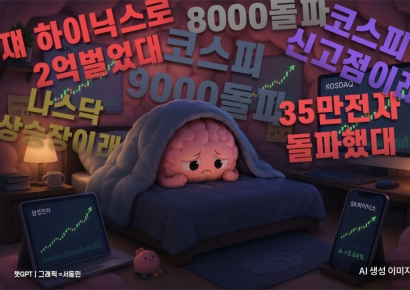 "A Friend Saying 'I Actually Made 200 Million Won with SK hynix' Feels Like Four Weeks' Worth of Pain?"
- "I'll Give You an Extra 1.4 Million Won a Month, But..." Major Firms Make Bold Moves, Even Conservative Japan Is Stirred
- [Exclusive] Hyundai Motor Affiliates Also Halt Operations... Supply Chain on Alert Amid 'Domino Strikes'
- Amid Volatility from Samsung and SK Hynix Leveraged ETFs, Securities Industry to Raise Minimum Deposits
- 'What’s Going On With Daiso Sunscreen?' Viral YouTube Claims "30 Million Won Clinical Trial" — The Truth Behind the 'Below SPF' Controversy [Why&Next]
The government expects that overwhelming investment, taking advantage of the semiconductor boom, will boost productivity across the broader economy and trigger a rebound in potential growth. However, the semiconductor industry is capital-intensive. While the boom lifts exports and large corporation profits, it does not sufficiently spread throughout the wider industry, employment, income, and domestic demand. This is why there are calls for swift measures to invigorate the economy for self-employed individuals and vulnerable groups, who are directly exposed to high interest rates, prices, and exchange rates. Byunghoon Seok, professor of economics at Ewha Womans University, pointed out, “Along with investment in strategic industries, there is still no visible long-term structural reform plan aimed at reducing labor market rigidity and boosting total factor productivity to overcome polarization within manufacturing. The key to reigniting potential growth lies in strengthening traditional export industries—such as steel, petrochemicals, batteries, displays, and consumer electronics—which are currently experiencing negative growth.”
© The Asia Business Daily. All rights reserved. Unauthorized AI training and use prohibited.