"With Electricity Surplus for 360 Days a Year"... Lee: "If Price Pressure Is Not an Issue, Household Rates Should Be Adjusted"
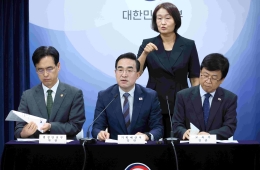
President Lee Jae-myung at the National Fiscal Strategy Meeting on July 13
"Household electricity rates are the same day and night... This needs to be fixed"
On the 13th, President Lee Jae-myung called for a reform of the electricity pricing system, stating, "For households, electricity rates are the same whether it's day or night. This needs to be changed."
President Lee made these remarks at the National Fiscal Strategy Meeting 2026, held at the Blue House State Guest House, after receiving a report from Lee Sang-min, a research fellow at the Korea Fiscal Policy Institute, who suggested that a flexible pricing system should be introduced so that electricity prices are lower during times and in regions where there is a surplus of electricity.

President Lee Jae-myung is speaking at the National Fiscal Strategy Meeting held at the Blue House on July 13, 2026. Photo by Yonhap News Agency
View original imageWhen Lee, the research fellow, pointed out that "except for the peak of summer and winter, there is a surplus of electricity on 360 days out of the year," President Lee agreed, saying, "That seems like a very important point. Outside of peak times, there is an oversupply of electricity. To control generation, we often stop accepting renewable energy and, in some cases, even shut down wind turbines."
Currently, industrial electricity rates are lower during the day and higher in the evening. This policy is intended to encourage demand during the day, when there is abundant solar and other renewable energy generation, and to curb demand in the evening, when electricity usage is concentrated. However, for households, a progressive rate system is applied, but there is no difference in rates by time of day.
Additionally, when Kim Seong-hwan, Minister of Climate, Energy and Environment, reported that "industrial electricity rates are 180 won per kWh, while in China it is in the 120-won range. Residential electricity rates are around 150-160 won," President Lee responded, "If there were no concerns about inflation or household income, the reality is that we would need to adjust residential electricity rates."
President Lee also called for a change in the household electricity pricing system to facilitate the introduction of heat pumps. A heat pump is a device that absorbs heat from outside and generates heat, and it is more than three to four times as efficient as direct electricity use.
President Lee stated, "In Europe, they have quickly and widely adopted heat pumps, but it seems we are not using them in Korea," and asked, "Is it correct that making household electricity cheaper during the day and more expensive at night would make heat pumps more efficient?"
The idea is to operate heat pumps during the day, when electricity is cheaper, to store energy and then use that energy at night, thereby managing energy demand more efficiently.
Hot Picks Today
 "Not Even Daiso, but Prices from 1,000 to 7,000 Won" Crowds Flock... This Place Becomes Millennial & Gen Z Shopping Hotspot
- "Is It Really This Big?" World Number One in Sight... K-Beauty’s Surge Captivates Foreign Consumers with Trusted Korean Products
- A Real-Life Fairytale: 26-Year-Old Car Salesman Revealed to Be a Prince
- "I'm Not Selling, I'm Still Waiting"... Why Jeon Wonju Holds Firm Despite a 9,000% Return on SK hynix
- "Does This Really Work?" Just Add Cold Water... Cup Noodles Sell Out in 68 Years' First Craze
In this regard, President Lee instructed, "Rationalizing energy use to solve energy issues is a national task," and added, "Since we need to make the transition as quickly and extensively as possible, increasing the budget should also be considered."
© The Asia Business Daily. All rights reserved. Unauthorized AI training and use prohibited.