SK hynix Earnings Outlook Lowered... Will KOSPI Overheating Debate Reignite? (Comprehensive)
Korea Investment & Securities: "SK hynix Q2 Earnings Fall Short of Expectations," Stock Price Plummets
Debate Heats Up Over 'Market Overheating' as KOSPI Stagnates
Market Is Overheated: "Leading Economic Indicators Down, Semiconductors Have

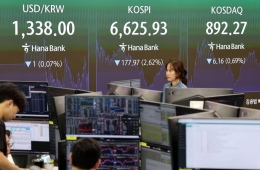
On the 13th, the KOSPI index opened at 7,412.03, down 63.91 points from the previous trading day, and the situation of the domestic stock market was displayed on the electronic board in the dealing room at the Hana Bank headquarters in Jung-gu, Seoul. On the same day, the won-dollar exchange rate started trading at 1,499.3 won, down 2.1 won from the previous trading day. July 13, 2026 Photo by Jinhyung Kang
View original imageThe KOSPI is undergoing a correction amid renewed concerns about the resumption of war between the United States and Iran. Despite the successful listing of SK hynix's American Depositary Receipts (ADR), the stock plummeted due to concerns over its second-quarter earnings.
With the KOSPI having fallen more than 20% from its recent peak, experts are split between those who argue that a rebound is possible and those who believe excessive overheating could prolong the correction.
Those who believe the market is not overheated point to valuation metrics such as the price-to-earnings ratio (PER) and price-to-book ratio (PBR), which remain lower than those of other countries. They also cite the high likelihood that growth in memory semiconductors will continue. In contrast, those warning of overheating cite weak leading economic indicators, a slowdown in memory semiconductor growth rates, and the excessive surge in the KOSPI compared to other markets.
SK hynix Stock Plunges on Forecast of Second-Quarter Earnings Miss
On July 13, the KOSPI opened at 7,412.03, down 0.85% from the previous trading day, and extended its losses, falling 2.99% to 7,252.33 as of 10 a.m. At the same time, the KOSDAQ was trading at 847.79, up 1.25% from the previous session.
Reports of an escalation between the U.S. and Iran weighed on the KOSPI from the start of the session. On July 12 (local time), the U.S. Central Command announced it had launched additional airstrikes against Iran in the Strait of Hormuz in response to threats against merchant vessels. The United States has been conducting airstrikes on Iran in response to its attacks on merchant ships in the strait, while Iran has retaliated by targeting U.S. military bases in the Middle East. The Islamic Revolutionary Guard Corps (IRGC) also announced a full blockade of the Strait of Hormuz. As armed clashes between the two sides continued, conditions surrounding the stock market deteriorated, with Nasdaq futures declining and international oil prices rising.
The semiconductor sector—and the entire KOSPI—was also affected by reports lowering SK hynix's earnings outlook. Despite the successful ADR listing on the U.S. stock market last Friday, SK hynix shares had dropped 7.25% as of 10 a.m.
On this day, Korea Investment & Securities published a report forecasting that SK hynix's second-quarter operating profit would fall short of consensus (the market average estimate). Min Sook Chae, a researcher at Korea Investment & Securities, projected SK hynix's second-quarter operating profit at 6.04 trillion won, 8% below the consensus of 6.5 trillion won. Chae explained, "Because SK hynix's revenue share from high-bandwidth memory (HBM) is higher than its competitors, its average selling price (ASP) growth is lower than the market average." Major semiconductor stocks such as Samsung Electronics (-1.75%), SK Square (-8.52%), and Samsung Electro-Mechanics (-9.22%) also saw steep declines.

"Low Valuation Metrics Such as PER and PBR: KOSPI Still Undervalued"
The KOSPI has entered a correction phase, having declined more than 20% from its intraday peak of 9,385 points recorded on June 19. As the KOSPI falls, the securities industry remains divided over whether the KOSPI is overheated.
The main argument for the market not being overheated is the low valuation metrics. According to Daishin Securities, as of July 8, the KOSPI's projected PER for this year is 8.7 times. PER is calculated by dividing the share price by earnings per share (EPS). A lower PER indicates that the stock is undervalued relative to the company's earnings. The KOSPI's PER is lower than that of the S&P 500 (22.7), Nasdaq (29.2), Taiwan's TAIEX (24.9), and Japan's Nikkei (17.3).
The PBR, which reflects how cheap a stock is relative to a company's net assets, is also low for the KOSPI at 2.7 times, compared to 7 times for the Nasdaq and 5.5 times for Taiwan, indicating a much lower level. Despite the KOSPI's rise of over 70% this year and ranking first among major global markets, analysts still consider it undervalued.
Kyungmin Lee, a researcher at Daishin Securities, stated, "The KOSPI has pulled back sharply from its peak due to excessive concentration in semiconductors, unwinding of leveraged investments, and a resulting decline in investor sentiment and supply-demand shocks. As a result, the current forward PER has dropped to levels seen during the 2008 global financial crisis." Lee added, "Although the KOSPI has fallen below key support levels and a trend reversal may take time, the index is now at a level that could rebound quickly on even minor positive news. Many sectors, including semiconductors, are experiencing earnings growth, yet the stock prices are in an undervalued range."

"Leading Economic Indicators Turning Downward, Semiconductors May Have Peaked"
On the other hand, there are concerns that the KOSPI remains overheated, and the correction could continue. The 'Buffett Indicator', which is the ratio of market capitalization to gross domestic product (GDP), stood at 221% for the KOSPI in June—far above the 2000–2025 average of 70.2%. Named after legendary investor Warren Buffett, this macroeconomic indicator is regarded as the best single metric for measuring whether the stock market is overvalued or undervalued at a given point in time.
There are also concerns about the narrowing spread between short- and long-term interest rates, a key leading economic indicator. According to economic statistics (FRED) from the Federal Reserve Bank of St. Louis, the yield spread between the U.S. 10-year and 2-year Treasury bonds was just 0.38 percentage points as of July 9, the lowest since April last year. Typically, a narrowing yield spread signals an economic slowdown or impending recession. The phenomenon is interpreted as a result of anticipated interest rate hikes in the U.S. due to inflation concerns. Youngik Kim, adjunct professor at Hanyang University’s Future Talent Education Center, explained, "A sharper decline in long-term rates compared to short-term rates reflects expectations of lower economic growth and inflation going forward."
Concerns about slowing growth in memory semiconductors—the main driver behind this year's sharp KOSPI rally—are also central to arguments that the KOSPI may have peaked. According to the Ministry of Trade, Industry and Energy's export-import trend data, export prices for DRAM (excluding modules) fell 4% month-on-month in June, and solid-state drive (SSD) export prices also declined 5%. The drop in DRAM export prices was the first since September last year, fueling concerns in the market that memory semiconductor growth may have reached its peak.
SK hynix-Linked Leveraged ETFs Flood Nasdaq Just Three Days After Listing
Meanwhile, single-stock leveraged exchange-traded funds (ETFs) based on SK hynix ADRs are being listed one after another on the New York Stock Exchange this week. According to announcements from U.S. ETF managers on July 12 (local time), firms including Leverage Shares, ProShares, GraniteShares, and Kogi Funds plan to launch leveraged and inverse ETFs tracking the daily returns of SK hynix ADRs between July 13 and 14.
Leverage Shares will debut 'SKHX', a 2x leveraged ETF tracking the daily movement of SK hynix ADRs, and 'SKHZ', an inverse ETF moving in the opposite direction, on July 13. ProShares will also list its own 2x leveraged product, 'SKHU', on the same day. GraniteShares is set to launch the 2x leveraged ETF 'SKUU' and the 2x inverse ETF 'SKDD' on July 14. Kogi Funds likewise plans to introduce a 2x leveraged ETF linked to SK hynix ADRs on the same day.
Hot Picks Today
![Claims That "Daiso Is Being Shut Down to Save AliExpress and Temu" Spread Widely... A Fact-Check [Why&Next]](https://cwcontent.asiae.co.kr/asiaresize/93/2023121315590987574_1702450749.jpg) Claims That "Daiso Is Being Shut Down to Save AliExpress and Temu" Spread Widely... A Fact-Check [Why&Next]
Claims That "Daiso Is Being Shut Down to Save AliExpress and Temu" Spread Widely... A Fact-Check [Why&Next]
- "Didn't Know This Trick?" 84-Sq.-M. Mixed-Use Unit Sells for 2.14 Billion Won... Indirect Buying Demand Spreads [One Year of Land Transaction Permit Zones Across Seoul]
- "Target Prices Cut to KRW 670,000 and KRW 260,000"... Why Hyundai and Kia May Find It Hard to Celebrate Even After Selling More Cars [Weekend Money]
- "Trying to Play with the Tiger?" He Jumped Into Its Enclosure... British Man Dies
- Exported All the Way to the U.S., Yet Discarded Six Times... Are Restrooms to Blame for 'K-Oysters' Sanitation?
SK hynix ADRs made a successful debut on the New York Stock Exchange on July 10, closing at $168.49, up 13.08% from the IPO price of $149. The sharp post-listing price swings have prompted ETF managers to accelerate the launch of related products.
© The Asia Business Daily. All rights reserved. Unauthorized AI training and use prohibited.