US Launches Large-Scale Strikes on 140 Iranian Targets... Iran Closes Hormuz, Retaliates Against US Bases
Iran "Updating Target List"
Additional Strikes Forewarned
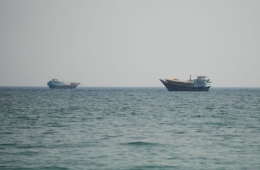
The United States and Iran are escalating their level of military engagement over control of the Strait of Hormuz. In response to Iranian attacks on merchant ships, the United States struck 140 military facilities in and around the Strait of Hormuz, while Iran declared the closure of the strait and launched missiles and drones at U.S. military bases in Qatar, Kuwait, Jordan, and other locations in the Middle East.

According to the Wall Street Journal (WSJ) and Bloomberg News on July 12 (local time), the U.S. military attacked 140 military targets in Iran by launching precision-guided munitions from fighter jets, drones, and warships. This is the third U.S. airstrike against Iran in the past week.
This latest U.S. attack was significantly larger in scale than previous strikes. The targets included radars and missile launchers near the Strait of Hormuz, as well as missile and drone storage facilities that Iran could use to attack merchant vessels.
The U.S. Central Command stated that U.S. President Donald Trump had ordered additional airstrikes to weaken Iran's capability to attack merchant ships. U.S. Secretary of Defense Pete Hegseth warned via social media that "Iran made the wrong choice" and "will now face the consequences."
This airstrike was in response to the Iranian military's missile and drone attack on the Cyprus-flagged container ship 'GFS Galaxy.' The attack damaged the ship's engine room and caused a fire onboard, with one civilian crew member reported missing. The vessel reportedly suffered significant damage and was unable to continue its voyage.
The Islamic Revolutionary Guard Corps (IRGC) of Iran claimed that the ship had attempted to pass through the Strait of Hormuz via a route not authorized by Iran, prompting warning shots. Iran's state-run IRIB reported that the Revolutionary Guard had also fired warning shots at other cargo ships, forcing them to halt operations.
On the same day, the Revolutionary Guard declared the closure of the Strait of Hormuz "until further notice," stating that no vessel would be allowed passage until all foreign intervention ceases. Iran views U.S. efforts to open the southern route off the coast of Oman and support merchant shipping as a challenge to its control over the strait.
However, the Joint Maritime Information Center (JMIC), an international maritime monitoring body, stated that the southern route off the coast of Oman remains technically open. JMIC noted that visible ship traffic through the strait has nearly stopped, but official passage is still possible. The agency also warned that maritime security threats remain "severe."
In retaliation for U.S. airstrikes, Iran launched counterattacks targeting U.S. military bases and American allies in the Middle East. The Iranian military announced that it had fired ballistic missiles and drones toward Qatar, Kuwait, Jordan, Bahrain, and Oman.
The Revolutionary Guard claimed to have attacked the U.S. command and control facility and drone hangar at Jordan's Prince Hassan Air Base. The Jordanian government stated that three missiles were launched toward its territory, but did not disclose specific details of the damage.
In Qatar, three people were injured by falling debris during the interception of Iranian missiles. Iran's semi-official Fars News Agency reported that the Revolutionary Guard attacked Al Udeid Air Base, one of the largest U.S. bases in the Middle East, with ballistic missiles.
The Iranian regular army claimed to have used drones to attack U.S. Patriot missile batteries, ammunition depots, and radar facilities in Kuwait. U.S. communications and radar facilities in Bahrain, as well as U.S. Navy logistics support and aircraft carrier refueling facilities at Duqm Port in Oman, were also reportedly targeted.
So far, no major casualties have been reported as a result of Iran's retaliatory strikes. Aside from the three injured in Qatar, most of the missiles and drones were intercepted, and damage appears to be limited.
The confrontation between the United States and Iran now threatens to unravel the 60-day interim ceasefire agreement reached last month. At that time, both countries agreed to halt hostilities and reopen the Strait of Hormuz, as well as to negotiate key issues such as Iran's nuclear program and the easing of sanctions.
However, the two sides have clashed directly over how to control the Strait of Hormuz. The United States believes Iran should open all routes to merchant ships and halt attacks on civilian vessels. In contrast, Iranian hardliners and the Revolutionary Guard have argued that the interim agreement granted Iran the authority to manage vessel passage through the strait.
Iran has reportedly demanded that ships use only routes approved by its government and has considered imposing transit fees. The country aims to use control over the strait as a bargaining chip to secure sanctions relief and a reduction of U.S. forces stationed in the Middle East.
On the other hand, the United States believes that weakening Iran's control over the strait is necessary to extract concessions on issues such as limiting Iran's nuclear program during full-scale negotiations. U.S. administration officials warned that serious consequences would follow if Iran does not publicly guarantee the opening of the strait and safe passage for merchant vessels.
Within the U.S. administration, pessimism is growing about the possibility of reaching a nuclear agreement. The WSJ reported that, according to U.S. officials, the Iranian negotiating team is seeking to resume dialogue, but the Revolutionary Guard's repeated attacks on merchant ships are undermining the talks.
Iranian Foreign Minister Abbas Araghchi visited Oman the previous day to discuss the Strait of Hormuz issue, but there was no confirmation of participation by senior U.S. envoys. Iran maintains that the United States must first fulfill its existing obligations, such as sanctions relief and normalization of oil exports, before additional negotiations can proceed.
Before the war, the Strait of Hormuz was a key energy corridor, accounting for about 20% of the world's maritime crude oil and liquefied natural gas (LNG) shipments. As the United States and Iran refuse to back down over control of the strait, not only is the risk of military conflict increasing, but so too is uncertainty in international oil prices and the global energy supply chain.
Hot Picks Today
 "Just Two Days After the Chairman's Visit"... Lotte Injects Another 250 Billion Won 'Here'
- 83% of Highway Fatalities Linked to This 'Habit'... Check This Button When Driving in Summer
- "How Many Days Off Does Your Company Give?"... Only Half Receive Vacation Allowances: The Reality of Summer Leave for Korean Workers
- "French Team Without Any French Players"... Former Spanish Prime Minister Slammed for Racist Remarks
- Corrective Orders Issued to Plastic Surgery Clinics for Elaborate 'Fake Reviews' Used as Deceptive Ads
© The Asia Business Daily. All rights reserved. Unauthorized AI training and use prohibited.