Kim Yongbum: "Bye-Bye, East Asia Stagnation Theory... Korea May Break Away from Japan's Long-Term Low-Growth Path"
"Mid-2025 Marks a Turning Point in Growth Trend"
Policy and AI Semiconductor Cycles Align
"Manufacturing Is the Engine, Capital Market the Transmission... Turning Production Gains into National Assets"
"Low Birth Rate, Household Debt,
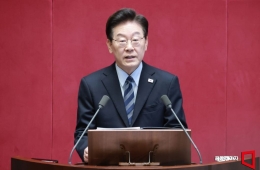
Kim Yongbum, Policy Chief at the Blue House, has diagnosed that the Korean economy has entered a structural inflection point, moving beyond a simple rebound in the semiconductor cycle and breaking away from the path of prolonged low growth similar to Japan. He argues that the AI semiconductor supercycle and government industrial policy are boosting production capacity, while capital market reforms are channeling those gains into national assets and future investments—potentially altering the long-term trajectory of growth itself.

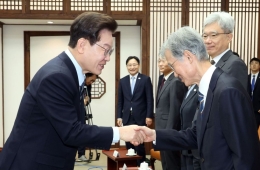
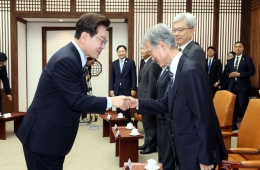
President Lee Jae-myung is conversing with Policy Chief Kim Yongbum during an aerial inspection of the Southwest Industrial Complex candidate site on June 30, 2026. Photo by Yonhap News Agency
View original imageOn July 12, Kim posted an article titled "Bye-Bye East Asia Stagnation Theory" on Facebook, stating, "Korea is no longer on its past growth trajectory," and suggesting, "We may already be on a growth path that has never been taken before."
He characterized the period from 2022 to 2024 as one marked by a semiconductor downturn, instability in real estate project financing (PF), and political turmoil, which fueled the spread of the 'Peak Korea' narrative. He assessed that "around the middle of 2025, as political uncertainty resolved and policy direction became clearer, the combination of rising memory demand, data center investments, advanced packaging, and expansion of power infrastructure began to shift the growth trend."
He also noted the rare alignment of policy and industrial cycles. Kim remarked, "In economic history, it is uncommon for policy and industrial cycles to move in the same direction," adding, "In the second half of 2025, Korea appears to have entered a phase where these two forces are amplifying each other." He cited the International Monetary Fund (IMF) outlook as the basis for this assessment. In its July World Economic Outlook, the IMF projected Korea's growth rate at 2.6% for this year and 2.5% for next year—up by 0.7 percentage points and 0.4 percentage points, respectively, from its April forecast. The IMF's forecast for U.S. growth this year is 2.3%, Japan 0.6%, and the Eurozone 0.9%. The IMF analyzed that, despite energy shocks originating in the Middle East, robust external demand for semiconductors would outweigh these risks.
Kim also pointed out that the nature of questions being asked in the stock market has changed. He stated, "If the question posed by the market in 2023–2024 was 'Is Korea finished?', the question now is 'When will the semiconductor cycle peak out?'" He observed that debates once centered on the nation's fate have now shifted to discussing the duration of the industry cycle.
He asserted that this reversal should not be explained solely by the semiconductor boom. Kim defined the three major "megaprojects"—semiconductors, AI data centers, and physical AI—as industrial policies aimed at fundamentally raising production capacity. Meanwhile, he characterized revisions to commercial law, the expansion of directors' fiduciary duty to shareholders, changes to treasury stock regulations, the National Growth Fund, and productive finance as capital market policies that connect the outcomes of production to corporate value, national assets, and future investment.
Kim emphasized, "If manufacturing is the engine, the capital market is the transmission," stressing that "the attempt is to add a new axis of growth—a strong capital market atop strong manufacturing." He argued that resolving the 'Korea discount,' where increased production and exports do not translate into shareholder value and national assets, is key to accelerating the entire economy. As a case in point, he cited Taiwan, which, without a reserve currency or a massive domestic market, has secured an irreplaceable position in the AI supply chain as a semiconductor hub and achieved high growth. However, he warned that unless increases in exports and corporate profits sufficiently spread to consumption, non-IT industries, and national assets, the risk of 'K-shaped growth' could deepen.
Regarding Japan and China, he analyzed that the two countries are pursuing different paths of structural transformation. Japan has made progress in corporate governance and value-up reforms but now faces the challenge of normalizing interest rates and managing massive government debt. China, on the other hand, is shifting away from a real estate-centered model and continuing a state-led transition toward advanced manufacturing.
Hot Picks Today
 "Two Spend 500,000 Won in a Flash, Yet Wait Two Hours?" ... 'Dreamland' Shunned by Kids and Foreign Tourists
- The Era of Getting 200 Million Won After 30 Years Is Over... A Japanese Bank's "Perpetual Department Head" Who Just Clocked In Cries Out
- Spain Hit by Its Worst Tragedy... Lee Kangin, Moreno and Real Madrid Join Soccer World in Mourning
- They Said, “Make It Your Home for Life” - Then Suddenly Kicked 200 Passengers Off... What Happened to the Around-the-World Cruise?
- "130 Rice Bowls Sold Out in a Day"... 'Unfiltered Face' Adds 8 Million Won to Night Market Sales: China's Bungeunwoo
Kim acknowledged that structural risks remain, such as low birth rates, population aging, high household debt, the low international status of the Korean won, and dependence on semiconductors and AI. Still, he stated, "Korea, the country that most faithfully followed Japan's path, could also become the first to break away from it," adding, "2025 may be remembered not as a year of high growth, but as the year when the long-term trajectory of the Korean economy began to change direction."
© The Asia Business Daily. All rights reserved. Unauthorized AI training and use prohibited.