All Experts Say "Another Hike in October After This Month"... Key Focus Is on 'Back-to-Back Hike Signals' [Monetary Policy Board Poll] ①
Survey of 14 Domestic and International Economic Experts by The Asia Business Daily
All Predict 'July Rate Hike'... 78.6% Expect Unanimous Board Approval
Next Hike Seen in October: "Oil Price Drop + Relative FX Stability"
July Mee
Ahead of the Bank of Korea Monetary Policy Committee's base rate decision on July 16, all surveyed experts predicted a 0.25 percentage point (25bp) rate hike. If the rate is raised as anticipated, it would mark a shift to a tightening stance for the first time in three years and six months since January 2023. Experts noted that the Bank of Korea has consistently highlighted financial imbalance risks, citing inflation expected to remain well above the 2.0% target for a considerable period, robust economic growth, and increased volatility in the foreign exchange market. As such, they considered this month's rate hike to be a foregone conclusion.

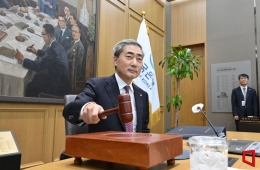
Shin Hyun-Song, Governor of the Bank of Korea, is speaking at a press conference following the Monetary Policy Direction Decision Meeting held on May 28 at the Bank of Korea in Jung-gu, Seoul. Photo by Yonhap News Agency Joint Coverage Team
View original imageExpert opinions also converged on the timing of the next rate hike. They broadly agreed there will be one additional rate hike within the year following the upcoming increase, most likely in October. However, some suggested that the possibility of a 'back-to-back hike'—an immediate additional increase in August after July—cannot be ruled out. Therefore, this meeting should focus on gauging the Monetary Policy Committee members' views regarding the timing and scale of future hikes.
![All Experts Say "Another Hike in October After This Month"... Key Focus Is on 'Back-to-Back Hike Signals' [Monetary Policy Board Poll] ①](http://www.asiae.co.kr/news/img_view.htm?img=2026071016044342061_1783667083.jpg)
All Experts Expect '25bp Hike in July'... 78.6% Say Decision Will Be Unanimous
According to a survey conducted by The Asia Business Daily from July 7 to 10 with 14 economic experts from domestic and global research institutes, securities firms, and banks, all 14 respondents (100%) anticipated the base rate would be raised by 25bp this month, bringing it to 2.75% annually. If the hike materializes, this would be the first increase since January 2023 when the base rate was raised by 0.25 percentage points to 3.50%, marking three and a half years since the last tightening. Notably, 11 out of the 14 respondents (78.6%) expected the decision to be unanimous among the Monetary Policy Committee members.
Experts noted that Governor Shin Hyun-Song repeatedly emphasized the need for a timely rate hike, considering inflation, growth, and financial stability—not only at the May committee meeting, but also during the BOK International Conference, the anniversary speech, inflation briefings, and temporary National Assembly work reports. This, they said, provided ample signals for a rate hike this month.
Yonggu Cho, researcher at Shinyoung Securities, stated, "Global crude oil prices have fallen more rapidly than expected, yet a certain level of inflation persists." He added, "While inflation may temporarily ease in July, high inflation in the 3% range—due to base effects—is likely in August." He explained that despite easing supply-side worries, caution remains regarding demand-driven inflationary pressures. Jinu Kim, Chief Economist at Citibank, also warned, "There is a risk that core inflation may remain elevated for a longer period from the second half of this year through the first half of next year."
With stronger-than-expected growth in the first quarter, this year's growth forecast (previously 2.6%) will likely need an upward revision. In terms of financial stability, concerns persist about the weakening of the won and overheating in the Seoul metropolitan real estate market. Kyungrak Gong, researcher at Daishin Securities, commented, "Current conditions for growth, financial stability, and exchange rates all point to the need for a rate hike." Junhee Han, Research Fellow at NH Financial Research Institute, explained, "Ongoing inflationary pressure due to war and continued rising exchange rates are fueling concerns over import prices and capital outflows, while the semiconductor boom has enhanced the Bank of Korea’s capacity for a hike." Seokgil Park, Economist at JP Morgan, also said, "Given that tightening factors are present in growth, inflation, and financial stability, a rate hike will likely be implemented as previously signaled by the Monetary Policy Committee."
![All Experts Say "Another Hike in October After This Month"... Key Focus Is on 'Back-to-Back Hike Signals' [Monetary Policy Board Poll] ①](http://www.asiae.co.kr/news/img_view.htm?img=2026071016044442063_1783667084.jpg)
October Is Next—Need to Monitor Possibility of August Hike at This Meeting
All 14 respondents also agreed that the next rate hike is likely in October (including one respondent who predicted October–November). Such consensus on the timing of the next hike is rare. Yeosam Yoon, researcher at Meritz Securities, stated, "Despite lingering uncertainties from the Middle East war, crude oil prices have stabilized at around USD 70 per barrel, limiting supply-side inflation. In addition, the previously vulnerable won–dollar exchange rate appears to be stabilizing due to improved dollar supply conditions," adding, "An October rate hike aligns with market expectations and is appropriate." He further noted, "With Korea’s interest rates rising by the largest margin among major economies this year and yields on ultra-long 30-year bonds reaching the mid-4% range, it is important to take these market interest rate burdens into account."
Researcher Cho also remarked, "With international oil prices rapidly declining, the inflation peak likely occurred in June (with the numerical peak due to base effects in August)," adding, "The need for back-to-back hikes in August appears limited." If, as in the May dot-plot median, there are two rate hikes this year, a rate hike following the August economic and dot-plot update in October would be more natural. Yunmin Baek, researcher at Kyobo Securities, similarly concluded, "Even considering inflation and exchange rate risks, a 0.5 percentage point hike (big step) or back-to-back hikes in July and August are unlikely, and the practical benefit of such a monetary policy response would be limited."
However, some experts did not rule out the possibility of another rate hike in August following July’s increase. They emphasized the need to gauge the intensity of Governor Shin's comments after the meeting to assess the likelihood of back-to-back hikes. Economist Kim noted, "While we basically expect hikes in July and October this year, factors such as double-digit nominal GDP growth led by semiconductors, the risk of persistently high core inflation from the second half of this year through the first half of next year, an active fiscal policy, historically accommodative financial conditions including a housing rally in Seoul, and a weak won mean that consecutive hikes in July and August could be the optimal policy response."
All Say '3.00%' for This Year... Most Expect 3.25% Next Year
For the year-end base rate, all experts forecast 3.00%, suggesting two 0.25 percentage point hikes in total. Regarding next year's year-end rate, the largest number of respondents (8, or 57.1%) anticipated 3.25%. Yeha Ahn, researcher at Kiwoom Securities, predicted the hiking cycle would pause after the first half of next year, once the growth in semiconductor-driven exports slows down. Researcher Cho forecast, "Following a rise to 3.25% in the first quarter, rates will be held steady after that."
Three respondents (21.4%) predicted the rate would climb to 3.50% next year. Economist Kim commented, "Due to expansionary fiscal policies in the second half of this year and the first half of next year, the impact of Bank of Korea’s rate hikes on growth, inflation, and financial imbalances may be more limited than in the past." He added, "A combination of active fiscal policy addressing micro-level issues such as the labor market and economic polarization, coupled with a forward-looking monetary policy focused on macro-level risks such as potential overheating of the economic and financial cycle, will likely be seen as optimal."
![All Experts Say "Another Hike in October After This Month"... Key Focus Is on 'Back-to-Back Hike Signals' [Monetary Policy Board Poll] ①](http://www.asiae.co.kr/news/img_view.htm?img=2026071016044442062_1783667084.jpg)
US Policy Rate: 64.3% Project a Hold This Year, 14.3% See Year-End Hike
Regarding the US policy rate, nine of the 14 respondents (64.3%) expected it to remain on hold at an upper limit of 3.75% within the year. More respondents (2, or 14.3%) expected a rate hike than a cut (1, or 7.1%). This is a notable shift from the last survey in May, when rate cut expectations were higher than those for a hike after a hold.
Moonjong Heo, Head of Woori Financial Management Research Institute, said, "The US will likely maintain its current restrictive monetary policy, considering both inflation concerns and signals of an economic slowdown." Researcher Baek also commented, "While we cannot completely rule out the possibility of a rate hike within this year, the fact that the US policy rate remains in restrictive territory means the Federal Reserve may proceed more cautiously with any policy shift." He added, "We should also consider that the results for the TF mentioned by Fed Chair Kevin Warsh are expected around the end of the year."
Hot Picks Today
 "KOSPI Faces Record Volatility Amid Doubts Over Semiconductor-Only Dominance"
- "Biggest 'Supply Cliff' in 70 Years of Memory History Approaching... Now Is the Time to Buy Samsung Electronics" [Click eStock]
- "I Might End Up Paying My Entire Salary Just for Interest"... Annual Per-Person Interest Could Reach 6.73 Million Won, 'Yeongkeul-jok' Lament
- One in Four Environmental Maintenance Workers Receives Less Pay Than Contracted
- "Earned $100,000 at 18": Young Americans Flock to Skilled Trades Like Plumbing, Undeterred by AI
Opinions on the US policy rate at the end of next year were widely divided. Three respondents (21.4%) thought it would remain at the current level (3.75%), and three others predicted it would fall to 3.25%. Researcher Cho pointed out, "Rather than preparing for additional hikes, the Fed is maintaining a cautious stance toward inflation. Even internally, opinions at the Fed are split. I expect the Fed to hold rates steady through the second quarter next year, followed by two rate cuts later in the year." Two respondents each forecast end-2027 rates at 3.50%, 4.00%, and 4.25%. Researcher Ahn said, "As there is still limited upward pressure on US core inflation, if crude oil prices fluctuate between USD 70–80 per barrel, the US is likely to keep rates on hold this year and possibly raise them once next year if the economy recovers."
© The Asia Business Daily. All rights reserved. Unauthorized AI training and use prohibited.




![[Second Half Work Report] Fund to Be Created from Data Breach Penalties... Whistleblower Reward System Introduced](https://cwcontent.asiae.co.kr/asiaresize/307/2026071610471248465_1784166432.jpg)