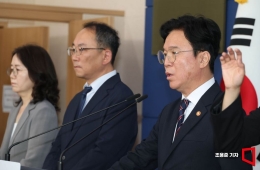
Choo Mi-ae: "Prosecutorial Reform Must Not Retreat... Sincere Apologies to Democratic Citizens"
Gyeonggi Province Governor Choo Mi-ae emphasized on the 11th that prosecutorial reform must not retreat at the final hurdle. She also expressed her sincere apologies to democratic citizens for having to leave her post without fully completing prosecutorial reform to the end.
On this day, Governor Choo began her post on her social networking service (SNS) by saying, "Since I have explained the basic direction of Gyeonggi provincial administration after taking office, I would like to briefly address concerns about prosecutorial reform over the weekend."
She continued, "Prosecutorial reform must not retreat at the final hurdle," and stressed, "Although some concerns have been raised regarding the investigative capabilities of the police, these should not be used as a reason to delay prosecutorial reform or to undermine the principle of dispersing prosecutorial authority."
Governor Choo also made it clear that she opposes the opinion that prosecutors should exceptionally be allowed to conduct direct investigations when new evidence is discovered just before the statute of limitations expires. She also drew a clear line regarding the recent argument that prosecutors need supplementary investigative authority, citing suspicions of evidence destruction in the murder case involving a police executive's son.
She stated, "Supplementary investigation by prosecutors is, in fact, a form of direct investigation by prosecutors," and added, "Requests for supplementary investigation by prosecutors correspond to indirect investigation through the police." She went on to say, "Even if exceptions are acknowledged as narrowly as possible, allowing direct investigation by prosecutors does not comply with the principle of separating investigation and indictment."

She also pointed out that, even under the current system, cases can occur where new evidence is discovered just before the statute of limitations expires, but the logic that this should be a reason to maintain the prosecutors' direct investigative authority lacks persuasiveness. She said that the argument for the necessity of prosecutors' direct investigation simply because the statute of limitations is imminent during a police investigation is also a logical leap.
Governor Choo noted that in the past, there were not a few cases where prosecutors, monopolizing the right of indictment, delayed handling cases or let the statute of limitations lapse, and assessed that concentration of prosecutorial authority has, in fact, caused greater harm. She emphasized that separating investigative and prosecutorial powers is the way to enhance trust in the criminal justice system.
She further argued that, rather than postponing the dispersal of prosecutorial authority, roles among investigative agencies—such as the police, the Serious Crime Investigation Agency, and the Corruption Investigation Office for High-ranking Officials—should be designed with precision and the supplementary investigation system should be strengthened. In addition, she explained that utilizing the criminal case digitization system and the investigation command and supervision system can sufficiently prevent issues related to managing the statute of limitations and investigation gaps.
Hot Picks Today
 24-Year-Old Wins Sleep Contest, Takes Home 19 Million Won After Sleeping Soundly Alongside Strangers
- "Should've bought this instead of Samsung and SK hynix"... One stock rose 32% as the KOSPI fell 17%
- "Even Underwear Has to Be Cut Up with Scissors"... China Hit by Rise of "Trash Hunters" in an "If You're Slow, You're Out" Scramble
- "Please Make More," After Hitting It Big in China and Vietnam... Orion Custard Expands Production Lines
- "Photos of Kim Jong Un Released by North Korea Are a Deception"... Debate Over Death Rumors Continues
Governor Choo emphasized, "The separation of investigative and prosecutorial powers is not about which institution, the prosecution or the police, is more competent or trustworthy, but about reforming the system to build a criminal justice framework based on popular sovereignty," and added, "An approach that prioritizes exceptions over principles can undermine public trust."
© The Asia Business Daily. All rights reserved. Unauthorized AI training and use prohibited.