[Q&A] Chairman Chey Tae-won: "Memory Supply Must Accelerate Tenfold"
"AI Demand Will Not End in Just a Year or Two"
"U.S. Investment Conditions Are Power, Water Supply, and Land"
"A Stock Split Could Be Considered"
Chey Tae-won, Chairman of SK Group, stated that the rapid proliferation of artificial intelligence (AI) is causing memory demand to far outpace supply, emphasizing the need to quickly scale up production capacity. Regarding the possibility of building a memory fabrication plant in the United States, he explained that while the option can be considered if conditions such as electricity, water supply, and land are met, construction has not been finalized.

SK Chairman Chey Tae-won is greeting New York correspondents after finishing a press conference at NASDAQ in New York, USA, on the 10th (local time). SK
View original imageAt a meeting with correspondents held at NASDAQ in New York on the 10th (local time), Chairman Chey said, "Now is the time to scale up and compete through continued investment," adding, "The biggest challenge is moving ten times faster than in the past."
The following are key excerpts from the Q&A with Chairman Chey.
- Why should people continue to buy SK hynix shares now? What are your plans for your Kioxia stake?
▲It is not my place as chairman to comment on how the stock price will move. That is something financial experts should answer. The ADR offering price is 149 dollars, and the first priority is to ensure that it does not drop below that. The second priority is to continuously enhance potential. We must create future growth potential and turn it into real action so that the stock price can continue its upward trajectory.
Financial markets may not always favor the current scale of investment, but this is a special situation in the AI era. We have to scale up and secure competitiveness through ongoing investments. This does not mean we intend to take on excessive debt for investment, nor do we intend to handle everything solely with our own funds. We are creating a situation where we can continuously expand supply with a much lighter business model than before.
SK hynix must also gain access to a wider range of technologies. Since all current momentum is thanks to AI, we must continue to seek new ways to access AI even more closely.
It is necessary to develop technology options through strategic investments and turn them into new businesses. The biggest challenge of the AI era is that this cycle must turn extremely quickly. We have done this in the past, but now, we must do it ten times faster than before. That is the biggest challenge we are facing now.
No decision has been made yet regarding the Kioxia stake. Kioxia is also experiencing upward momentum in its share price. There will come a time to discuss how to sustain this strategically. All possibilities, including additional purchases or utilizing it as strategic leverage, are being kept open.
- Is the U.S. fab for general-purpose DRAM, or is it an HBM fab? Are specific sites and investment amounts under review? Has the U.S. government made a direct request?
▲The U.S. government has not made a direct investment request to us. There are several conditions required to build a memory semiconductor fab. The biggest are power and water supply. A large amount of clean water is needed, and of course, land is essential as well.
Nowadays, fabs are not built one at a time as they once were but must be constructed as quite large complexes. The required scale of electricity and water is also significant. Building small fabs here and there is difficult, and managing them would become even more challenging, so large-scale construction is inevitable.
If there is a location that meets these conditions, it doesn't matter whether it is in the U.S. or anywhere else in the world. At this moment, there is a strong momentum to expand supply by any means necessary. Every time I meet with customers, they ask when and by how much we will increase chip supply, and they ask for more chips in any way possible.
What concerns me is that if we do not act quickly, the semiconductor market could stagnate. The semiconductor market is not solely about AI. While capital can continue to flow into the AI sector, if chip prices become too expensive in traditional industries such as consumer electronics and automotive, it will be impossible to manufacture or purchase products. If chips cannot be secured, the market itself could contract significantly. That is not what we want. We must find a way to increase chip supply as quickly as possible, and in this context, the United States is no exception.
- Do you feel pressured by requests from the Trump administration regarding investment?
▲We are business people. We do not believe that every political issue should be decided based on election cycles or presidential terms. What matters is that the largest market is in the United States and that a significant portion of our revenue comes from American customers. They want supply stability and sustainability. We make decisions based on our customers. However, this does not mean reducing investment in Korea and moving it to the U.S. This is not a zero-sum game. We simply need more supply capacity. Considering the United States as an option is a given in business. However, we have never stated that we will definitely build a fab in the U.S.
- Do you believe the semiconductor industry has departed from its traditional cycle due to AI growth?
▲I believe a structural change has occurred. It is now certain that the industry no longer moves in the same cycles as before. However, this does not mean that cycles have disappeared entirely. Cycles are ultimately about supply and demand.
Currently, the gap between supply and demand is extremely wide. At present, demand is growing much faster than we can increase supply.
There is a significant lead time in building fabs, along with numerous bottlenecks and constraints. Since we cannot build fabs just anywhere, there are limits to how much we can expand supply.
The advent of the AI era has changed the very structure of the memory industry. AI is still like a four- or five-year-old child. It has potential but needs considerable time to mature. For AI to reach adulthood means attaining AGI (artificial general intelligence). Until AI reaches AGI, it will continue to learn, develop applications, and increase KV caching. Technologies that use less HBM and DRAM, as well as other storage and compression technologies, will advance, but even so, there will be few ways to prevent the amount of memory that needs to be stored from increasing.
- Since coming to the U.S., what have you discussed with partners?
▲Before coming here, I stopped by California to meet with client companies. The common questions were "How can we secure a certain amount of memory?", "How will you increase production to supply us?", and "How will you ensure supply in the long term?"
If this demand was expected to end within a year or two, clients would not be making such plans. We expect explosive AI-driven demand to continue to grow in the future. However, there is no way to rapidly increase supply. We must build what we can as quickly as possible, but it is not easy. Building a factory does not translate into immediate production just because you have the money.
- Is the pursuit by Chinese semiconductor companies a real threat?
▲By the time you feel a real threat, it's already too late. We have to move even faster. We must expand our AI technology and portfolio and continue to advance the memory solutions needed for this. I believe Chinese companies will catch up quickly, especially in general-purpose technology fields. Thanks to the AI market, Chinese companies are turning losses into profits and achieving significant corporate value through IPOs. They are also creating conditions that allow for continued preemptive investment.
This is not a favorable environment for just us. Chinese companies operating in the same market are also in a good environment. We must be prepared for the fact that the speed of pursuit will inevitably accelerate, and we must accept this as a given.
- How does your relationship with TSMC change in HBM4 development?
▲We have become a strategic customer. The logic die for HBM4 will use TSMC's logic foundry. We have become a very large-scale customer. Naturally, it can be called a cooperative relationship, but the current situation is that SK hynix has become a significant customer of TSMC.
- Are you considering a stock split for your KOSPI-listed shares?
▲If there are more requests for it, we can consider a stock split. I have not yet received any related proposals from the CFO. As this matter has not yet reached me, I do not have detailed knowledge to answer specifically.
Hot Picks Today
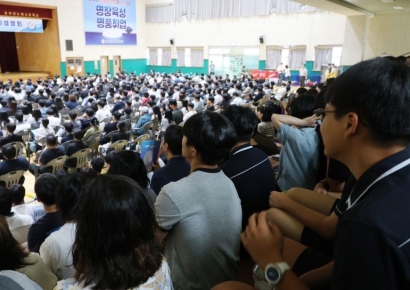 "Skip College and Take the Express to Samsung and SK hynix": Crowds Flock to Semiconductor High School Admissions Briefing
- "Japan Sees Through It: The Real Reason Behind Korean Youths' Stock Obsession"
- President Lee Visits Lee Tae-joon Memorial Hall, Symbol of Korea-Mongolia Friendship
- Window Suddenly Blows Out Mid-Flight... Wife Saves Husband as Head and Shoulder Are Sucked Outside
- "Put This in Watermelon?" Shocked... Why 'MZ Recipes' Are Going Viral on SNS
- What are your plans for establishing a separate AI investment company?
▲What we need is AI technology. We must continue to invest in various options to secure the desired technology. If necessary, we can participate in joint research and development or pursue new businesses together with clients or partners. AI investment can be a good means to achieve this.
We also intend to expand research and development based in the United States. The range of talent we need has become much broader. Now, we need not just memory-related engineers and talent, but far more AI experts. To access such talent, we have no choice but to conduct R&D and investment activities in the United States. We are continuously developing and adjusting our strategy.
© The Asia Business Daily. All rights reserved. Unauthorized AI training and use prohibited.