SK Chairman Chey Tae-won: "AI Demand Outpaces Supply Expansion... Structural Changes in the Memory Industry"
Key Requirements for U.S. Investment: Power, Water, and Land
AI Reshapes Memory Industry Structure
"We Must Move Ten Times Faster Than Before"
Clients Request Expanded Memory Supply
U.S. Investment Decisions Driven by Customer Demand, Not Politics
China's Pursuit Accelerates... It's Too Late When You Feel Threatened
Chey Tae-won, Chairman of SK Group, stated that the proliferation of artificial intelligence (AI) has brought about structural changes in the memory semiconductor industry. He explained that as AI learning and service usage expand, the amount of data that must be stored is surging, leading to a new phase in which memory demand consistently outpaces the speed at which supply can be expanded. He also left open the possibility of investing in overseas fabs, including in the United States.

On July 10 (local time), during a press conference with correspondents in New York, Chey said, "I believe structural changes have occurred," adding, "It has become clear that the industry no longer moves in the same cycles as before."
He clarified that the cyclical nature of the semiconductor industry has not disappeared altogether. However, he diagnosed that the gap between demand and supply is widening in a different pattern than in the past, due to the spread of AI.
Chey stated, "Ultimately, the cycle is a matter of supply and demand," continuing, "Right now, the gap between supply and demand is extremely large, and the pace of demand growth is far outstripping the speed at which we can increase supply."
He revealed that, prior to his visit to New York, he had received questions from customers in California such as, "How much memory can we secure and in what way?", "How will you expand production to increase supply?", and "How will you ensure supply over the long term?"
He added, "All customers agree on the outlook for future memory demand," and "They are asking for much more memory than I had anticipated."
Chey also announced that SK hynix will significantly accelerate its investment and business execution to respond to surging demand. He said, "We are in a unique era of AI," and "Now is the time to scale up continuously through persistent investment and secure competitiveness." He added, "We have taken such actions in the past, but now we must move ten times faster than before," emphasizing, "That is the most difficult challenge at present."
He also raised concerns that if supply expansion is not expedited, the traditional semiconductor market, aside from AI, could contract. Chey said, "If we don't act quickly, the semiconductor market will die," and "It's not just the AI sector that exists in the semiconductor market."
He warned, "In traditional industries, such as consumer electronics and automotive, if chip prices become too high, manufacturers cannot make products and consumers cannot buy them," and "If chips become unavailable, the market could shrink."
Regarding investment methods, he stated that SK hynix does not intend to rely solely on excessive borrowing or internal funds, but will expand supply through models with less capital burden than before. Chey said, "We are not aiming to solve everything with aggressive borrowing or only with our own funds for investment," and "We are creating a situation in which we can continue to expand supply with a much lighter model than in the past."
He also left open the possibility of investing in global production facilities, including in the United States. Chey said, "If there is a location that meets the necessary conditions, it doesn't matter whether it is in the United States or anywhere in the world," and "Right now, we need momentum to expand supply at all costs."
He identified power, water, and large-scale land as the key requirements for fab construction. He explained that since recent memory fabs must be developed as large complexes rather than individual factories, it is essential to secure sites with sufficient infrastructure.
Chey said, "The biggest requirements for building a memory fab are power and water," and "Now, instead of building fabs one by one, we must build them as significantly large complexes."
He repeatedly emphasized that the construction of a fab in the United States has not been finalized. Chey said, "When I visit the United States, I review the U.S. market, and when I visit Japan, I review the Japanese market," adding, "Reviewing is a given, but I have never said we will definitely build one."
He also dismissed interpretations that reviewing a U.S. fab is a result of political pressure from the Trump Administration. Chey said, "It is not a consideration to make decisions based on political events such as elections or terms," and "What matters is that the largest market is in the United States and that significant revenue comes from U.S. customers." He added, "Customers want sustainable and stable supply," and "We will make decisions with our customers in mind."
He also emphasized that investments in Korea and the United States are not in a substitute relationship. Chey said, "There is no change in the fact that we are investing as much as possible in Korea," but added, "I believe that will not be enough." He continued, "This is not a zero-sum game, where we build less in Korea and move production to the United States," and "We need more supply capacity overall."
Regarding competition from Chinese semiconductor companies, he expressed caution, saying, "By the time you feel a real threat, it's already too late." Chey said, "Chinese companies are also turning profitable from deficits thanks to the AI market, gaining high valuations through IPOs, and creating conditions for proactive investment."
He added, "It is not only a favorable environment for us," and stressed, "We must be prepared, knowing that the pace of pursuit by Chinese companies will inevitably accelerate."
Hot Picks Today
!["Samsung, SK Hynix Face Same Struggles" Why TSMC Is Sighing After Pouring Billions Into the U.S. [Taiwan Chip Dispatch]](https://cwcontent.asiae.co.kr/asiaresize/93/2026070915571840697_1783580238.png) "Samsung, SK Hynix Face Same Struggles" Why TSMC Is Sighing After Pouring Billions Into the U.S. [Taiwan Chip Dispatch]
"Samsung, SK Hynix Face Same Struggles" Why TSMC Is Sighing After Pouring Billions Into the U.S. [Taiwan Chip Dispatch]
- "Just This One Thing and I Feel at Peace": Why Young People Are Embracing 'Spiritual Consumption' [Z Gold Around the World]
- The Humbling of Germany's Automotive Giant: Volkswagen Plans to Cut 100,000 Jobs After Losing Ground to China
- "Marriage Was the Easiest"... US Woman Who Married 14 Husbands and Gambled Away Their Money Finally Admits Guilt
- Genius High School Student Awarded Full Samsung Scholarship: "Korea Offers Many Opportunities for Cooperation and Growth"
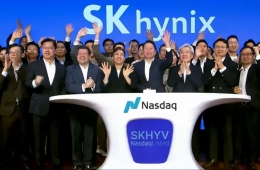
Regarding the recent listing of an American Depositary Receipt (ADR) on Nasdaq, he highlighted its significance in expanding access to global capital markets and increasing investment options. Chey said, "Through ADRs, we can access global capital markets and more people will become aware of SK hynix," adding, "With a greater variety of financial investors and partners, the likelihood of future investment success increases." He also emphasized, "This does not mean we have split up the Korean stock pie and moved it to the United States," and "I believe we have grown the entire pie through the ADR."
© The Asia Business Daily. All rights reserved. Unauthorized AI training and use prohibited.