"Return the Japanese Government Compensation" Forced Mobilization Victims' Families Lose Final Lawsuit Against the State
Supreme Court Dismisses Appeal Without Full Trial, Upholding Appellate Ruling
"Compensation Liability Should Be Resolved Through Legislative Action by the National Assembly"
The lawsuit filed by the family members of victims of forced mobilization during the Japanese colonial period, demanding the return of compensation received from Japan, has ended in a final defeat.

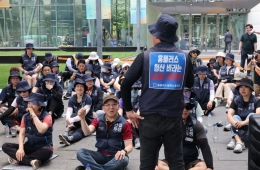
Families of victims and related parties of forced mobilization during the Japanese colonial period. Yonhap News Agency.
View original imageAccording to the legal community on July 10, the third division of the Supreme Court (Presiding Justice Oh Seokjun) last month finalized the lower court's ruling against the plaintiff by dismissing the appeal without a full trial in the damages claim case filed by the victim’s family member, Kim, against the state. Dismissal without a full trial means that, except for criminal cases, if the appeals court finds no legal error in the second-instance ruling, it can dismiss the appeal without proceeding to a substantive hearing.
Earlier, in 1965, South Korea and Japan signed the "Korea-Japan Basic Treaty" to normalize diplomatic relations and resolve postwar compensation issues. As part of this, the two countries entered into a claims agreement under which the Japanese government provided the Korean government with $30 million annually for 10 years, totaling $300 million, as compensation. Kim filed a lawsuit in November 2014 demanding the return of compensation, arguing that a portion of the $300 million should have been allocated to victims of forced mobilization but was not distributed by the government.
In the first trial held in September 2015, the court, citing the Supreme Court's 2012 precedent, ruled that individual rights to claim damages under the Korea-Japan Claims Agreement had not been extinguished. However, it stated that the state's responsibility for compensation should be resolved through legislative action by the National Assembly, and thus ruled against the plaintiff.
Kim appealed the decision, but the appellate court reached the same conclusion. In February, the appellate court stated, "While it is true that the plaintiffs suffer greatly due to Japan's evasion of responsibility, it is difficult for the payments the plaintiffs seek to be achieved through judicial procedures," "and such matters should be resolved through the National Assembly or similar means when there is sufficient public consensus and budgetary support."
Hot Picks Today
 "Japan Sees Through It: The Real Reason Behind Korean Youths' Stock Obsession"
- "Put This in Watermelon?" Shocked... Why 'MZ Recipes' Are Going Viral on SNS
- Hit and Run After Striking Citizen Who Tried to Stop Drunk Driving: "I Didn't Know," but the Black Box Knew the Truth
- "Frightening and Chilling": Shock in the Park... The Truth Behind 48 Statues Revealed
- "I Want to Apologize to Park Geun-hye Before I Die"... Choi Seo-won Releases Handwritten Letter
The court further stated, "The defendant (the state) must face the pain and sacrifice of the victims of forced mobilization and their families, and strive to build public consensus to expand the scope of consolation and support payments."
© The Asia Business Daily. All rights reserved. Unauthorized AI training and use prohibited.