Seosomun-ro Reopens After 46 Days... Full-Scale Construction of New Overpass Begins
Joint Inspection with Relevant Agencies... Full Reopening at Midnight on the 11th
Construction to Begin on August 1... Targeting Completion in 2029
GPR, Precision Measurements, and Reinforcement Inside Subway Tunnels
Advanced Technology Adopted... Prioritizing "Safety" Over Speed
Seoul City has completed the demolition work on the Seosomun Overpass and is reopening Seosomun-ro. This comes 46 days after the collapse of the overpass. Once on-site cleanup, including the maintenance of railway facilities, is finished, construction of the new Seosomun Overpass will begin.
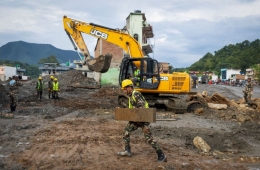
On July 10, Seoul City announced that, after a joint inspection with the Ministry of Land, Infrastructure and Transport, the National Railroad Authority, and Korea Railroad Corporation, Seosomun-ro will fully reopen from midnight on July 11. Following the accident that occurred during the overpass demolition, the city completely revised its demolition plan after consulting with experts and conducting safety reviews. Subsequently, in cooperation with the Ministry of Land, Infrastructure and Transport, the National Railroad Authority, and Korea Railroad Corporation, all remaining structures were removed.

Rendering of the new Seosomun High School, scheduled for completion in March 2029. Seoul City
View original imageAfter completing the removal of the deck within the railway protection zone on May 29, and the demolition of the bridge piers on July 5, construction of the new Seosomun Overpass will begin on August 1. The target for reopening is March 2029.
The section of railway lines beneath the Seosomun Overpass, including the Gyeongui-Jungang Line, sees more than 600 train operations a day. The decision to construct a new overpass was made to ensure the safety of train operations through the installation of a grade separation facility and to relieve chronic traffic congestion in the Seosomun-ro area.
The newly constructed Seosomun Overpass will be a four-lane road, stretching 570 meters in total length. The distance between bridge piers will be expanded from the current 28 meters to a maximum of 45 meters. As a result, the number of complex bridge piers will be reduced from 18 to just 7—a decrease of 11. By significantly reducing the number of piers, interference with railway facilities will be minimized, and maintenance efficiency will be enhanced.
The clearance under the overpass where the railway passes will also be raised from the current 6.9 meters to 8.7 meters. This change will improve the sense of openness and visibility for drivers by alleviating the constricted feel of the space under the overpass. Both the space above and below the overpass will be integrated into a pleasant public area designed to harmonize with the surrounding urban landscape.
To ensure both constructability and safety in the complex urban environment, the bridge’s main structure will use a 'steel plate girder'—a steel frame made by joining steel plates—rather than the conventional 'prestressed concrete girder,' which is a concrete frame reinforced with steel cables. Compared to the 'prestressed concrete girder' method where high-strength steel cables are inserted inside the concrete, the steel plate girder is lighter and allows for long-span construction, playing a decisive role in reducing the number of bridge piers.
Additionally, the foundation work for the overpass piers will employ the 'sacrificial steel pipe + RCD (Reverse Circulation Drilling)' method. This technique involves placing a sturdy steel pipe in advance when excavating the ground to firmly fix the retaining wall, then filling it with concrete. According to the city, this method is used to minimize the impact on adjacent subway tunnels and ensure stable construction.
This new construction project is focused on 'safety.' In the past, the overpass was built first and then Subway Line 2 was constructed underneath, but this time, the new overpass must be constructed above already-operating subway lines. The city has used ground-penetrating radar (GPR) surveys and precision measurements to determine the location of subway tracks and major underground facilities, and has precisely adjusted the positions of bridge piers to minimize interference.
During construction, 76 automated monitoring devices of six types, including crack meters and inclinometers, will be installed at key points inside the tunnels to automatically monitor minute structural movements in real time. Real-time monitoring will continue for more than six months even after the overpass construction is completed. Due to these measures, the opening date was postponed by a year from the originally planned March 2028 to March 2029.
Seoul City will conduct consultations and pre-construction safety verifications in cooperation with relevant agencies such as the Ministry of Land, Infrastructure and Transport, the National Railroad Authority, and Korea Railroad Corporation. For future railway section construction, task force meetings will be held to adjust train operation times. Lim Chunkeun, Head of the Urban Infrastructure Headquarters at Seoul City, stated, "We have strengthened the safety management system for the entire construction process, taking the accident during the previous demolition as a lesson. We ask for citizens’ understanding regarding unavoidable traffic inconveniences during construction, and we will thoroughly consult and apply reinforced safety standards to ensure that the project is completed safely so that citizens can trust and feel assured."
Hot Picks Today
 Wealth Surpasses 20 Quadrillion Won... The Super-Rich Score Big, But Where Did the Money Flow?
- Trusted the 'Helper' and Opened the Door... She Returned and Stole Nearly 60 Million Won
- "Even as Stocks Crumbled, Investors Trusted This Steadily Rising ETF"[Weekend Money]
- "Help Us"... Novice Hikers Underestimate 4,000m Trail, Ultimately Call for Rescue
- "Just Drinking to Lift Your Mood"...Unexpected Warning: Raises Risk of Cancer Death

Perspective view of the new Seosomun High School, scheduled for completion in March 2029. Seoul Metropolitan Government
View original image© The Asia Business Daily. All rights reserved. Unauthorized AI training and use prohibited.