Rigakem Chairman Yongju Kim: "Chinese Tsunami Is Coming, Super-Gap Needed"
Rigakem R&D Day Held in Yeouido on July 8
Secures 1 Trillion Won Investment Including National Growth Fund
"We Will Lead Late-Stage Clinical Trials to Enhance Corporate Value"
Yongju Kim, Chairman of Rigakem Bioscience, emphasized the sense of crisis regarding the rise of China in the biotech sector and stressed the need to secure "super-gap technologies."
At the 'Global R&D Day 2026' press conference held on July 8, 2026, at the Conrad Hotel in Yeouido, Seoul, Chairman Kim stated, "Is the so-called tsunami from China really limited to the biotech field?" He continued, "I believe there are hardly any of our country’s major industries that haven’t been impacted by the 'Chinese tsunami.'" He further explained, "Patents provide protection for about 20 years, but when there are five or six years left until expiry, 'counterfeits' begin to emerge. The only way to stay ahead of China, which pushes forward with a strategy of overwhelming volume, is to keep running, and we need a breakthrough 'super-gap' that completely transforms the playing field, breaking away from the existing framework of antibody-drug conjugates (ADC)." To this end, the company began research on new delivery vehicles five years ago and plans to create a clear technological gap with competitors by actively pursuing open innovation, not limiting itself to in-house research.

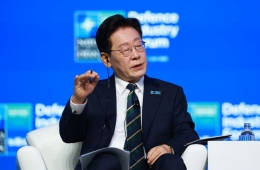
Kim Yongju, Chairman of Rigacombioscience, is speaking at the 'Global R&D Day 2026' press conference held on the 8th at the Conrad Hotel in Yeouido, Seoul. Photo by Jeong Donghoon
View original imageThe Rigakem Bioscience 2.0 Era: Accelerating Clinical Trials to Secure 20 ADC Pipelines
Sejin Park, CEO of Rigakem Bioscience, announced the 'LCB 2.0' vision as a mid- to long-term business strategy to respond to these market shifts and sense of crisis. CEO Park explained the background of the strategy, saying, "In 2023, as competitors were acquired by big pharma companies and the Chinese tsunami arrived, I felt an urgent sense that our previously differentiated strengths alone would not guarantee the next five or ten years." The company defined the period from 2011, when it first filed ADC patents, to 2020, when it accumulated related capabilities, as the 1.0 era, and characterized the period after 2023, when it secured funding and accelerated clinical trials in response to a changing competitive landscape, as the 1.5 era.
The goal of the newly announced 2.0 era is a qualitative transformation that goes beyond quantitative growth. The company aims to accelerate the clinical entry of its existing pipelines while introducing entirely new technologies to the market within five years. CEO Park presented detailed objectives, stating, "Within the next five years, we will secure 20 best-in-class and first-in-class ADC new drug pipelines, while expanding investment into new modalities." To support this, the company has proactively secured a total of 1 trillion won in funding, including 500 billion won raised through the National Growth Fund. CEO Park added, "With this 1 trillion won in funding, Rigakem Bioscience intends to pioneer a path that Korean biotech companies have not previously walked."
Specific research and commercialization tactics were also discussed. Jinhwan Han, Chief Technology Officer (CTO), introduced a next-generation platform strategy to overcome the chronic challenges of drug resistance and toxicity in antibody-drug conjugates (ADCs) and to expand their indications. The company’s task is to discover a new "topoisomerase I inhibitor" to replace the widely used camptothecin (CPT) class and fundamentally block resistance issues. In addition, the company plans to integrate new mechanisms of action (MoAs), such as targeted protein degraders (TPDs) and immune stimulators, and to accelerate research on developing STING agonists that activate innate immunity only in the tumor microenvironment, thereby minimizing systemic toxicity to normal cells.

On the 8th, at the Conrad Hotel in Yeouido, Seoul, CEO Sejin Park (from left), Vice President Taewook Chae, Chairman Yongjoo Kim, CTO Jinhwan Han, ADC Research Director Cheolwoong Jung, and TR Research Director Chanyoung Ok held a press conference at the 'Global R&D Day 2026'. Photo by Donghoon Jung
View original imageRaising Corporate Value Through Open Innovation and Advanced Late-Stage Clinical Trials
The process for discovering and validating new drug candidates will also be made more efficient. From the initial planning stages, the translational research team will participate to design biomarkers in parallel, and an artificial intelligence (AI) preclinical data analysis model will be introduced to focus research resources on selecting candidates with higher chances of success. Director Ok repeatedly stressed the importance of external collaboration, stating, "We cannot and do not need to do everything ourselves. It is crucial to find partners that, when combined with our mature technology, can help us move ahead quickly, and in fact, we are conducting in-depth joint research discussions from multiple angles on a near-daily basis."
The two-track strategy to strengthen business capabilities is also fully underway. Until now, the company had taken the approach of licensing technology to partners in the preclinical or early clinical stages due to the significant costs associated with new drug development. However, with sufficient liquidity now secured, the company plans to internalize its own antibody designs and directly lead promising and highly competitive assets through to late-stage clinical development, thereby enhancing added value.
Jaewook Chae, Chief Business Development Officer (CBDO), stated, "In the past, the total value of preclinical stage deals was typically between 700 million and 800 million dollars (about 1.0586 trillion to 1.2098 trillion won), with upfront payments in the range of 30 million to 50 million dollars (about 45.3 billion to 75.6 billion won)." He emphasized, "(With the technology transfer to Johnson & Johnson), we received an upfront payment of 100 million dollars (about 151.2 billion won) even without patient data."
Hot Picks Today
 "Unimaginable in Korea": No Air Conditioning Despite 40°C Carriages... London's 'Gentleman’s Country' Endures Sweltering Subways
- "900 Snakes Escape in Heavy Rain, Including Venomous Species... Resident Hospitalized After Bite"
- Broadcasting, Media and Communications Committee Designates and Notifies Eight Platforms Including Naver and Google Under False Information Act
- "Beyond Discomfort—It's Enough to Make You Sick"...Criticism Mounts Over Prime Minister Takaichi's 260 Million Yen Necklace
- Snapping Photos in Tokyo Wearing Uniqlo and Drinking Asahi Beer: "What's No Japan?" A Shift in Consumer Trends
Regarding the company’s future direction, he added, "We are no longer in a position to rush into contracts and lower our value as we did before. In addition to simple financial gain, we are preparing a 'package big deal' that will benefit the company in multiple ways."
© The Asia Business Daily. All rights reserved. Unauthorized AI training and use prohibited.





![[Breaking] Trump: "It Seems the Iran Armistice MOU Is Over... I Don't Want Negotiations"](https://cwcontent.asiae.co.kr/asiaresize/307/2026070811062738397_1783476387.png)