After Losing Out in Canada, Hanwha Ocean Receives U.S. Overture... Will the Door Open for 'Warship Construction'? [Why&Next]
U.S. Government Seeks Warship and Oiler Capabilities from Korean Shipbuilders
HD Hyundai Heavy Industries, Hanwha Ocean, and Others Queried on Construction Capacity
Attention on Possible Temporary Easing of Shipbuilding Regulations
"RFI Is Only a Preliminary Review"…Cautious Outlook Remains
After failing to win the Canadian submarine project, Hanwha Ocean is now finding new opportunities in the U.S. market. As the U.S. government issues a Request for Information (RFI) to domestic shipbuilders to assess their capabilities for constructing warships and replenishment oilers, expectations are rising for an entry into the U.S. military ship market. There are also signs within the United States of efforts to partially ease regulations related to shipbuilding, but some experts remain cautious, noting that it is still uncertain whether this will lead to a comprehensive relaxation of regulations.

A liquefied natural gas (LNG) carrier filled in the yard dock of Hanwha Ocean Okpo Shipyard in Geoje, Gyeongnam, continues the construction work with its lights on. Photo by Kang Jin-hyung
View original imageAccording to industry sources on July 8, the U.S. Department of Defense (War Department) and the U.S. Navy recently sent RFIs regarding warships and replenishment oilers, respectively, to domestic shipbuilders. The two leading Korean special-purpose shipbuilders, HD Hyundai Heavy Industries and Hanwha Ocean, reportedly submitted their warship design and construction capabilities to the U.S. Department of Defense last month. For the U.S. Navy’s RFI on medium-class replenishment oilers, three companies—including Samsung Heavy Industries—responded.
After acquiring the Philadelphia Shipyard in Pennsylvania in 2024, Hanwha Ocean is also proceeding with the process to secure the necessary licenses to build U.S. warships. HD Hyundai is in a cooperative partnership with Huntington Ingalls, the largest naval shipbuilder in the United States, while Samsung Heavy Industries is working with General Dynamics NASSCO.
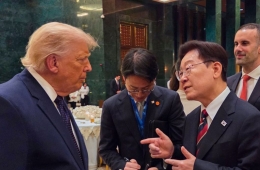
This RFI is considered especially significant given that U.S. President Donald Trump recently mentioned collaboration on warship construction directly to Korea. President Lee Jaemyung revealed that, at last month’s G7 summit, President Trump asked him whether Korea could rapidly build 10 warships for the U.S.
There is speculation that this proposal for collaboration between the two leaders has now moved to a practical review by the U.S. Department of Defense and the Navy. The RFI is seen as a preliminary step to assess the technical and production capabilities of overseas shipbuilders that could potentially cooperate in the future.
The key issue is regulatory relaxation. Currently, under the Burns-Tollefson Amendment, U.S. military vessels are required to be built within the United States. Therefore, for Hanwha Ocean to actually participate in warship construction, legal amendments or regulatory easing must precede.
An industry insider stated, "This RFI could accelerate the relaxation of shipbuilding-related regulations. There is a possibility that various scenarios will be considered, such as temporarily easing relevant regulations or manufacturing hull blocks in Korea and conducting final assembly in the U.S."
![After Losing Out in Canada, Hanwha Ocean Receives U.S. Overture... Will the Door Open for 'Warship Construction'? [Why&Next]](http://www.asiae.co.kr/news/img_view.htm?img=2026070814065338670_1783487214.png)
It is also noteworthy that there have recently been moves within the U.S. to partially ease related regulations. The U.S. Senate Armed Services Committee has included in the draft of the National Defense Authorization Act for fiscal year 2027 a provision allowing up to two bulk fuel ships and two strategic sealift ships to be constructed at foreign shipyards. Although further procedures remain before final legislation, analysts see significance in the fact that allied shipyards may now be utilized.
However, there is also a cautious view that it is too early to conclude these moves will lead to actual system improvements. Professor Jang Wonjun of the Department of Advanced Defense Industry at Jeonbuk National University said, "Since this is an RFI, not an official Request for Proposal (RFP), it is premature to interpret it as confirmation that the project will proceed. At this stage, it is appropriate to view the U.S. government as simply assessing the capabilities of overseas shipbuilders for potential cooperation."
Professor Jang added, "It will not be easy for the U.S. to change its shipbuilding policy stance in a short period. While a partial relaxation through presidential executive orders or exceptions may be realistic, a comprehensive overhaul of the system will take time." He also stated, "The government should prioritize taking a more proactive approach to concluding the Korea-U.S. Reciprocal Defense Procurement Agreement (RDP-A)."
The background behind the U.S. push to expand cooperation with the Korean shipbuilding industry is the rapid growth of China’s naval power. According to the 2024 China Military Power Report, the Chinese navy currently possesses more than 370 warships and submarines, making it the world’s largest fleet, and is expected to increase that number to 435 by 2030. In contrast, the U.S. Navy operates only 296 ships.
Hot Picks Today
 "Unimaginable in Korea": No Air Conditioning Despite 40°C Carriages... London's 'Gentleman’s Country' Endures Sweltering Subways
- "Thank You, Samsung Electronics and SK Hynix" National Pension Service Earns 189 Trillion Won from Domestic Stocks in Three Months
- Trump Says End-of-Hostilities MOU with Iran Is Effectively Over
- "Beyond Discomfort—It's Enough to Make You Sick"...Criticism Mounts Over Prime Minister Takaichi's 260 Million Yen Necklace
- Snapping Photos in Tokyo Wearing Uniqlo and Drinking Asahi Beer: "What's No Japan?" A Shift in Consumer Trends
While China is rapidly expanding its maritime power based on overwhelming shipbuilding capacity, the U.S. is facing challenges such as limited shipbuilding capability, supply chain constraints, and a lack of skilled labor. As a result, the industry believes that the United States is seeking to fill this gap by strengthening cooperation with Korea, a major ally and a powerhouse in shipbuilding.
© The Asia Business Daily. All rights reserved. Unauthorized AI training and use prohibited.