Space Lintec Begins Development of AI-Based "Space Medicine Platform"
Promoting the Establishment of New Drug Research and Manufacturing Services Utilizing Space Microgravity
DCP Agreement with the Ministry of SMEs and Startups... Laying the Foundation for Commercialization by 2030
Development of an artificial intelligence (AI)-based autonomous experimental platform for new drug research and pharmaceutical manufacturing in microgravity environments in space is now in full swing. The aim is to go beyond individual space experiments and build a service platform that allows pharmaceutical and biotech companies to utilize space as a space for research and development.
Space Lintec, a company specializing in space medicine, announced on July 8 that it has completed the first phase agreement of the ‘2026 Deep Tech Challenge Project (DCP) Ecosystem Innovation Type,’ supported by the Ministry of SMEs and Startups and the Korea Technology and Information Promotion Agency for SMEs (TIPA). The company has begun preliminary research for the development of an ‘autonomous platform for pharmaceutical manufacturing and structural research based on microgravity in space.’

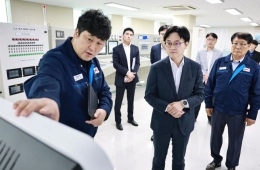
Yoon Haksoon, CEO of Spacelintech, is giving a presentation at the launch ceremony of the DCP Ecosystem Innovation-Type Preliminary Research held on the 24th of last month. Provided by Spacelintech
View original imageThe goal of this project is not just to conduct individual space experiments targeting specific proteins or diseases, but also to build a research and manufacturing platform that enables pharmaceutical and biotech companies to repeatedly utilize the space environment. Ultimately, the project seeks to promote the establishment of a space medicine industry ecosystem linked to private space stations.
AI to autonomously run space experiments
The core technology is an AI-based autonomous operation system. Even with limited communications, power, and computing resources, the experimental equipment is designed to analyze data in real time, assess the status of experiments, and respond to abnormal situations. By integrating on-device AI, optical monitoring, sensor analysis, and fault diagnosis technologies, the platform will implement a space bio-experiment infrastructure capable of long-term, repetitive operations.
During this first phase, Space Lintec plans to pursue technology verification (PoC), market validation (PoM), and investment linkage to lay the groundwork for subsequent research and development (R&D). The project will receive support of up to 20 billion won and will run through June 2030.
The consortium includes the Korea Institute of Science and Technology (KIST), PiQuant, and Hanseo University as joint research institutions, while Nota, JW Pharmaceutical, and Severance Hospital are participating as commissioned research institutions. Mobillint and the Dana-Farber Cancer Institute in the United States are also collaborating partners.
Hot Picks Today
 "Unimaginable in Korea": No Air Conditioning Despite 40°C Carriages... London's 'Gentleman’s Country' Endures Sweltering Subways
- "900 Snakes Escape in Heavy Rain, Including Venomous Species... Resident Hospitalized After Bite"
- 'Black Wednesday': KOSPI Plunges 5.4%... KOSDAQ Also Down Over 5%
- "Beyond Discomfort—It's Enough to Make You Sick"...Criticism Mounts Over Prime Minister Takaichi's 260 Million Yen Necklace
- Snapping Photos in Tokyo Wearing Uniqlo and Drinking Asahi Beer: "What Is No Japan?"—How Consumer Trends Have Changed
Yoon Haksoon, CEO of Space Lintec, said, “This agreement marks the starting point for advancing the AI-based autonomous space medicine service platform to the actual research and development stage. We will verify both the technological feasibility and marketability to lay the foundation for the commercialization of space CRO and space manufacturing services, and support the global expansion of the domestic space bioindustry.”
© The Asia Business Daily. All rights reserved. Unauthorized AI training and use prohibited.