HL Genomics to Expand with Second Plant, Aiming to Become a Partner-Oriented API Company
HL Genomics IPO Press Conference
Expanding Production Capacity with New Yongin Plant
Extending Business to CMO, CDMO, and Microneedles
"We will grow into a partner-type API company equipped with global-standard production infrastructure, based on quality and trust."
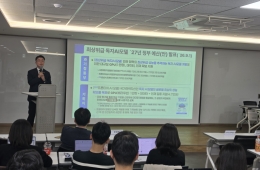
Kim Hojin, CEO of HL Genomics, held a press conference on July 8, 2026, at Conrad Hotel in Yeouido, Seoul, regarding the company’s initial public offering (IPO). He stated, "HL Genomics is a company with a stable API portfolio for chronic diseases and industry-leading profitability." The company is evolving its business model beyond being a simple raw material supplier, aiming to become a ‘partner-type API company’ that supports both product development and commercial production for finished drug companies.

Kim Hojin, CEO of HL Genomics, is announcing the KOSDAQ listing strategy and mid-to-long-term growth plan at the IPO press conference held on the 8th at Conrad Hotel in Yeouido, Seoul. Photo by Kwak Minjae
View original imageFounded in 2000, HL Genomics develops and produces active pharmaceutical ingredients (APIs), which are the core raw materials for finished pharmaceutical products. Its parent company is Hanlim Pharm. Leveraging high-purity crystallization and impurity control technologies, HL Genomics has built a portfolio of high-quality APIs focused on chronic diseases such as cardiovascular, allergy, musculoskeletal, and neurological disorders. The key products are pitavastatin calcium (API for hyperlipidemia treatment), S-amlodipine nicotinate (API for hypertension treatment), and bepotastine besilate (API for allergic rhinitis treatment). As of last year, the revenue share stood at 45.2% for cardiovascular and 27.6% for allergy APIs, indicating a diversified structure that lowers dependence on a single product category.
When a finished drug manufacturer wants to change its API supplier, it must undergo a new manufacturing site qualification assessment and a re-evaluation linking the API and finished drug, resulting in significant costs and time. According to the company, this is why finished drug companies rarely switch from verified suppliers. HL Genomics stated that, based on this industry structure, it has secured long-term business relationships lasting over 10 years and maintains a high repurchase rate.
The company’s performance has steadily increased over the past three years. On a consolidated basis, sales rose from 24.8 billion won in 2023 to 28.9 billion won in 2025. The operating profit margin increased annually from 30.9% in 2023 to 32.3% in 2025, with an average of 31.7% over the last three years. According to the company, this is the result of a portfolio focused on high value-added products and ongoing efforts to reduce manufacturing costs.
To meet rising demand, HL Genomics plans to build a second plant in Yongin. Construction will begin in the third quarter of this year, with completion targeted for the fourth quarter of next year. The company aims to start commercial production in 2029. The facility will include one large-scale line and two small-scale lines. The large-scale line will double the production capacity of existing products to enhance cost competitiveness, while the small-scale lines will be optimized for CMO and CDMO businesses, providing a partner-type model for domestic and international finished drug companies. A representative case is the joint development project for HL267, a treatment for macular degeneration, currently underway with parent company Hanlim Pharm.
Hot Picks Today
![An Apartment Once Worth 400 Million Won Nears 1 Billion... "Still Worth It" as 1990s-Born Pangyo Workers Flock to Gyeonggi Gwangju [Report]](https://cwcontent.asiae.co.kr/asiaresize/93/2026100211322949134_1790908349.jpg) An Apartment Once Worth 400 Million Won Nears 1 Billion... "Still Worth It" as 1990s-Born Pangyo Workers Flock to Gyeonggi Gwangju [Report]
An Apartment Once Worth 400 Million Won Nears 1 Billion... "Still Worth It" as 1990s-Born Pangyo Workers Flock to Gyeonggi Gwangju [Report]
- Suddenly Called Out During Class, Awarded $100,000 as Students Cheer in the Gym
- "After a Dream About Feces, Bought a Lottery Ticket and Won 20,000 Won... Scratched Again and Hit a 2 Billion Won Jackpot"
- Daycare Center Management Who Embezzled 100 Million Won in Subsidies Lose Lawsuit Over 'Brazen' Protest Against Name Disclosure
- "What Is This?" Jensen Huang Amazed... Korea's Iconic 'Health Gift' Captivates Foreigners [K-Holic]
In the mid-to-long term, HL Genomics is also pursuing a contract manufacturing business for vaccine microneedles. In 2023, the company signed a strategic partnership with Quadmedicine, securing exclusive manufacturing rights for three globally commercialized vaccines. CEO Kim explained, "Quadmedicine will provide the manufacturing technologies and facilities required for microneedle technology development and global business expansion, while we will establish a contract manufacturing plant to exclusively produce and sell to global customers." He added, "We anticipate construction will begin in 2028, in line with Quadmedicine’s R&D progress."
© The Asia Business Daily. All rights reserved. Unauthorized AI training and use prohibited.