[K-Industry, Future Architects] "Withstands 8,700 Hours Underground"... Hanwha TotalEnergies Leads Ultra-Large Pipe Market with Domestic Technology
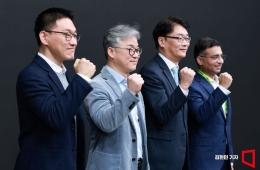
(10) Jaehyuk Han, Team Leader of Material Development Team 1 at Hanwha TotalEnergies
Independent Development of High-Performance Pipe Material 'PE100-RC' Previously Dependent on Imports
Successful Production of Ultra-Large Pipes with 2,6
The blueprint for the future industries envisioned by Korea all begins underground. Whether it is cooling water for artificial intelligence (AI) data centers, power grids for offshore wind farms, or industrial water for semiconductor clusters, pipelines serve as the lifelines for next-generation industries. As advanced infrastructure expands, the performance demands on pipelines also increase: durability that lasts half a century, pipes larger than a person's height, and heat resistance to withstand high temperatures. If Korea continues to rely on foreign technology for these materials, the speed and cost of national infrastructure will be dictated by other countries. This is why the material developed independently by Hanwha TotalEnergies is garnering attention.
High-density polyethylene (HDPE) pipes are emerging as the material of choice for these hidden "arteries" of cities. Their resistance to pressure, cracking, and impact makes them a solution to the chronic problem of corrosion in metal pipes. Because the fusion welding method integrates joints, these pipes can be installed underground without excavation, classifying them as an eco-friendly construction method.

Han Jaehyuk, Team Leader of the Material Development Team 1, posing after an interview with The Asia Business Daily on the 23rd of last month at the Hanwha TotalEnergies Daesan Research Institute in Seosan, Chungnam. Hanwha TotalEnergies
View original imageHanwha TotalEnergies' PE100-RC is a prime example. Plastic pipes for pipelines are classified by strength, with PE100 being the highest grade—once buried, they can be used for over 50 years. The "RC" designation indicates enhanced crack resistance. In short, this is a pipe material that lasts long and is highly resistant to breakage.
During an interview with The Asia Business Daily at the Hanwha TotalEnergies Research Institute in Seosan, Chungcheongnam-do, on the 23rd of last month, Jaehyuk Han, Team Leader of Material Development Team 1, said, "With the development of XLS10B, a PE100-RC grade material, we've entered the market for large-diameter pipes—those with a diameter of 2,600 mm or more. Globally, only Hanwha TotalEnergies and Borouge, a petrochemical company in the Middle East, produce pellets capable of making pipes of this size."
The PE100-RC pipes developed by Hanwha TotalEnergies have achieved crack resistance of over 8,700 hours. Existing products reached only about 500 hours, meaning the new material has improved resistance by more than tenfold.
Among PE100-RC products, XLS10B is optimized for producing large-diameter pipes. Han explained, "To make HDPE pipes, you need to melt the material with heat, form the pipe, and then cool it to harden. Sometimes, before hardening, the pipe can't maintain its shape and experiences sagging. With the development of the XLS10B material, we've greatly improved resistance to sagging and also secured high melt strength, making it possible to produce ultra-large pipes."

Jaehyuk Han, Team Leader of the Material Development Team 1 at Hanwha TotalEnergies, explained the pellet production process at the Daesan Research Center on the 23rd of last month. Hanwha TotalEnergies
View original imageHan added, "We have fully realized low sagging (LS·Low Sagging) PE100-RC grade products, which used to rely on imports, using domestic technology. Now that production is possible in Korea and we can offer rapid technical support, we are supplying these products to a variety of industrial sites." The large-diameter pipe materials produced by Hanwha TotalEnergies are used in projects such as Gangneung Anin Thermal Power Plant, Pyeongtaek Godeok sewage and wastewater treatment plant, Ulsan Integrated Energy Cluster, and the Yeosu liquefied natural gas (LNG) terminal.
Thanks to its outstanding properties, the material has gained recognition overseas as well. It is being used in mega-projects such as cooling water pipelines for nuclear power plants in China and desalination facilities for lithium projects in Chile.
Even after perfecting the design for a new material, manufacturing it directly at the plant is another challenge. Han said, "Chemical plants operate in continuous processes 24 hours a day, and changing factory conditions just to obtain samples can result in daily losses of about 1,200 tons. To minimize opportunity costs and avoid wasting two years of research and development investment, we have to make sound decisions right from the initial stages."
Hot Picks Today
 "Two Spend 500,000 Won in a Flash, Yet Wait Two Hours?" ... 'Dreamland' Shunned by Kids and Foreign Tourists
- The Era of Getting 200 Million Won After 30 Years Is Over... A Japanese Bank's "Perpetual Department Head" Who Just Clocked In Cries Out
- Spain Hit by Its Worst Tragedy... Lee Kangin, Moreno and Real Madrid Join Soccer World in Mourning
- They Said, “Make It Your Home for Life” - Then Suddenly Kicked 200 Passengers Off... What Happened to the Around-the-World Cruise?
- "130 Rice Bowls Sold Out in a Day"... 'Unfiltered Face' Adds 8 Million Won to Night Market Sales: China's Bungeunwoo
Certification for new materials is also being prepared to meet European market demand. The research institute where Han works has developed the PE100-RC-RT product, which boasts even greater heat resistance, and is aiming to obtain certification by the end of this year. Han said, "In Europe, buried pipelines and protective pipes are used to transmit offshore wind power to inland demand centers, and the pipes must withstand the high heat generated during transmission. We will do our utmost to ensure that our newly developed products pass certification and can be applied in these projects."
© The Asia Business Daily. All rights reserved. Unauthorized AI training and use prohibited.