Education Grants at a Crossroads: Park Hongkeun Calls for Overhaul Linked to National Taxes vs. Choi Kyojin Insists on Maintaining Current Rate (Comprehensive)
Education Grant Reform Forum Held at Government Complex on July 8
Park: "Rigid Structure Must Be Overhauled to Reduce Volatility"
Choi: "Concern Over an Approach Driven by Economic Logic"
The first public forum on the reform of local education finance grants (education grants), a system that has been in place for over 50 years, was held. This event was arranged at the suggestion of President Jaemyung Lee, as the differences between the Ministry of Planning and Budget and the Ministry of Education had not been easily resolved. While ministers from both ministries and experts generally agreed on the need to revise the education grant system in response to the declining school-age population and changes in the educational environment, they expressed differing views on the direction, method, and pace of the reform. Nevertheless, since the discussion, which had previously been limited to inter-ministerial consultations, was now initiated publicly before the nation, it is being evaluated as an important starting point for reform discussions.

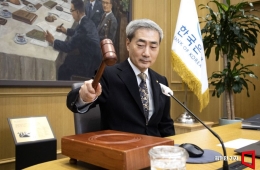
Hongkeun Park, Minister of Planning and Budget, is speaking at the 'Local Education Finance Grant Reform Forum for Future Generations' held on the 8th at the Government Seoul Building in Jongno-gu, Seoul. Photo by Yonhap News
View original imageOn July 8, the Ministry of Planning and Budget and the Ministry of Education jointly held the forum "Opening a New Waterway for Educational Finance: Local Education Finance Grant Reform Forum for Future Generations" at the Government Seoul Building. The event was attended by Hongkeun Park, Minister of Planning and Budget; Kyojin Choi, Minister of Education; Keunsik Jung, Superintendent of the Seoul Metropolitan Office of Education; as well as fiscal and education experts and education field representatives, who discussed the necessity and direction of reforming the education grant system. The forum was broadcast live through KTV, the Planning and Budget YouTube channel, and the Ministry of Education YouTube channel, allowing for public input.
The current education grant system, introduced in 1972, automatically allocates 20.79% of national taxes to provincial and metropolitan offices of education. However, despite a significant decrease in the school-age population, the total amount of education grants has continued to rise as tax revenues have increased, leading to criticism that new educational demands such as early childhood, higher, and lifelong education have not been sufficiently reflected. During the forum, while there was consensus on the need for reform, differences emerged regarding the solutions.
Minister Park argued for a fundamental overhaul of the education grant system that is linked to national tax revenue. He stated, "I believe the core of this education grant reform discussion centers on two things: First, how can we secure stability by mitigating the volatility of educational finances that result from fluctuations in tax revenues? Second, how can we better ensure balanced growth across different segments of education investment in Korea?"
According to Minister Park, while additional grants of 6.4 trillion won and 11 trillion won were allocated in 2021 and 2022, respectively, only 10.4 trillion won and 4.3 trillion won were disbursed in 2023 and 2024. He pointed out that the current structure, in which grants fluctuate greatly depending on tax revenue conditions, could cause more confusion in the education field. Minister Park said, "Such confusion stems from the rigid structure of allocating 20.79% of national taxes," and added, "The decline in the school-age population must inevitably be reflected in the calculation of grants."
In contrast, Minister Choi opposed changes to the grant method or the statutory grant rate. He said, "The most robust legal safety net agreed upon by society so that important education is not shaken by unpredictable economic fluctuations or political situations has so far been the allocation of 20.79% of national taxes." He further stated, "It is very concerning that the recent logic is proceeding solely on the basis of economic reasoning or numerical efficiency, such as simply reducing the budget because the number of children has decreased."
Minister Choi suggested that after maintaining the current grant rate, if there are surplus funds exceeding the standard, they should be utilized across all areas of education, including higher education, early childhood education, and lifelong education. He said, "The basic principle should be to maintain the allocation of 20.79% of national taxes, and if there is any surplus beyond certain standards, we should pool our wisdom to see if it can be used more broadly for higher education, early childhood education, and lifelong education." He emphasized, "If the reform of education grants is pursued without thorough review and communication with the field, the educational safety net and future growth engine that we have painstakingly built could be entirely undermined."
Hot Picks Today
 "The Transfer Failed, but 'Ding Dong' Money Came In"... 32.5 Billion Won Financial Incident at Toss Bank
- "They Wouldn't Give It a Second Look When Offered to Ancestors"... MZ Goes Wild for 80-Year-Old Ceremonial Liquor as a Household Must-Have
- Pinky swear: "I'll become a female soldier"... An elementary school student's moving letter of support from 11 years ago
- Arrest Warrant Sought for Daughter in Her 40s Over 'Mother's Murder'; She Denies the Crime in Police Questioning
- The 'Hangover Legend' That Had You Waking Up the Day After Tomorrow Returns After 11 Years... Lee Sunmin's Captain Q Sells Out
Experts also differed on priorities. Haksoo Kim, Senior Research Fellow at the Korea Development Institute (KDI), stressed the importance of fiscal efficiency, saying, "The current method for calculating educational finances should be reorganized into a structure that allows for rational and flexible resource allocation according to the policy environment and objectives." Sunho Lee, Director at the Korea Educational Development Institute, argued, "The goal of the education system in an era of population decline must be clearly defined, and the reform should ensure sustainable educational finances to meet the resulting educational demand." Superintendent Jung and Hanseop Lee, policy chief of the Korean Teachers and Education Workers Union, emphasized, "Improving the quality of education is crucial, including support for students with special needs and enhancing classroom conditions through securing a diverse range of teachers." Based on the discussions at the forum, the government plans to continue consultations with the education sector and related ministries to develop a revised education grant plan.
© The Asia Business Daily. All rights reserved. Unauthorized AI training and use prohibited.