First Korea-U.S. Energy Infrastructure Cooperation Success... Vice Minister Kim Itak: "Policy Finance Enabled Korean Participation"
Nevada Lithium and Boron Plant Agreement Ceremony in the U.S.
Korean Companies to Be Linked for Additional Collaborative Projects
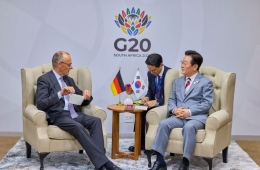
Kim Itak, First Vice Minister of the Ministry of Land, Infrastructure and Transport, attended the signing ceremony for the Nevada lithium·boron plant business agreement held in Washington D.C., USA, on the 7th (local time). He stated, "We will serve as a reliable partner so that our construction companies can take the lead in high value-added investment and development projects in the core infrastructure market in the United States."

Kim Itak, First Vice Minister of the Ministry of Land, Infrastructure and Transport, shakes hands with Kyle Howstbait, Deputy Secretary of the U.S. Department of Energy, after discussing cooperation plans for the lithium and boron plant project in Nevada on the 7th (local time) in Washington D.C., USA. Ministry of Land, Infrastructure and Transport
View original imageVice Minister Kim also remarked, "Going forward, we will keep high-level government-to-government (G2G) cooperation channels open at all times and organically link policy and financial investments."
This agreement was signed between Korea Overseas Infrastructure & Urban Development Corporation (KIND) and the U.S. developer Ioneer, as well as between Hyundai Engineering and Ioneer. KIND will be responsible for providing policy-based financial support, while Hyundai Engineering will participate as the plant construction partner.
The Nevada lithium·boron plant project is backed by a long-term, low-interest loan support agreement from the U.S. Department of Energy. It is linked to the supply of key minerals essential for electric vehicle batteries and advanced industry supply chains.
Initially, the Nevada lithium·boron plant project was expected to be led by U.S.-based construction firms. However, as the Korean government entered the project structure with policy-based financial support, domestic companies secured the opportunity to participate as construction partners.
This marks the first achievement among the energy infrastructure construction projects identified by the Korean and U.S. governments in January of this year. The two governments pioneered a high value-added investment and development project accompanied by financial structuring, moving beyond the simple contract-based approach. Financial structuring and corporate collaboration were achieved in a short period.
Hot Picks Today
 "The Transfer Failed, but 'Ding-Dong,' Money Came In"... KRW 32.5 Billion Financial Incident at Toss Bank
- Shark 'Bukkangi' Missing... Oil Spill off Busan North Port Raises Concerns
- "Made 12 Billion Won Cleaning Up Other People's Dog Poop With Just a Rake"... 'Poop Scoop Millionaire' Is All the Rage in the U.S.
- [2026 Parliamentary Audit] Education Ministry Pushes New Applicant Numbers That Make the "Competition Rate Impossible to Infer" for Regular Admissions
- Woman Who Bought Economy Ticket Causes Uproar, Demands "Put Me in Business Class," Delays Flight
Prior to the agreement ceremony, Vice Minister Kim met with Kyle Howstbeit, Deputy Secretary of the U.S. Department of Energy, to discuss ways to expand Korea-U.S. cooperation in energy infrastructure. The U.S. side proposed additional energy cooperation projects within the United States, and Vice Minister Kim responded that he would link domestic companies capable of participating in these projects and support their financial structuring.
© The Asia Business Daily. All rights reserved. Unauthorized AI training and use prohibited.