Korea-Japan Foreign Ministers Hold NATO Meeting... "Expanding Shuttle Diplomacy and Substantive Bilateral Cooperation"
The foreign ministers of Korea and Japan held a separate meeting on the sidelines of the Korea-U.S.-Japan Foreign Ministers' Meeting, agreeing that shuttle diplomacy between the two leaders is driving bilateral cooperation in various fields and to further expand substantive cooperation.

Foreign Minister Cho Hyun held talks with Japanese Foreign Minister Toshimitsu Motegi during the APEC Foreign Ministers' Meeting held in Gyeongju in October last year. Ministry of Foreign Affairs
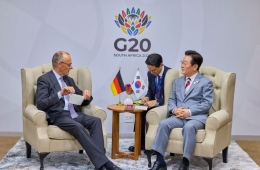
View original imageAccording to the Ministry of Foreign Affairs on July 8, Foreign Minister Cho Hyun held a Korea-Japan Foreign Ministers' Meeting with Japanese Foreign Minister Toshimitsu Motegi on July 7 (local time) in Ankara, Türkiye, on the occasion of the Korea-U.S.-Japan Foreign Ministers' Meeting.
The two ministers agreed to further advance Korea-Japan and Korea-U.S.-Japan cooperation. They also assessed that shuttle diplomacy between the leaders of Korea and Japan is driving cooperation in various fields and decided to maintain close communication to further expand substantive cooperation that citizens can tangibly feel.
This meeting was a brief session held after the Korea-U.S.-Japan Foreign Ministers' Meeting on the occasion of the North Atlantic Treaty Organization (NATO) summit. The primary significance was to reaffirm the recent trend of Korea-Japan cooperation and to agree on its continued development, rather than to discuss specific individual cooperative projects in detail.
Hot Picks Today
 "The Transfer Failed, but 'Ding-Dong,' Money Came In"... KRW 32.5 Billion Financial Incident at Toss Bank
- Shark 'Bukkangi' Missing... Oil Spill off Busan North Port Raises Concerns
- "Made 12 Billion Won Cleaning Up Other People's Dog Poop With Just a Rake"... 'Poop Scoop Millionaire' Is All the Rage in the U.S.
- [2026 Parliamentary Audit] Education Ministry Pushes New Applicant Numbers That Make the "Competition Rate Impossible to Infer" for Regular Admissions
- Woman Who Bought Economy Ticket Causes Uproar, Demands "Put Me in Business Class," Delays Flight
An official from the Ministry of Foreign Affairs explained, "Recently, through shuttle diplomacy between the leaders, various forms of cooperation are underway, including efforts to sign a memorandum of understanding (MOU) for joint response by the two countries' police authorities against transnational scam crimes, consultations in the social and economic sectors, and collaboration in energy and liquefied natural gas (LNG). These types of cooperation constitute substantive cooperation that citizens can tangibly experience."
© The Asia Business Daily. All rights reserved. Unauthorized AI training and use prohibited.