"Semiconductor Is Over" vs. "No, More to Come": Heated Debate Over Memory Peak
Market Correction on Memory Semiconductor Peak-Out Concerns
Nasdaq Falls on Worries Over Memory Semiconductor Peak
Slowing Earnings Growth Inevitable vs. Supply Shortage Likely to Last at Least Until Next Year

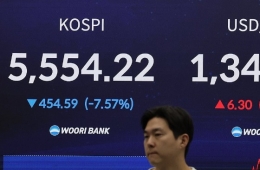
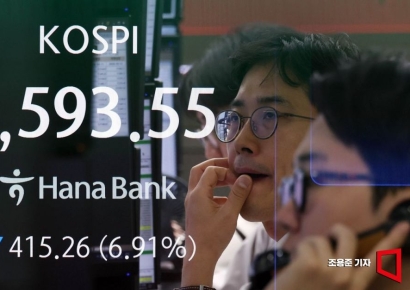
The KOSPI index plunged more than 4% in early trading, breaking below the 8,000-point level on the 7th. The status of the domestic stock market was displayed on the electronic board in the dealing room of Hana Bank in Jung-gu, Seoul. 2026.7.7 Photo by Kang Jinhyung
View original imageConcerns are emerging that the memory semiconductor industry has reached its peak, impacting the Korean stock market as well. The main arguments for the "semiconductor peak-out" theory include the slowing pace of semiconductor price increases, declining profit growth for Samsung Electronics and SK hynix, and fears of reduced investment by major U.S. big tech companies. On the other hand, there are also strong claims that a memory semiconductor supply shortage lasting through next year, improved earnings for related companies, and expectations for large-scale shareholder returns could drive a rebound in share prices.
Stock Market Correction Amid Memory Semiconductor Peak-Out Concerns
On July 8, the KOSPI opened at 7,452.48, down 2.66% from the previous trading day, but then reversed to trade at 7,716.27 as of 10:03 a.m., up 0.78%. The KOSDAQ is trading at 820.85, down 1.25%.
On the KOSPI, foreign investors and retail investors net sold 200 billion won and 400 billion won respectively, putting downward pressure on the index, but institutional investors net purchased over 600 billion won, leading the rebound. This is interpreted as bargain-hunting following the previous day’s sharp decline.
Overnight, the New York stock market fell, led by semiconductor stocks, causing the Korean market to open weaker. On the New York Stock Exchange (NYSE), the Dow Jones Industrial Average ended at 52,925.15, down 130.70 points (0.25%) from the previous session. The large-cap S&P 500 closed at 7,503.85, down 33.58 points (0.45%), and the tech-heavy Nasdaq finished at 25,818.69, down 302.47 points (1.16%). Semiconductor stocks such as Micron (-4.71%), Intel (-9.66%), AMD (-6.51%), and Marvell (-7.45%) showed pronounced weakness.
However, the Korean market rebounded, led by semiconductor stocks. On this day, SK hynix opened at 2,134,000 won, down 1.5% from the previous day, but as of 10:07 a.m., it was trading at 2,287,000 won, up 3.86%. At the same time, Samsung Electronics was trading at 294,500 won, down 0.51% from the previous day. Other large-cap stocks such as SK Square (-0.22%), Samsung Electro-Mechanics (-1.03%), Hyundai Motor (-0.10%), LG Energy Solution (-2.56%), and Samsung Life Insurance (-4.0%) are showing weakness.
Debate remains heated in the market over whether memory semiconductor stocks have reached their peak. Morgan Stanley argued in a report released the previous day that "memory semiconductor stocks could undergo a correction, citing the slowing pace of DRAM price increases, stabilization of inventory improvement, and the peak in upward EPS revisions." While the firm forecasts that memory semiconductor companies’ earnings will increase next year compared to this year, it diagnosed that the rate of increase is likely to slow, which could trigger share price corrections. Morgan Stanley is also known for its "Winter is Coming" report in the past, which sent memory semiconductor stocks tumbling and earned it the nickname "grim reaper of the memory semiconductor market."
In the U.S., some analysts noted that despite strong earnings, Samsung Electronics failed to meet heightened market expectations, increasing downward pressure on AI-related semiconductor stocks in general. Chris Murphy, co-head of derivatives strategy at Susquehanna International Group, said, "The perception that Samsung Electronics’ results fell short of expectations continues to weigh on the AI hardware sector overall and is encouraging selling of memory-related stocks." However, he added, "Investors now appear to be shifting their focus from the AI hardware bellwethers, where buying had become excessive, to broader earnings plays and sector rotation trends."
In Korea, there was also a report lowering the target price for Samsung Electronics. Kiwoom Securities said, "Volatility in the second half will increase due to changes in the memory industry, amid slowing EPS growth for Samsung Electronics," and cut its target price from 430,000 won to 390,000 won. Park Yuak, a researcher at Kiwoom Securities, predicted, "The probability that memory prices will rise more than expected in the second half appears low," and "Accordingly, the probability that Samsung Electronics’ EPS growth in the third quarter will exceed current market expectations is also low."

Inevitable Slowdown in Profit Growth vs. Supply Shortages to Last Until at Least Next Year
Nevertheless, most domestic securities firms remain positive on the semiconductor industry. They point out that the current correction is due to profit-taking after a rapid rise, while fundamental factors such as earnings outlook and shareholder returns remain intact. Kim Dongwon, head of research at KB Securities, raised his target price for Samsung Electronics from 550,000 won to 600,000 won, arguing, "Recent AI concerns are just noise" and "The spread of AI agents will more than triple memory demand, autonomous driving will increase it fivefold, and robotics will boost it more than tenfold."
Kim Sunwoo, a researcher at Meritz Securities, said, "Samsung Electronics’ second-quarter results were excellent, far surpassing market expectations," and noted, "Due to spatial constraints, memory supply will remain far short of demand growth at least through the fourth quarter of next year." Kim advised, "It is now a time when investors should base their decisions less on vague expectations and more on a clear understanding of where we are in the memory cycle."

Meanwhile, ahead of SK hynix’s Nasdaq listing, its American Depositary Receipt (ADR) offering is reportedly attracting a large number of investors. According to Bloomberg, global long-term investment funds and technology-focused investors are showing strong initial demand for SK hynix’s ADR offering. Approximately 1,000 institutional investors reportedly participated in the management marketing call held on July 6.
Hot Picks Today
 "I Invested KRW 10 Million, Only KRW 2 Million Is Left" ... 77% Plunge Sends Retail Investors Who Piled Into Samsung Electronics and SK hynix Leveraged ETFs Crying Out
- "There's a Drink Like This?"... Chinese Beverage With "Korean" in Its Name Rakes in 85 Million Won in Monthly Sales
- "No Need to Hire a Model"... The 25-Year-Old Woman Who Entered Social Media with a Face That Cost Just 1,500 Won [AI Content: The Bright and Dark Sides] 1
- "Samsung Electronics at 70,000 won, SK hynix at 200,000 won"... Why the gloomy outlook despite 'record-breaking earnings'?
- "The leggings are all see-through. It's so embarrassing to look at," complaints prompt Lululemon to fire development staff.
With growing interest in SK hynix ADRs, UBS has suggested that it would be advantageous to buy SK hynix ADRs while selling the Korean-listed ordinary shares. This assessment is based on expectations that the newly issued ADRs are likely to trade at a premium.
© The Asia Business Daily. All rights reserved. Unauthorized AI training and use prohibited.