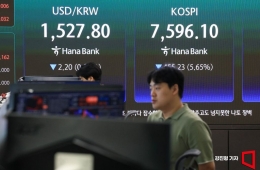
"Unprecedented Semiconductor Boom": Current Account Surplus for Jan-May Already Surpasses Last Year's All-Time Annual Record (Comprehensive)
Current Account Surplus Hits Record High Again in May at $38.61 Billion
Goods Account Surplus of $37.86 Billion Driven by Semiconductors; Exports Surge 167.7%
Travel Account Turns to Surplus; Record Drop in Foreign Stock Investment
Janu
In May, South Korea's current account posted a surplus of $38.61 billion, breaking its previous all-time record once again. The unprecedented goods account surplus, led by the semiconductor boom, was the driving force behind this historic current account performance. The reduction in the service account deficit—thanks in part to the travel account turning positive—and the primary income account swinging back into surplus after a seasonal dip in April also contributed to the record-breaking current account surplus in May.
This year, aside from April, which reflected seasonal factors, the current account has repeatedly hit new record highs. Fueled by this historic surplus rally, the cumulative current account surplus for January to May reached $141.28 billion. Even before the first half of the year ended, this surpassed last year’s annual all-time high of $123.05 billion. At this pace, analysts expect the Bank of Korea’s annual forecast of a $250 billion current account surplus to be easily exceeded. In June, as well, exports based on customs clearance surpassed $100 billion for the first time ever, signaling the continuation of the current account surplus rally.

Semiconductor Export Boom... Biggest-Ever Goods Account Surplus
According to the "Preliminary Balance of Payments for May 2026" released by the Bank of Korea on July 8, the current account surplus in May was $38.61 billion. This surpassed the previous record set in March ($37.93 billion), making it the largest surplus on record. The surplus increased significantly compared to the previous month ($28.29 billion) and was nearly four times higher than the same period last year ($9.91 billion). With this, Korea has posted a current account surplus for 37 consecutive months since May 2023, the longest streak since March 2019.
The record surplus in May was driven by the goods account, the largest component of the current account. The goods account posted a surplus of $37.86 billion in May, reaching an all-time high. The previous record was $35.68 billion in March.

The surplus widened as export growth, boosted by the semiconductor effect, outpaced import growth. Goods exports reached $94.34 billion in May, up 62.9% from the same period last year. IT products, including semiconductors, surged 128.9% year-on-year. Customs-cleared semiconductor exports were $37.29 billion, up 167.7% compared to May last year. Computer peripherals, specifically solid-state drives (SSDs), shot up by 249.4%. Non-IT items also increased by 10.0%, with petroleum products (49.1%) and chemical products (11.0%) seeing significant growth.
Goods imports totaled $56.48 billion, up 22.2% from the same period last year. Imports rose mainly due to raw materials (22.1%) and capital goods (28.0%). Raw materials imports increased as oil prices soared due to the Middle East conflict, with petroleum products (70.5%), coal (37.2%), chemical products (27.6%), and crude oil (24.8%) all posting sharp rises. Capital goods imports were driven largely by semiconductors (61.1%) and semiconductor manufacturing equipment (54.9%).

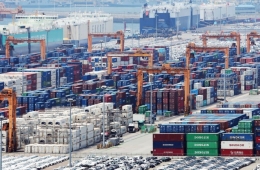
Containers are piled up at Pyeongtaek Port, Gyeonggi Province. Yonhap News Agency
View original imageIncrease in Travelers Turns Travel Account Positive... Dividend Income Account Recovers from Seasonal Dip
The service account and primary income account also contributed to May's record monthly current account surplus. The service account posted a deficit of $1.09 billion, narrowing its deficit from the previous month ($2.42 billion) and the same period last year ($2.56 billion). The travel account turned positive with a $50 million surplus due to the increase in inbound travelers, while the intellectual property royalties account also swung to a $70 million surplus, reflecting the seasonal pattern of rising income in the middle month of the quarter.
The primary income account ($2.17 billion) swung to a surplus, mainly due to dividend income ($1.15 billion). The dividend income account turned positive as dividend payments were reduced following the resolution of seasonal factors that had weighed on the previous month.

Tourists are taking photos and making memories on Myeongdong Street in Jung-gu, Seoul. Photo by Yonhap News
View original imageRecord Drop in Foreign Stock Investment Due to Profit-Taking Sales
Meanwhile, net external assets in the financial account—assets minus liabilities—increased by $31.08 billion, marking the second-largest increase on record after $38.05 billion in March.
Direct investment assets ($4.56 billion) saw slower growth, mainly in debt instruments, while direct investment liabilities ($2.69 billion) reversed to an increase, mainly due to profit reinvestment.
Securities investment assets increased by $6.24 billion, but bond assets (-$1.35 billion) reversed to a decrease, limiting overall growth. Equity assets ($7.6 billion) expanded, especially among general government and other financial institutions, thanks to the strong US stock market, while debt securities (-$1.35 billion) saw a turnaround to a decrease, primarily in short-term bonds.
Securities investment liabilities (-$24.65 billion) reversed to a decrease, mostly in equities (-$31.05 billion), marking the second-largest decline on record after March. Equities posted the largest-ever decrease, mainly due to foreign investors taking profits as domestic stock prices rose. Debt securities ($6.4 billion) saw an expanded increase, supported by inflows of funds tracking the World Government Bond Index (WGBI).
June Sets Export Milestone... "Current Account Surplus Expected to Easily Surpass $250 Billion in 2026"
The current account surplus for January to May has already surpassed last year’s annual surplus, leading to a significant upward revision of this year’s current account surplus forecast. In its May economic outlook, the Bank of Korea projected a $250 billion current account surplus for the year. The first-half surplus was projected to be around $151.5 billion. However, Korea already achieved nearly $141.3 billion in current account surplus from January to May. With just over $10 billion needed in June to surpass the first-half forecast, and June’s projection standing at around $40 billion, the record-breaking export performance suggests the historic current account surplus rally will continue in June as well.
According to the Ministry of Trade, Industry and Energy, Korea’s exports in June surged 70.9% year-on-year to $102.25 billion. This is the first time monthly exports have exceeded $100 billion. The main driver was semiconductors, which surpassed $40 billion in a single month for the first time ever. Semiconductor exports soared 199.5% year-on-year to $44.82 billion.
Hot Picks Today
 "Unimaginable in Korea": No Air Conditioning Despite 40°C Carriages... London's 'Gentleman’s Country' Endures Sweltering Subways
- "Two Eggs for Breakfast, My Protein" The Betrayal of Soft-Boiled Eggs...In July, Always Eat Them Hard-Boiled
- "The Bottom Is Here, Time to Buy and Hold" — Three Undervalued Sectors to Watch While Semiconductors Stall [Real Asset Management]
- [Breaking] "Iranian Revolutionary Guard Attacks 85 U.S. Bases in the Middle East"
- "It Feels Like Just Yesterday We Said 'Never Going to Japan'... 'No Japan' Is Out, 'Yes Japan' Shaping New Consumer Trends"
Woosung Uk, Director General of Financial Statistics at the Bank of Korea, stated, "For June, in addition to the goods account, we need to watch trends in the service and primary income accounts to see if the surplus will surpass $40 billion," adding, "The first-half current account surplus will certainly exceed forecasts, and the annual surplus could be much higher than projected."
© The Asia Business Daily. All rights reserved. Unauthorized AI training and use prohibited.





![[Exclusive] Over 3,000 Virtual Asset Crimes... No Statistics on Coin Recovery [Coin Lawless Zone] ③](https://cwcontent.asiae.co.kr/asiaresize/307/2025100617132460671_1759738404.jpg)