Education Grants Near 80 Trillion Won Amid Semiconductor Boom…'20.79% Domestic Tax Link' at a Crossroads
Number of Students Dropped from 1 Million in 1972 to 250,000 Last Year
Semiconductor Boom May Push Education Grants Over 80 Trillion Won Next Year
Experts Warn "Distorted Structure Deepens Fiscal Imbalances"
Strategy and Finance Ministry Proposes New Formula and Broader Use
Education Ministry Cautions Against Reform Based on Simple Economic Logic
The education grants system, introduced in 1972, has served as the "lifeline of educational finance," accounting for about 70% of metropolitan and provincial education offices' revenues. At the time, with a rapidly growing population and a severe shortage of educational facilities, it was decided that a certain portion of domestic taxes would be automatically distributed to these education offices. Because the grants increase automatically as tax revenues rise, the amount has grown from 4.31615 trillion won in 2016 to 7.64381 trillion won this year, an increase of over 3 trillion won in just ten years. Some projections suggest that, if excess tax revenues from the semiconductor boom are reflected, the grants could exceed 8 trillion won for the first time ever next year.
"Student Numbers Plummet, But Budgets Soar"…Abnormal Structure Under Scrutiny
The main issue is the inverted demographic structure. While the number of school-age children reached 1 million at the system's inception, it has since dropped by hundreds of thousands each year, plummeting to just 250,000 last year. As a result, the number of students is decreasing, but tax revenue increases are causing the grants to rise further, leading to a distorted and entrenched system. Fiscal authorities believe that this system exacerbates imbalances in resource allocation. Hongkeun Park, Minister of Strategy and Finance, stated, "The school-age population has fallen sharply, but the grants continue to rise at a fixed rate," adding, "It is time to thoroughly review a structure that does not reflect any economic indicators, such as inflation or economic growth rates."

Abundant Funding for Elementary and Secondary Schools, Shortages for Universities…Worsening Fiscal Imbalance
Experts also point out that the "20.79% automatic allocation" method undermines national fiscal efficiency. While education offices have accumulated trillions of won in surplus funds from elementary, middle, and high schools or used them as cashable welfare points, sectors such as higher education (universities), early childhood care, and lifelong education are suffering from chronic financial shortages. In fact, Korea's investment in primary and secondary education is much higher than the OECD average, but investment in higher education is relatively low. As of 2022, public education expenditure per primary and secondary student was $21,476—about 1.7 times the OECD average of $12,438. In contrast, higher education spending was $6,617 per student, only about 0.4 times the OECD average of $15,102. Haksoo Kim, Senior Research Fellow at the Korea Development Institute (KDI), highlighted in his 2021 paper, "Problems and Improvement Measures for Local Education Finance Grants," that "the current grant calculation method, which is linked to domestic tax revenues, fails to reflect the declining trend of the school-age population and is also inappropriate for rationally adjusting resource allocation within the education sector or coordinating with other areas of expenditure, making reform urgent."

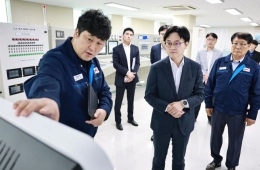
Minister of Education Kyojin Choi (left) and Minister of Planning and Budget Honggeun Park (right) are attending the public discussion on the reform of the local education finance grant held on July 8 at the Government Seoul Office in Jongno-gu, Seoul, exchanging greetings. July 8, 2026 Photo by Yongjun Cho
View original imageStrategy and Finance Ministry: "Revise the 20.79% Domestic Tax Link"
The Ministry of Strategy and Finance is reportedly considering two main options. The first is to adjust the current 20.79% linkage rate to domestic taxes itself. The second is to replace it with a new formula that incorporates factors such as the school-age population, economic growth rate, and inflation rate. The aim is also to reduce the volatility of the grants, which can surge or fall sharply depending on tax revenue. Minister Park emphasized, "We are not trying to reduce the total amount of education grants," and presented the following principles: △ the total amount will not be reduced compared to previous years, △ per-student education spending will continue to increase, and △ the stability of elementary and secondary education finances will be maintained. The ministry plans to redistribute secured resources to sectors that lack investment capacity, such as universities, lifelong education, and early childhood education.
Hot Picks Today
 "Unimaginable in Korea": No Air Conditioning Despite 40°C Carriages... London's 'Gentleman’s Country' Endures Sweltering Subways
- "900 Snakes Escape in Heavy Rain, Including Venomous Species... Resident Hospitalized After Bite"
- "This Is a Company Worth 'Donjjal'ing": Delisting Fears Rise, But It's Been Supporting Veterans for 25 Years
- "Beyond Discomfort—It's Enough to Make You Sick"...Criticism Mounts Over Prime Minister Takaichi's 260 Million Yen Necklace
- Snapping Photos in Tokyo Wearing Uniqlo and Drinking Asahi Beer: "What Is No Japan?"—How Consumer Trends Have Changed
Education Ministry: "Maintain the Grant Rate…Expand Investment Despite Fewer Students"
On the other hand, the Ministry of Education agrees on the need to adjust the grant structure but argues that the 20.79% allocation rate should be maintained. They contend that the rate should not be simply cut based on declining student numbers or temporary tax windfalls. Investments are increasing regardless of the decline in student numbers, including the reconstruction and redevelopment of aging schools, school relocations and expansions, the expansion of artificial intelligence (AI) education, support for basic academic skills, special education, and education for students from immigrant backgrounds. Education Minister Kyojin Choi stated, "A rational reform of the grant system is inevitable," but also drew a line, saying, "It does not seem right to lower the 20.79% rate amid new educational demands such as AI education." Instead, the ministry is reportedly considering expanding the scope of grant usage. Currently, grants can only be used for elementary, middle, and high schools, but legal amendments could allow them to be used for universities, lifelong education, and early childhood education as well. This would be a compromise that maintains the overall scale of education finance while also increasing investment in higher education. In short, while the Ministry of Strategy and Finance seeks to change the "allocation formula," the Ministry of Education is focusing on expanding the "scope of use."
© The Asia Business Daily. All rights reserved. Unauthorized AI training and use prohibited.