"KOSPI Plunge Attributed to AI Concerns... Semiconductor Cycle Has Not Peaked" [Click eStock]
Samsung Securities: "Big Tech Earnings Are a Turning Point... Rebound Likely if Investment Trends Are Reaffirmed"
On July 7, Samsung Securities analyzed that the main reason behind the KOSPI's sharp plunge of over 8% and the triggering of the circuit breaker was growing concerns over the sustainability of artificial intelligence (AI) investments. However, the firm does not believe the current AI investment cycle has peaked. It forecasted that if the direction of AI investment is reaffirmed during the upcoming earnings announcements by major U.S. big tech companies at the end of this month, the stock market will demonstrate resilience.
!["KOSPI Plunge Attributed to AI Concerns... Semiconductor Cycle Has Not Peaked" [Click eStock]](http://www.asiae.co.kr/news/img_view.htm?img=2026063008013427582_1782774094.png)
On this day, despite Samsung Electronics announcing its highest-ever quarterly profit, the KOSPI recorded an 8% drop as of 2 p.m., driven by continued selling from foreign investors. Samsung Securities cited three main reasons for the sharp decline.
The first is profit-taking due to the surge in memory semiconductor stocks. In the first half of this year, Samsung Electronics and SK hynix shares soared by 177% and 305%, respectively. During the same period, foreign investors made net sales of 82 trillion won and 66 trillion won in these two stocks, respectively. Nevertheless, despite the net selling of approximately 150 trillion won in the first half, the proportion of foreign investors in the KOSPI actually increased from 36% at the beginning of the year to around 40%.
The second factor is concerns that memory semiconductor companies may have already reached their profit peak. While Samsung Electronics announced its highest-ever preliminary second-quarter results, there was also selling driven by concerns that the year-on-year growth rate will slow in the second half due to the base effect.
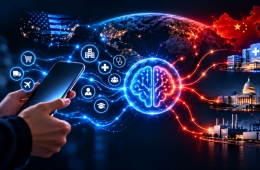
The third and main reason cited for the sharp decline was "doubts about the sustainability of AI investment." The delayed IPO of OpenAI and Meta's entry into the cloud business are said to be negative factors affecting the stock prices of AI companies.
Samsung Securities pointed out, "As AI investment increases, big tech companies are experiencing a slowdown in cash flow, and there are growing doubts as to whether only memory chip makers can continue to perform well."
Given the increased weight of the "big two" memory semiconductor companies, the firm believes that greater market volatility is inevitable for the time being. Samsung Electronics and SK hynix now account for about 53% of the KOSPI's market capitalization, amplifying their influence on the index. This is contrasted with the Nikkei 225 in Japan, where, despite the top market cap company Kioxia dropping by 11%, the index itself fell only around 1%.
In the first half of this year, the KOSPI posted the highest growth rate among major global stock indices, rising by approximately 100% on the strength of robust memory semiconductor stock performance.
Hot Picks Today
![Claims That "Daiso Is Being Shut Down to Save AliExpress and Temu" Spread Widely... A Fact-Check [Why&Next]](https://cwcontent.asiae.co.kr/asiaresize/93/2023121315590987574_1702450749.jpg) Claims That "Daiso Is Being Shut Down to Save AliExpress and Temu" Spread Widely... A Fact-Check [Why&Next]
Claims That "Daiso Is Being Shut Down to Save AliExpress and Temu" Spread Widely... A Fact-Check [Why&Next]
- "We invested on the government's assurances"... The 'Valley of Death' drags on [Hydrogen, Broken Ladder] ②
- "All He Did Was Reheat and Eat Fried Rice Made the Day Before"... Man in His 20s Nearly Needed a Liver Transplant
- Zelensky: "I Will Hold an Election If Putin Agrees to a 60-Day Ceasefire"
- "Looks Like They're Having an Affair": What If You Opened a KakaoTalk Chat, Filmed It, and Shared the Video With Coworkers?
Samsung Securities noted that concerns about overheating in AI investments following rapid short-term gains are a natural phenomenon, stating, "The earnings announcements by major U.S. big tech companies at the end of July will mark a critical inflection point for memory semiconductor stocks." The firm added, "If the sustainability of AI investments by hyperscalers (large cloud companies) is reaffirmed, our stock market is likely to demonstrate resilience once again."
© The Asia Business Daily. All rights reserved. Unauthorized AI training and use prohibited.