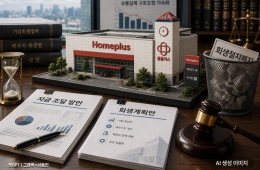
[Homeplus, Aftermath] ① The Defining Scenes of the 'Retail Apocalypse'
Homeplus 'Last Stronghold': Inside the Gangseo Branch
Empty Shelves Everywhere, Tenant Stores Withdrawing One by One
In-Depth Analysis of the Homeplus Crisis by Experts
A Complex Mix: Regulations, MBK, and Online Shift
"Strong Labo

On the afternoon of the 8th, the refrigerated corner at Homeplus Gangseo Branch in Seoul displayed household goods instead of refrigerated products.
View original imageOn the afternoon of the 8th at the Homeplus Gangseo Branch in Gangseo-gu, Seoul, Ms. Lee Myungsook (61, alias) looked around the empty vegetable stands for a while, then folded her empty shopping basket and said, "I've been coming to Homeplus for over 10 years, but now it really feels like the end."
The store was empty in many areas that day. Where eggs should have been, there were Homeplus's private brand "Simplus" cutting boards, and household goods were displayed at the tofu section. The ready-to-eat foods and meat corner had their lights off, and notices announcing "temporary suspension of business" were posted at the entrances of in-store restaurants and coffee shops. An employee at the clothing brand store of the Saejeong Group said, "We haven't been paid for two months, and if you add up all overdue payments across Homeplus stores, it amounts to 1 billion won. As an in-store vendor, we are third in line as creditors for corporate rehabilitation, so I don't know if we’ll ever be paid." On this day, the stores that ended operations offered even new products at a 50% discount.
The Gangseo Branch, which houses the Homeplus headquarters, was known as its "last bastion of pride." Because headquarters executives frequented the branch, it had a reputation for strict product selection and quality control, especially for fresh food. The doors remained open, but it was not just products that were disappearing. Customers stopped coming, suppliers halted deliveries, and in-store vendors took down their signs. Employees quietly sensed this was the company's final chapter.

On the afternoon of the 8th, at the Jeonggwanjang store in Homeplus Gangseo Branch, Seoul.
View original imageIt is not only Homeplus that has collapsed. Since the opening of the Emart Changdong Branch in Chang-dong, Dobong-gu, Seoul, on November 12, 1993, large discount stores, once bustling with family customers on weekends, are fading out. This marks the beginning of what is called the "retail apocalypse" for offline retail.
According to a survey and in-depth interviews conducted by The Asia Business Daily on the 10th with executives of large discount stores, suppliers, in-store vendors, current and former Homeplus employees, and distribution experts, the fall of Homeplus is the result of multiple factors. Half of the respondents pointed to large-scale retail regulations as the starting point, followed sequentially by the management approach of MBK Partners, the spread of online consumption, and the declining competitiveness of Homeplus.
![[Homeplus, Aftermath] ① The Defining Scenes of the 'Retail Apocalypse'](http://www.asiae.co.kr/news/img_view.htm?img=2026071008565841192_1783641417.jpg)
Scene <1> Distribution Law Stifles Growth
Homeplus, launched when Samsung C&T opened its first store in Daegu in 1997, rapidly expanded after British retailer Tesco acquired management rights in 1999. In 2004, Homeplus began its supermarket business, and in 2008, by acquiring Homever from E-Land Group, operated over 140 stores nationwide, growing into Korea’s second-largest discount store chain. At the time, Homeplus was considered one of Tesco's most profitable overseas markets.
However, things changed after the Distribution Industry Development Act was amended in 2012. New store openings were blocked, mandatory closure days were introduced, and from the following year, stores were required to close twice a month and limit business hours from midnight to 10 a.m. Although these policies were introduced to protect traditional markets and small businesses, they gradually shut down the growth engine of large discount stores.
A former Homeplus employee said, "I understand that after the implementation of the Distribution Industry Development Act, Tesco (then the owner of Homeplus) judged that growth potential would fall and eventually decided to sell the Korean business. I see the distribution law as the starting point of Homeplus's crisis." Professor Cho Chunhan of Gyeonggi University of Science and Technology explained, "Mandatory closures are not just about taking a day off; they are regulations restricting business hours, delivery, and the overall operation of stores. As these regulations became prolonged, the environment forced companies to prioritize survival over investment."
![[Homeplus, Aftermath] ① The Defining Scenes of the 'Retail Apocalypse'](http://www.asiae.co.kr/news/img_view.htm?img=2026071008572441194_1783641443.jpg)
Scene <2> Private Equity Sells Stores for Cash
The industry argues that regulations alone cannot explain the downfall of Homeplus. This is because Emart and Lotte Mart, subject to the same regulations, are still in the market. The decisive blow to Homeplus is seen as the management approach following its acquisition by MBK Partners in 2015.
In September 2015, MBK acquired Homeplus for 7.2 trillion won through a leveraged buyout (LBO), taking on about 4 trillion won in debt during the process. At the time of acquisition, MBK promised to invest 1 trillion won over two years, but afterward, it focused more on asset liquidation than strengthening competitiveness. Starting with the sale of major stores such as Gajwa, Gimpo, Gimhae, Dongdaemun, and Suwon, raising 644 billion won, MBK went on to sell a total of 28 stores and logistics centers by last year, securing a total of 4.1 trillion won.
With the sale-and-leaseback strategy, annual rent payments ballooned to the 400 billion won range. The industry believes that the funds raised through store sales were used primarily to pay off acquisition financing and recover investment, while the capacity for investment to enhance store competitiveness decreased. A Homeplus labor union official said, "For the major shareholder, recovering the investment is inevitably the priority over growing the business long-term. This is the result of focusing on short-term profits over future competitiveness." A former Homeplus executive also pointed out, "Under Tesco, the focus was on global sourcing and store investment, but under MBK, cost reduction and asset liquidation became the top priorities."
![[Homeplus, Aftermath] ① The Defining Scenes of the 'Retail Apocalypse'](http://www.asiae.co.kr/news/img_view.htm?img=2026070917044840833_1783584288.png)
Scene <3> Online Shopping Booms After COVID-19
The decisive blow that pushed Homeplus to the brink of collapse is widely considered to be the shift in consumer spending to online markets, triggered by the COVID-19 pandemic in 2020. Just before the MBK acquisition, in 2014, Homeplus had sales of 7.0526 trillion won and operating profit of 194.4 billion won. Even after converting major stores to sale-and-leaseback, Homeplus continued to post annual profits exceeding 100 billion won through 2019.
However, as unprecedented social distancing became the norm and non-face-to-face consumption spread, consumers began to abandon large discount stores. Weekend grocery shopping at large stores shifted to mobile orders, and companies like Coupang and Market Kurly penetrated the fresh food market with early-morning delivery. Online transaction volume surpassed offline, and buying groceries online became routine. According to the Ministry of Trade, Industry and Energy (now the Ministry of Economy and Finance), total sales of retail companies grew by an annual average of 6.7% from 2021 to 2025, but online grew 10.1%, while large discount stores declined by 4.2% annually.
Homeplus's performance also deteriorated. In 2020, when COVID-19 hit hard, operating profit plunged to the 90 billion won range, and from 2021, the company posted operating losses for five consecutive years through last year. Last year, Homeplus posted sales of 5.7963 trillion won and an operating loss of 546.4 billion won. A current Homeplus employee said, "Even after converting to sale-and-leaseback, if we had enough customers, we could still make a profit after paying rent. The mistake was underestimating how much the online market would grow during COVID." Choi Jayoung, President of the Korea Distribution Association, commented, "Consumers have gotten used to fast and convenient delivery services like Market Kurly's early-morning delivery and Coupang's next-day delivery. Once consumers experience this level of convenience, they do not return to traditional channels."
Scene <4> Strong Labor Union, No Buyer Found
![[Homeplus, Aftermath] ① The Defining Scenes of the 'Retail Apocalypse'](http://www.asiae.co.kr/news/img_view.htm?img=2026070816222838989_1783495349.png)
Homeplus also tried to target the online market. In August 2020, Homeplus joined Naver’s newly launched "Grocery Shopping" service. Similar to how Kurly recently joined Naver Shopping to distribute fresh food, this was a win-win strategy for both Homeplus and Naver. However, opposition from the labor union hindered the online transition. A former Homeplus employee said, "Internally, there were opinions that we should aggressively expand online delivery, but the union strongly opposed it, arguing that it would increase workload, so change was not easy."
Hot Picks Today
 184 Million Won in Six Months... Samsung, SK hynix No Longer Top Salary Earners
- "Please Teach Us the Technology"—Korea Once Sought Help from Japan... Now Threatens the Origin Country After 65 Years [Advance of K-Ramen]①
- 'Yong Hyein Risk' Emerges Within Democratic Party...Park Jihyun Says, "If There Is No Clear Justification for Ministerial Change, It Should Be Reconsidered"
- "A Must-Visit in Korea" Even Celebrities Flock... 'Local Grocery Shopping' Becomes Essential for Millennials & Gen Z
- "Just a Month After Joining, I Feel Older... My Company Won't Safeguard My Looks" Office Workers' Survival Tactics Go Viral in China
As the online market rapidly grew, the number of unprofitable offline stores with no customers increased, but the union opposed store closures, making restructuring difficult. Due to amendments to distribution laws and the stagnation of offline channels, Homeplus refrained from forced restructuring, unlike Emart and Lotte Mart, which cut their workforce. In fact, in 2019, Homeplus converted 14,200 contract workers into regular employees. At that time, the number of Homeplus employees exceeded 22,000, and as of February last year, before corporate rehabilitation, it was 19,500. By contrast, industry leader Emart reduced its workforce from over 30,000 in 2015 to about 23,000 last year, and Lotte Mart reduced its workforce from 13,000 to 9,700 over the same period. A large retail company official noted, "With new store openings blocked and assets continuously monetized, only the burden of interest payments increases. If you don’t reduce labor costs, everything turns into losses. A strong labor union also increases the burden for potential buyers."

© The Asia Business Daily. All rights reserved. Unauthorized AI training and use prohibited.