[Interview] Governor Lee Jeagak of Jindo: "Leading Regional Transformation with the '1 Trillion Won Budget Era'"
All-Out Efforts for National Funding and Private Investment... Implementing Field-Oriented Administration
Emerging as a Gateway City for Marine Tourism, Energy, and Logistics on the Southwest Coast
Lee Jeagak, who is expected to usher in a new era for Jindo County in the Jeonnam-Gwangju Metropolitan Special City, was inaugurated as the 50th Governor of Jindo County on July 1, marking the start of the ninth popularly elected administration in the county.
As a former military general, Governor Lee immediately presented "A Happy Jindo for Residents" as his administrative vision upon taking office, expressing a strong determination to overcome the crisis of local extinction and drive regional economic advancement based on integration and communication.

In a recent interview with our publication, Governor Lee stated, "Jindo is currently facing a complex crisis of population decline, regional economic stagnation, instability in the agricultural and fisheries industries, and the outflow of young people; however, with its pristine sea, culture and arts, Jindo dogs, agricultural and marine products, marine tourism, and the future value of Jindo Port, the county has rich potential for development." He added, "The next four years will be a time of 'change that residents can feel,' and I will be a governor who listens to residents' voices in the field."
▲ As the 50th Governor of Jindo County, what is the first message you would like to convey to the residents?
=Above all, I would like to express my deep gratitude to all the residents. This election was not a personal victory, but the result of the will of residents seeking change and renewal. I am keenly aware of the heavy responsibility entrusted to me, and I will devote myself to listening to residents and making Jindo a happy place.
▲ This election was decided by a margin of just 107 votes. Some say this means public sentiment in Jindo is divided. How do you plan to achieve community integration?
=I take the result—a margin of 107 votes—very seriously. I believe that not only the opinions of those who supported me, but also the intentions of residents who made other choices, should be reflected in county administration.
The election is over, and now all Jindo residents need to come together as one. There will be no division or retaliatory administration. What matters is not what side you were on during the election, but what role you can play for the future of Jindo.
To promote community integration, I will regularize on-site meetings in each town and township, and I will revisit the complaints and policy proposals raised during the campaign. I will ensure that residents feel, "My voice is being reflected in county administration."
▲ What is the first change you want to make in county administration methods at the start of your term?
=The first is communication. Communication with residents and with public officials is the starting point of county administration. Government is not an organization that moves solely on the governor’s instructions. We need a system where public officials, who know the field best, can work with conviction, and where residents' voices become policy.
The second is fairness. I will ensure that there is no controversy over preferential treatment in personnel matters, business projects, or licensing processes. Personnel appointments in key departments will be based on fairness and expertise, and there will be no interference in county administration by campaign contributors or close associates.
After taking office, I pledged to operate a "Visiting Governor's Office," disclose details of business promotion expenses, and ensure transparency in personnel administration. These promises are basic steps toward restoring residents' trust.

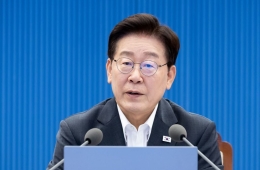
Lee Jaegak, Jindo County Governor, presenting the development vision for Jindo County. Photo by Seunghyun Jung
View original image▲ During the election, you emphasized ushering in a "1 trillion won budget era" for Jindo. How do you plan to realistically achieve this?
= The "1 trillion won budget" is not simply about increasing numbers. It means actively attracting national projects, private investment, and cooperative projects with Jeonnam Province that will transform the future of Jindo.
First, I will strengthen the dedicated system for securing national funds within the county office. Instead of having each department act independently, we will analyze central government projects and Jeonnam Province’s policy directions in advance and respond proactively. We will also actively utilize our networks with the National Assembly, central government, and Jeonnam Province.
In particular, Jindo Port, Seomang Port, transportation improvements in the Noksin area, logistics infrastructure for agricultural and marine products, marine tourism, and new and renewable energy-linked projects are all areas with strong potential for securing national funding. From my first year in office, I will prioritize projects and release the resource plans for each pledge.
▲ The core of Jindo's economy is agriculture and fisheries. What specific measures do you have to increase the income of farmers and fishers?
= "Agriculture and fisheries are the foundation of Jindo's economy. The problem is that while production is robust, farmers and fishers do not have enough power in distribution and price setting. From now on, we must shift from a production-centered administration to one focused on distribution, processing, and branding."
I will enhance the brand value of Jindo Gopchang Laver, dried laver, abalone, marine products, and agricultural products, expand grading systems and joint sales, and strengthen online distribution networks. In particular, since I have pledged to introduce a grading system and price stabilization for dried laver, a joint sales settlement system for abalone, and expand smart logistics support centers, I will push these forward with speed.
It is important to build a structure where farmers and fishers receive fair compensation. Administration should not be limited to simply distributing subsidies. The county will actively work to create markets, open sales channels, and manage quality."
▲ Jindo has many unique strengths in tourism, but there are concerns about the lack of stay-type tourism. What strategies do you have?
=Jindo is not a place without attractions. In fact, its many resources are scattered, and the problem is that they have not been bundled into stay-type tourism. Jindo’s unique content includes the Mysterious Sea Road, Jindo Arirang, the Battle of Myeongnyang, Unrimsanbang, Sebang Sunset, the Jodo area, and the Jindo dog.
Going forward, we must shift from one-day sightseeing to a tourism model where visitors stay and spend. I will develop Jindo Port as a hub port on the southwest coast and reorganize the Jindo Bridge Plaza and Noksin area for transportation and tourism functions. We will also pursue the Jodo area marine garden, the four-season festival renewal, and night tourism product development.
Tourism succeeds when culture and arts, food, accommodations, transportation, and local businesses all move together. I will create tourism policies that are linked to residents' incomes.
▲ The issues of population decline and youth outflow are the biggest challenges for Jindo. How do you plan to make Jindo a place where young people and children stay?
= For young people, the most important factors are jobs, housing, and education. No matter how good the slogans, if these three are not addressed, young people will not return.
I will devise realistic support for youth job seeking, youth housing costs, and settlement support for returning farmers and people moving to rural areas. I will also consider renovating vacant houses and connecting them to young people and new residents returning to the countryside. My pledges include support for youth housing costs, a comprehensive support system for returning farmers, and utilizing scholarships to foster talent.
Education is also important. Jindo students should be able to receive a good education without leaving the region. I will enhance the competitiveness of local high schools, strengthen culture, arts, and experiential education, and create an environment where even students from outside want to come to Jindo to study.
▲ One of the most pressing issues for residents is healthcare and welfare. What are your plans for emergency medical services, health checkups, and senior welfare?
= I am fully aware that residents of Jindo often have to leave the area for emergency situations or health checkups. Healthcare issues cannot be solved in a short period, but that does not mean we can do nothing.
First, I will consult with relevant agencies to improve the emergency medical response system and accessibility of health checkups. We will also support the attraction of pediatric and OB-GYN departments, promote early detection of senior diseases, and strengthen home medical and care services for seniors with mobility difficulties. As these pledges are directly linked to residents' daily lives, I will push them as top priorities.
Senior jobs, meal programs at senior centers, expansion of energy vouchers, and transportation support for the mobility disadvantaged are also key aspects of welfare. Welfare is not just support; it is administration that protects the dignity of residents.

Lee Jaegak, Jindo County Governor, vows to open the era of a 1 trillion won budget for Jindo County. Photo by Seunghyun Jung
View original image▲ How do you see the discussions on the Jeonnam-Gwangju Metropolitan Special City and the expansion of transportation networks in the southwest region as opportunities for Jindo?
=The key point in discussions on the Jeonnam-Gwangju Metropolitan Special City is to ensure that the southwest region, including Jindo, is not marginalized. If integration is designed to favor Gwangju and a few cities, the goal of balanced development will inevitably be weakened.
Jindo can serve as a gateway for marine tourism, energy, and logistics on the southwest coast. The recently proposed opening of Local Road No. 801, which would connect Haenam Solar City and the Jindo offshore wind power complex, is a project with a total budget of 460 billion won for a new 13.1km four-lane road. If implemented, it is expected to shorten travel distances and enhance connectivity for energy, logistics, and tourism throughout the southwest region.
Hot Picks Today
 "No Wonder It Soared Today... Morgan Stanley Eyes 3 Million Won Target—Which Stock Is It?"
- "Who Wants to Hire 40 Skilled Kimbap-Making Women?"... A 'Suspicious Ad' Appears Online
- HiteJinro Reports KRW 64.9 Billion Q2 Operating Profit, Up 0.7% Year-on-Year
- "If You're So Sure, Try It Yourself": 44-Year-Old Father Admitted to Prestigious University After Daughter's Challenge
- "This Is Not Right, Chairman"...Flood of Criticism over SK hynix's Pursuit of 'Five-Layer Duplicate Listing'
The improvement of National Road No. 18 and the development of the Noksin area are also key projects to enhance Jindo’s role as a gateway. Amid discussions of a Metropolitan Special City, we will actively respond to ensure that Jindo is not on the periphery but is established as a key connection point in the southwest region.
© The Asia Business Daily. All rights reserved. Unauthorized AI training and use prohibited.