First Step Toward UAV Engine Localization... Hanwha Aerospace and ADD Unveil Prototypes for the First Time
Ground Test Launch Ceremony Held for 5,500-Pound Turbofan and 1,400-Horsepower Turboprop Engines
First Independent Development of Long-Life Engines... Boosting Self-Reliance and Export Competitiveness
Hanwha Aerospace, in collaboration with the Agency for Defense Development (ADD), unveiled prototypes of two unmanned aerial vehicle (UAV) engines developed with indigenous technology for the first time. The company aims to strengthen self-reliant national defense and proactively secure competitiveness in UAV exports by developing UAV engines—a core power for future battlefields—using domestic technology.

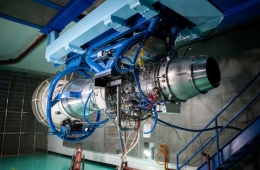
The 5,500-pound turbofan engine developed with domestic technology is preparing for a test run at Hanwha Aerospace's Changwon Plant 1. Hanwha Aerospace
View original imageOn July 7, Hanwha Aerospace announced that it held a ceremony marking the commencement of ground testing for the first prototypes of domestic long-life aircraft engines at its Changwon Plant 1 in South Gyeongsang Province. At the event, the company unveiled a 5,500-pound turbofan engine for low-observable UAV wingmen and a 1,400-horsepower turboprop engine for medium-altitude UAVs. This marks the first completion of prototypes for long-life engines capable of being operated for thousands of hours.
Over 300 representatives from the public, private, and military sectors attended the event, including Lee Gunwan, President of the Agency for Defense Development; Jeong Giyeong, Director General of the Future Power Programs at the Defense Acquisition Program Administration; Kim Seongjung, Director of Planning and Management at the Air Force Headquarters (Major General); and Kim Sun, Head of the Aerospace Division at Hanwha Aerospace.
The low-observable UAV wingman is a next-generation unmanned aerial system that operates in conjunction with the KF-21 fighter jet to perform various missions such as reconnaissance, electronic warfare, and strikes, and is regarded as a core force for the future. The medium-altitude UAV (MUAV) is expected to significantly enhance the military's intelligence capabilities by conducting long-duration flights and surveilling vast areas.
The domestic UAV engines unveiled this time have successfully completed ground test runs after assembly. Once development is fully completed, South Korea will have achieved true UAV localization, securing not only airframes, flight control, and mission equipment—already successfully localized—but also the engine, often referred to as the "heart" of the aircraft, with indigenous technology.

A 1,400-horsepower turboprop engine produced at Hanwha Aerospace's Changwon Plant 1. Hanwha Aerospace
View original imageKim Jinhyung, lead researcher at the Agency for Defense Development, stated, "The completion of the first domestic aircraft engine prototypes and the launch of ground testing mark the true beginning of securing aircraft engine technology. Although many challenges and difficulties are expected ahead, we will do our utmost until the day our domestically developed aircraft engines soar confidently through Korea's skies and compete on the global stage."
This domestic aircraft engine development project is seen as a turning point that can enhance not only engine technology but also the self-reliance and export competitiveness of the entire Korean aerospace industry.
Aircraft engines are critical components that determine the performance and operational range of aircraft. Major countries strictly control the transfer and export of related technologies through various regulations such as the Missile Technology Control Regime (MTCR), International Traffic in Arms Regulations (ITAR), and Export Administration Regulations (EAR), citing reasons of national security and the prevention of advanced technology leakage.
Even when engines are procured from overseas, approval from the original manufacturing country is required to maintain or upgrade the engine, or to export aircraft equipped with the engine. Currently, without U.S. consent, it is impossible to export aircraft such as the KF-21 or FA-50 developed with domestic technology.
Hanwha Aerospace plans to actively participate in government-led aircraft engine development, including a 10,000-pound turbofan engine to be installed in future "stealth UAVs" and advanced aircraft engines slated for next-generation fighter jets such as the KF-21.
Hot Picks Today
 "Is This the Peak?" Shares Plunge Amid Fears... 'Grim Reaper of Semiconductors' Morgan Warns of Memory Correction
- "Who Wants to Be a Civil Servant These Days?" Japan on High Alert as Technical Positions Receive Zero Applicants
- "If Labor's Demands Are Accepted, Monthly Wages Will Rise by 300,000 Won"... What Is the 'Paid Weekly Holiday Allowance' Burdening Employers?
- "Why Must Underwear Be Removed at School?"... Japan Stirred by 'Female Student Health Checkup' Controversy
- After Gaining Popularity with Her Brown Hair and Charming British Accent... Now Starring in Her First Feature Film
Kim Joungho, head of the Advanced Engine Business Team at Hanwha Aerospace, said, "Based on Hanwha Aerospace's accumulated experience and technological capabilities, we will rapidly close the gap with advanced countries and focus all our efforts on achieving self-reliance in Korea's aircraft engine technology."
© The Asia Business Daily. All rights reserved. Unauthorized AI training and use prohibited.