Japan Accelerates Revision of Three Key Security Documents in Response to China’s SLBM Launch
Chief Cabinet Secretary Addresses the Press on July 7
Suspected SLBM Has a Range of Over 10,000 km
U.S. and Australian Governments Also Voice Concerns
On July 7, the Japanese government announced that it would accelerate the revision of its three key security documents in response to China’s test launch of a submarine-launched ballistic missile (SLBM) into the Pacific Ocean, stating that “the security environment is becoming increasingly severe.” The governments of the United States and Australia also expressed their concerns.

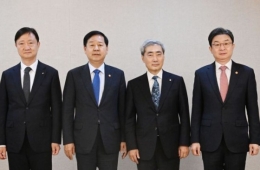
Minoru Kihara, Chief Cabinet Secretary and spokesperson for the Japanese government, is holding a press conference in Tokyo, Japan, on the 30th of last month. Photo by UPI
View original imageMinoru Kihara, Chief Cabinet Secretary and spokesperson for the Japanese government, said at a regular press conference on this day that the government is continuing to analyze the impact of the launch on Japan and intends to quickly proceed with the revision of the “three key security documents” currently being promoted. However, he added, “As stated previously, it has not been confirmed that the missile passed through Japanese territory or the exclusive economic zone (EEZ),” and “there have been no reports of damage to Japanese aircraft or vessels.”
Currently, the Japanese government is pursuing revisions within the year to its National Security Strategy, National Defense Strategy, and Defense Buildup Program, with a focus on strengthening defense capabilities and increasing defense spending. The government also indicated that the “Three Non-Nuclear Principles,” including the prohibition of nuclear weapons introduction, could be included in the review.
Previously, the Chinese People’s Liberation Army Navy announced that at 12:01 p.m. the previous day, a nuclear-powered submarine had launched an SLBM toward the high seas of the Pacific. The missile was equipped with a dummy warhead for training purposes. However, the military did not disclose the specific splashdown location of the missile. Navy spokesman Wang Xuemeng stated through state media that the launch was “conducted as part of the Chinese Navy’s annual military exercises in accordance with international law” and “was not aimed at any particular country or target.”
On the same day, Australia’s public broadcaster ABC reported that the SLBM launched by the Chinese military may have landed near the EEZ of Tuvalu, a Pacific island nation. The missile is believed to have passed over the EEZs of at least three countries, including the Federated States of Micronesia. According to Kyodo News, a Japanese government official said it is highly likely that the SLBM launched by China was fired from waters east of Hainan Island toward the South Pacific.
Although China did not disclose the missile type, military experts suggest that it is likely the Julang-3 (JL-3), China’s third-generation SLBM, which is capable of targeting most regions on earth, including the U.S. mainland. With a range of over 10,000 kilometers, it is known to be able to strike parts of the U.S. mainland even if launched from Chinese coastal waters.
Hot Picks Today
 "The Ramen Tasted Best at Jungfrau in Switzerland"... Controversy over Yeosu Officials' Overseas Trip Reports
- "Another Paper Rejection"—How a Female Student from Busan Became the First Korean CEO at a 150-Year-Old Global Company [Power K Woman]
- [Breaking] Cho Hyun on Foreign Affairs: "We Will Join International Cooperation, But Prioritize Citizens' Safety Regarding 'Troop Deployment' Questions"
- "Famous Actress on KBS Is Perpetrator's Sister"... KBS Responds to 'Busan Fall Death' Family's Plea
- "Embarrassment Even with International Guests: Series of Crashes by 'K-Drones' Before 1,500 Defense Experts"
Thomas Pigott, spokesperson for the U.S. State Department, condemned the missile launch, stating that “China test-fired an unarmed intercontinental-range ballistic missile (ICBM-class) from a submarine, which fell into the South Pacific.” He also emphasized that “the rapid and opaque expansion of nuclear weapons is a major concern for the region and the world.” However, the State Department did not comment on whether China had given the United States prior notice of the test launch. Australian Foreign Minister Penny Wong also stated that China had notified Australia in advance, but criticized the launch as “an act that creates instability in the region.”
© The Asia Business Daily. All rights reserved. Unauthorized AI training and use prohibited.