Launch of Jeonnam-Gwangju Integrated Metropolitan City: 75% Expect "Positive Impact on Regional Economy"
Bank of Korea Gwangju-Jeonnam Branch Surveyed 40 Economic Experts
Concerns Raised Over Short-Term Integration Costs and Regional Conflicts
In order to overcome the crisis of regional extinction caused by the continuous outflow of young people and the aging population, the newly established 'Jeonnam-Gwangju Integrated Metropolitan City,' which was launched on July 1, is expected to become the largest regional government by economic size outside the Seoul metropolitan area and to reshape the regional economic landscape.

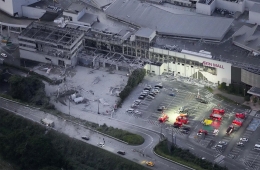
Min Hyungbae, former mayor of Gwangju-Jeonnam Metropolitan City, is inspecting the Air Force ammunition depot site near Gwangju military airport on the 7th. Photo by Yonhap News Agency
View original imageAccording to the "Analysis of the Regional Economic Impact of the Jeonnam-Gwangju Administrative Integration" report released by the Gwangju-Jeonnam branch of the Bank of Korea on July 7, the simple sum of the gross regional domestic product (GRDP) for Gwangju (54.8 trillion won) and Jeonnam (104 trillion won) is projected to reach a total of 158.8 trillion won in 2024. This ranks third nationwide after Seoul and Gyeonggi Province, and constitutes the largest economic base among regional governments outside the Seoul metropolitan area.
This integration was rapidly promoted in conjunction with the government's "Five Growth Poles and Three Specialized Zones" balanced development strategy, which aims to alleviate the overconcentration in the Seoul metropolitan area. As of 2025, Gwangju's net outflow rate of young people (2.50%) is the second highest in the country after North Gyeongsang Province, while Jeonnam has the highest proportion of elderly population (28.5%) nationwide, with 16 out of its 22 cities and counties designated as declining population areas—evidence of a chronic extinction crisis. In response, the government enacted special legislation in March this year, granting the integrated city special status equivalent to that of Seoul and promising a bold fiscal support package of up to 5 trillion won per year for four years, totaling 20 trillion won.
According to a survey conducted by the Bank of Korea among 40 regional economic experts, 75.0% of respondents believed that the administrative integration would have a positive impact on the regional economy. The experts identified "improving administrative efficiency (82.5%)"—through the prevention of redundant infrastructure investments and realizing economies of scale in public services—and "attracting companies and investment (57.5%)" as the core pathways for this impact. In particular, there are high expectations for a strong industrial ecosystem synergy if Gwangju's advanced industries such as artificial intelligence (AI) and semiconductors are combined with Jeonnam's large-scale renewable energy supply potential.
On the other hand, some experts expressed caution. Ten experts who gave neutral or negative opinions raised concerns about the short-term costs of integration and potential conflicts between regions. They pointed out that if bold public sector structural reforms are not implemented, the integration could lead to mere expansion without substance, and resources may become concentrated in urban areas, accelerating the so-called "straw effect," whereby some rural areas in Jeonnam experience even faster decline.
The Bank of Korea conducted a quantitative analysis of the economic ripple effects of the government's 20 trillion won fiscal support using the regional input-output table. The analysis estimated that the nationwide production inducement effect would reach 36 trillion won, with 47.2%—or 17 trillion won—of this effect occurring within the Jeonnam-Gwangju area.
The employment inducement effect is projected to create a total of 44,000 jobs nationwide, with 23,000 jobs (51.3%) expected to be generated within the Jeonnam-Gwangju region. However, so far, the employment ripple effect has been concentrated mainly in the public sector and other low value-added service industries, while employment in high value-added advanced industries remains limited. As a result, experts have identified the need for an urgent restructuring of the regional industrial structure around future core industry value chains.
Hot Picks Today
 "Even More Money Isn't Enough: Gen Z Refuses Management Roles Over Added Responsibility"
- "Licking a Straw Changed His Life: The Consequence for a 19-Year-Old's Vending Machine Prank"
- "Did Banks Tighten Too Much?" Total Lending Cap Falters Over Balance Payment Loans... Will the Government Adjust the 1.5% Target?
- "Betrayal in a Cup of Iced Coffee"... Even 7,500 Won Coffee Not Spared from 'Contaminated Ice'
- Crawling and Rolling on All Fours in Broad Daylight... The Reason Behind a Woman in Her 20s’ Shocking Behavior Near Suwon Station
An official from the Bank of Korea stated, "To achieve tangible results from the administrative integration, bold structural reforms to boost productivity in the public sector must come first," and suggested, "It is necessary to establish a highly actionable mid- to long-term roadmap that links energy and advanced industries, based on the transfer of substantial authority from the central government."
© The Asia Business Daily. All rights reserved. Unauthorized AI training and use prohibited.