[Market Pulse] The Real Issue Is How Korea Uses Dollars Earned from Its Surplus
As the Export Surplus Grows, Overseas Investment Surges
Earned Dollars Flow Abroad Instead of Returning Home
Weak Won and Exchange Rate Distortion Fuel a Prolonged Vicious Cycle
Restoring a Virtuous Dollar Cycle Requires Boosting Domestic I
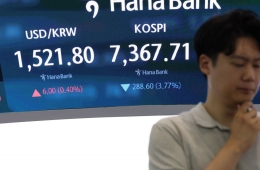
Recently, the South Korean economy has been experiencing unfamiliar phenomena—some of which even appear paradoxical. For the first time ever, monthly exports have surpassed USD 100 billion (USD 102.25 billion), and the current account surplus is headed toward an annual total of USD 250 billion, according to the Bank of Korea's projections. According to textbook economics, an influx of dollars should lead to the appreciation of the Korean won. However, the reality is quite the opposite. The won-dollar exchange rate continues to hover in the mid-1,500 won range without any sign of retreat. In January, the U.S. Treasury Department commented that the weak won was "not consistent with Korea’s strong economic fundamentals." Nevertheless, since then, the exchange rate has at one point risen by nearly another 100 won.

An employee is holding up a US dollar bill at Hana Bank's Counterfeit Response Center in Myeongdong, Seoul. Photo by Yonhap News
View original imageThis is due to the flow of money. In the short term, the surge in domestic stock prices has increased the proportion of won-denominated assets held by foreign investors, who are now realizing profits and engaging in currency hedging—thereby pushing the exchange rate higher. Fundamentally, the issue arises as dollars earned from exports are not returning home but are instead flowing back overseas. Investors are purchasing foreign stocks at an unprecedented scale, and companies are converting only a portion of their dollar earnings into won, holding onto the rest. Surpluses are not being absorbed into domestic investment and consumption, but are instead flowing out immediately through the financial account. This structure is creating the current paradox. While foreign investors’ rebalancing demands are likely to stabilize at some point, the structural phenomenon of surpluses not returning home may persist.
Experts on the ground have also shifted their perspectives. When the unprecedented semiconductor-driven surplus first emerged, many were concerned about a ‘Dutch Disease’ scenario—where an appreciation of the currency would erode the export competitiveness of other manufacturing sectors. Contrary to these expectations, as the high exchange rate persisted, concerns have now shifted in the opposite direction, toward a ‘Taiwan Disease.’ The term "Taiwan Disease," as coined by The Economist, refers to the adverse effects seen in Taiwan where the government has effectively tolerated an undervalued currency, resulting in suppressed consumption and distorted resource allocation. Although, unlike Taiwan, the South Korean government is not intentionally pursuing a weak currency policy, the outcomes could end up being similar, regardless of intent.
However, it would be misguided to interpret this as a "damned if you do, damned if you don't" situation. On the contrary, even if not to the same extent as before, a high exchange rate clearly benefits export-oriented companies, while a low exchange rate aids domestic demand and price stability. Therefore, any concerns about the current situation must be identified with precision. Mahgoub and Sosa of the International Monetary Fund (IMF) analyzed global cases and concluded that it is not the mere level of the exchange rate, but a misaligned or highly volatile exchange rate that is more detrimental to growth. According to research by economists Paul Krugman and Richard Baldwin, once an industrial base collapses and factories leave due to exchange rate turmoil, returning the exchange rate to its former level does not restore what was lost.
The essence of Dutch Disease lies in the fact that a temporary boom-induced exchange rate shift can trigger permanent changes in industrial structure. When two oil shocks and a collapse in energy prices followed the boom, the Netherlands had already lost its manufacturing competitiveness due to a transformed industrial structure. The problem with exchange rate distortion arises when the exchange rate, whether high or low, remains out of sync with the country's economic fundamentals.
There are many historical examples of the risks posed by sharp fluctuations in exchange rates that are misaligned with economic fundamentals. South Korea's experience during the 1997 currency crisis stands as a prime example. In 2022, the UK faced a near meltdown of the pound sterling, government bonds, and pension funds after tax cut proposals shook policy credibility. The foreign exchange market adjusts rapidly, and as participants’ expectations fluctuate, the risk of overshooting or self-fulfilling crises becomes very real. If today’s exchange rate is significantly misaligned, the risk of sudden volatility is equally high. Japan offers another instructive case. After the 1980s, as a strong yen worsened cost conditions, Japanese companies began relocating production overseas. Although the Japanese government adopted an ultra-weak yen policy from the 2010s, its effects were short-lived. In particular, even though the yen has lost more than a third of its value since 2021, export volumes have not increased, nor have many companies returned to Japan. What remained was a sharp rise in import prices, and Japan’s real wages have declined for four consecutive years. Despite recording its largest-ever current account surplus, much of Japan’s earnings are not returning home, meaning the national surplus is not translating into household income.

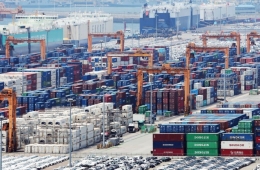
Containers piled up at Pyeongtaek Port in Gyeonggi Province. Photo by Yonhap News Agency
View original imageAs such, exchange rate stabilization cannot be taken lightly, and the reasons are manifold. Another point to consider is the growing international scrutiny of countries with undervalued currencies. There is a widespread perception—shared by U.S. and European Union policymakers as well as free-trade economists—that China is unfairly maintaining a large trade surplus by combining an undervalued yuan with excessive subsidies for overcapacity, thereby undermining other countries’ manufacturing bases. The problem is that the U.S. administration under President Donald Trump is applying this perception to its allies as well. In a Section 301 investigation launched in March, the Office of the United States Trade Representative (USTR) raised suspicions that South Korea, like China, is pursuing a policy of overproduction. While this is an unjust charge, it remains true that a combination of a weak currency and an expanding trade surplus does not create a favorable impression.
So what is the solution? The issue is not the absolute level of the exchange rate, but whether the exchange rate reflects economic fundamentals, and whether the dollars earned through surpluses are recirculated into domestic productive capacity. To address this, first, a more proactive policy approach to exchange rate stabilization is needed. It is important to maintain ongoing communication with the market and to enhance macroprudential management and external balance mechanisms to ensure that misaligned exchange rates do not persist for long. Second, policies that channel export-driven surpluses back into the domestic economy—such as the recently announced ‘mega-projects’ encouraging large-scale domestic investment by exporters—offer a win-win by both stabilizing the exchange rate and strengthening the foundation for growth. Third, beyond semiconductors, conditions related to power, water, human resources, regulations, and taxation must be innovatively improved to encourage not only the reshoring of overseas companies but also direct investment by foreign firms. If these policies are combined and effectively implemented, they will win the market’s trust and amplify their policy impact.
The coexistence of record surpluses and a high exchange rate is not a signal of crisis, but neither is it a sign to be ignored. The key issue is not the surplus itself, but how that surplus is used. A country that channels its dollar earnings into overseas financial assets will look very different in ten years from one that invests those dollars in domestic factories and infrastructure. Rather than blaming companies or retail investors, urgent efforts should be made to transform Korea into the most attractive investment destination. Only then will today’s surpluses become the seed money for the next phase of growth.
Hot Picks Today
 "Unimaginable in Korea": No Air Conditioning Despite 40°C Carriages... London's 'Gentleman’s Country' Endures Sweltering Subways
- "900 Snakes Escape in Heavy Rain, Including Venomous Species... Resident Hospitalized After Bite"
- 'Black Wednesday': KOSPI Plunges 5.4%... KOSDAQ Also Down Over 5%
- "Beyond Discomfort—It's Enough to Make You Sick"...Criticism Mounts Over Prime Minister Takaichi's 260 Million Yen Necklace
- Snapping Photos in Tokyo Wearing Uniqlo and Drinking Asahi Beer: "What Is No Japan?"—How Consumer Trends Have Changed
![[Market Pulse] The Real Issue Is How Korea Uses Dollars Earned from Its Surplus](http://www.asiae.co.kr/news/img_view.htm?img=2025081208551280009_1754956512.jpg)
Kwon Namhoon, President of the Korea Institute for Industrial Economics and Trade
© The Asia Business Daily. All rights reserved. Unauthorized AI training and use prohibited.