[BOK Focus] The Three Key Factors Pointing to a Rate Hike... How Have They Changed with 10 Days Until the Monetary Policy Board Meeting?
Inflation Exceeds 3% in May and June
"High Levels Expected for Now"
Exchange Rate Stays Above 1,500 Won for 35 Trading Days
Concerns Over Increased Volatility
Real Estate: Semiconductor Belt Gains and Worries Over Asset Shift F
"Inflation, growth, and financial stability—all factors are pointing in the same direction." It has been about six weeks since Shin Hyun-song, Governor of the Bank of Korea, suggested at the Monetary Policy Board meeting in May that "it will be necessary to raise the base rate at an appropriate time in the future." As of July 7, with about ten days remaining until the upcoming Monetary Policy Board meeting, the market has virtually accepted a rate hike this month as a given. Here is a look at how these three major factors, which were all aligned during the previous meeting, have changed as of now.

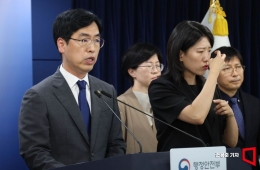
Shin Hyun-song, Governor of the Bank of Korea. Photo by Yonhap News Agency Joint Press Corps
View original imageInflation: Economic Recovery Offsets Declining Oil Prices..."Remain Elevated for Now"
Inflation is supporting a rate hike. After the last Monetary Policy Board meeting, the consumer price index for May and June exceeded 3%, at 3.1% and 3.2% respectively. Core inflation rose to the 2.5% range, and the public's expected inflation rate for the next year also remained in the 2.8% range for May and June. The cost of living index, which Governor Shin stressed, climbed from 3.3% in May to 3.4% last month, marking the highest level since April 2024 (3.6%). The Bank of Korea expects the consumer price index to remain elevated for the time being. This is because the downward pressure from lower international oil prices is offset by increasing demand pressure due to economic recovery.
Choi Jiuk, a researcher at Korea Investment & Securities, commented, "Although this month the expression 'the inflation rate will remain in the 3% range for the time being' mentioned last month has disappeared, inflation is still expected to exceed the Bank of Korea's 2.0% target." He added, "Given that the high level of the exchange rate will exert upward pressure on prices with a time lag, I expect the Bank of Korea to raise the base rate by 0.25 percentage points at the July Monetary Policy Board meeting."
![[BOK Focus] The Three Key Factors Pointing to a Rate Hike... How Have They Changed with 10 Days Until the Monetary Policy Board Meeting?](http://www.asiae.co.kr/news/img_view.htm?img=2026070709350536531_1783384505.jpg)
Exchange Rate: Higher Levels and Volatility...Growing Risk
From the perspective of financial stability, the exchange rate, which was mentioned first, has climbed even higher. According to the Bank of Korea's Economic Statistics System, the average weekly closing exchange rate (3:30 PM) for June was 1,527.95 won. On a monthly average basis, this is the highest level since February 1998 (1,626.75 won) during the foreign exchange crisis. For the second quarter of this year, the average was 1,501.64 won, also surpassing the 1,500 won mark on a quarterly basis—the highest since the first quarter of 1998 (1,596.88 won).
The exchange rate surpassed 1,500 won for the first time since the financial crisis in March, triggered by the Middle East conflict, then temporarily dropped to the low 1,400 won range, but has remained above 1,500 won for 35 consecutive trading days since May 15, continuing its surge. Early this month, the weekly closing even exceeded 1,550 won, repeatedly setting new highs since the global financial crisis. The main concern is that the outflow of foreign capital from the domestic stock market, which has led to a sharp decline in the value of the won, could persist for some time. While the launch of the 24-hour foreign exchange market on July 6 is expected to improve accessibility for foreign investors in the longer term, until overnight trading becomes active, a lack of liquidity could actually increase volatility risks.
Kim Jina, a researcher at Eugene Investment & Securities, noted, "Despite several interventions recently, the exchange rate has returned to the mid-1,500 won range. The sensitivity to the weak yen is also extremely high. Even though the authorities' estimated intervention volume has kept the rate in the 1,530 won range, there is no confidence that this level will be maintained." She pointed out that if the authorities' interventions fail to stabilize the exchange rate in the low 1,500 won range, a strong hawkish message may accompany a rate hike at the July Monetary Policy Board meeting.

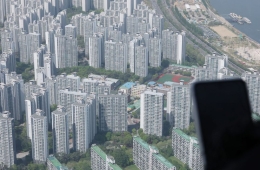
Apartment complexes around Dongtan Station, Hwaseong-si, Gyeonggi-do. Photo by Yonhap News Agency
View original imageReal Estate: "Semiconductor Belt"-Driven Gains and Concerns Over Reallocation of Surging Financial Assets
Another pillar of financial stability, the real estate market, also faces significant overheating risks. The continued upward trend in the southern Gyeonggi region, known as the "Semiconductor Belt," and the possibility that surging financial assets from the domestic stock market could be reallocated to real assets such as real estate in the future cannot be ruled out.
According to the Korea Real Estate Board, in the fifth week of June (as of June 29), the average price of apartments for sale in Seoul rose by 0.27% compared to the previous week. Seoul apartment prices have now risen for 73 consecutive weeks since the upturn in the first week of February last year. The Korea Real Estate Board commented, "Demand continues to be centered on major complexes such as those under reconstruction, popular station areas, and large complexes, with steady buyer inquiries leading to increased transactions and overall price increases in Seoul." The strength of the "Semiconductor Belt" in the southern Gyeonggi region, including Dongtan in Hwaseong, Gyeonggi Province, is also evident. Dongtan's cumulative increase this year is 13.00%. Although regulated zones and land transaction permit zones have been designated since then, the prevailing view in the market is that trends need to be monitored for the time being.
Growth: IB Forecasts Exceed 3%..."Upward Revision, Even If Only Mechanically"
Growth is also easing the burden of a rate hike. An upward revision to Korea's economic growth forecast has already been signaled in the Bank of Korea's revised outlook due next month. In a keynote speech at the Korean Finance Association's annual academic conference dinner last month, Governor Shin noted, "The preliminary figure for real GDP growth in the first quarter of this year (compared to the previous quarter) was revised upward to 1.8% from 1.7%," and added, "The annual growth forecast will also be revised upward, even if only mechanically, from the 2.6% projected in May." He particularly emphasized that the 10.5% quarter-on-quarter jump in nominal GDP in the first quarter was driven not by domestic inflation, but by a sharp rise in export prices led by semiconductors.
As a result, both domestic and international institutions have raised this year's growth forecasts for Korea. The average forecast among major global investment banks recently surpassed 3%. According to the International Financial Center, as of the end of June, the average real GDP growth forecast for Korea from eight major investment banks was 3.0%, up 0.2 percentage points from 2.8% at the end of May. JP Morgan raised its forecast from 3.0% to 3.7% within a month, and Citibank also raised its forecast from 3.0% to 3.5%. This reflects the record-breaking semiconductor export boom, the government's three major mega-projects, and the second supplementary budget.
Hot Picks Today
 "Money Matters More Than Studying": 2.7 Million Won Camps Fully Booked as Chinese Parents Raise 'Little Buffetts'
- "Lifetime Democratic Supporters Turn Away Amid Stock Crash... Foreign Media: 'Political Burden for President Lee'"
- "Get a Tattoo for an Interview": US Startup Draws Job Seekers' Anger After 7 Get Permanent Ink
- "Should You Buy Hynix Tomorrow?"... What Is the 'Rumor About Why Chey Tae-won Said to Buy the Stock'?
- "Thanks to Consumers Turning Away, Twosome Place Enjoys a Boost as Customers Flock Away from Starbucks"
In the market, other factors surrounding Korea's monetary policy are also seen as favoring a rate hike. In particular, due to the ongoing Middle East conflict, the focus regarding the U.S. policy rate is less on "whether there will be a hike" and more on "whether the current pause can be maintained." While the market sees the likelihood of a U.S. rate hike in the near term as low, it believes that maintaining the pause will require employment and inflation indicators to continue showing a modest slowdown.
© The Asia Business Daily. All rights reserved. Unauthorized AI training and use prohibited.