Despite Government's Request, Corporate Dollar Deposits Continue to Rise
Corporate Dollar Deposits Reach USD 52.917 Billion as of July 3
Despite Government's Request for Early Conversion of Export Proceeds, Balances Increase Over the Month
Companies See Greater Advantage in Holding Dollars
Some Attribute R
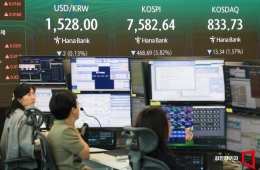
Last month, the government requested that companies convert their export earnings into won, but corporate dollar deposits actually increased over the past month.
According to the financial sector on July 7, as of July 3, the dollar deposit balance of five major commercial banks (Shinhan, KB Kookmin, Hana, Woori, and NH Nonghyup) held by corporations amounted to $52.917 billion (approximately KRW 81.1112 trillion). Compared to the end of May, when the balance stood at $49.927 billion, this represents an increase of about $3 billion in just over a month. Considering that the balance at the end of last month was $52.172 billion, this means it rose by $745 million in just three days.

This trend runs counter to the direction of the foreign exchange market stabilization efforts promoted by the government. On June 11, the Ministry of Economy and Finance and the Ministry of Trade, Industry and Energy held a meeting with major exporters such as Samsung Electronics, SK hynix, Hyundai Motor, and Kia, asking them to cooperate with the early conversion of export proceeds into won. Prior to this, on June 9, the Financial Supervisory Service held a meeting with foreign currency and fund managers of major commercial banks and foreign bank branches, requesting that they refrain from excessive events or marketing campaigns aimed at attracting dollar deposits. Typically, when companies convert their dollar holdings into won, the resulting increase in dollar supply in the market acts as a factor in boosting the value of the won. Conversely, if corporate dollar deposits increase, it can result in downward pressure on the value of the won. Corporate dollar deposits have been on the rise, reaching $44.722 billion at the end of March and $48.043 billion at the end of April.
From the perspective of corporations, it appears that holding dollars is seen as more advantageous. This is because it allows them to hedge against the possibility of a rising exchange rate and external uncertainties. The KRW-USD exchange rate (based on the standard rate) rose from 1,466.50 won at the end of February to 1,548.00 won at the end of last month. On July 1, it climbed to 1,552.50 won, surpassing the 1,550 won mark. Assuming the same amount of dollars is converted, the won amount received on July 1 is about 6% higher than at the end of February. Hyungjung Park, an economist at Woori Bank, said, "Due to factors such as the rise in the KRW-USD exchange rate, investment agreements with the United States, and overseas investments, corporations have become more inclined to hold dollars over the past one to two years," adding, "It is clear that they are converting less than before."
Some also interpret the increase in dollar deposits as being driven by a significant improvement in the performance of export companies, regardless of their plans to convert. According to the Ministry of Trade, Industry and Energy, exports last month amounted to $102.25 billion, up 16.52% from the previous record high of $87.75 billion in May. Surpassing $100 billion in monthly exports makes Korea the fourth country in the world to do so, after Germany, China, and the United States. The trade surplus was tallied at $36.15 billion, exceeding $30 billion for the first time ever. A banking sector official said, "Typically, in June, some companies convert dollars into deposits for the purpose of closing their second-quarter financial statements," adding, "The increase in foreign currency earnings by corporations also appears to have contributed to the growth in dollar deposits."

In contrast, individual dollar deposits, which temporarily rose at the end of April, have been declining since May. Unlike corporations, individuals appear to have viewed the return of the KRW-USD exchange rate to above 1,500 won as an opportunity to sell and realize profits. As demand for safe assets increased due to the Middle East conflict and the strong dollar trend emerged, individual dollar deposits decreased by $1.14 billion from the previous month to $12.495 billion at the end of March. After a slight increase to $12.788 billion at the end of April, concerns over a prolonged conflict and high exchange rates led to further declines, reaching $12.274 billion at the end of May and $11.975 billion at the end of last month.
Hot Picks Today
 "Is This the Peak?" Shares Plunge Amid Fears... 'Grim Reaper of Semiconductors' Morgan Warns of Memory Correction
- Even the Last Lifeline of Ramen, Snacks, and Milk Withdraws... Suppliers Sever Ties with Homeplus
- Koo Yoon-chul: "Discussing Supplementary Measures for Leveraged ETFs"
- "Why Must Underwear Be Removed at School?"... Japan Stirred by 'Female Student Health Checkup' Controversy
- "I Spent 28 Billion Won and Even Received My Son's Plasma to Avoid Aging... But Was Diagnosed with an Incurable Disease"
The renewed increase in overseas investment by domestic investors also appears to have contributed to the decrease in individual foreign currency deposits. With the domestic stock market experiencing sharp fluctuations in the second quarter and the tax deduction rate for domestic market reentry accounts (RIA)—which allow for capital gains tax reductions when reinvesting proceeds from selling overseas investments into the domestic market—falling from 100% at the end of May to 80%, there has been an uptick in Korean retail investors’ investments in the U.S. stock market. According to the Korea Securities Depository’s SEIBro portal, investments by domestic investors in the U.S. stock market decreased from $27.65243 billion in January to $23.74462 billion in April. However, they rebounded to $27.99397 billion in May and increased further to $33.13325 billion last month. Economist Park explained, "While there is certainly demand for converting dollars into won to realize profits, the renewed increase in individuals’ overseas investments since April and May is also a factor behind the decline in foreign currency deposits."
© The Asia Business Daily. All rights reserved. Unauthorized AI training and use prohibited.