How Gwangju Military Airport, Watched by Samsung for Five Years, Became the Site for the Honam Semiconductor Cluster
Blue House Selects Cluster Site in Honam Region Within a Week
Accessibility, Water, and Power All Align... "A Site Reviewed by Samsung"
Military Airport Relocation Remains a Challenge—Will the Government Accelerate the Process?
The Blue House and Samsung have aligned. On the 6th, the government finalized Gwangju Military Airport as the site for the new Honam Semiconductor Cluster. This decision is the result of both companies seeking to overcome the limitations of the Seoul metropolitan area as a location, amid an explosive increase in memory semiconductor demand driven by the artificial intelligence (AI) revolution, and President Lee Jaemyung's government’s vision for regional balanced development through an industrial map overhaul. Just one week after the announcement of South Korea's Three Major Leap Forward Mega Projects on June 29, the site was selected, prompting observers inside and outside the Blue House to call it the first achievement of a high-speed push.
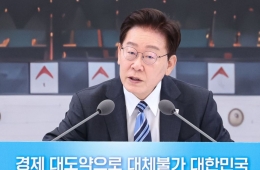
The site selection was made during a public-private joint inspection meeting for the Mega Project, presided over by President Lee on the same day. Major companies, including Samsung Electronics and SK hynix, as well as relevant government ministries, attended the meeting. Afterward, Kang Hoonsik, Chief of Staff at the Presidential Office, briefed the press at Chunchugwan, stating, "The companies expressed the opinion that Gwangju Military Airport is the most suitable site among the candidates in the Honam region."
Concerns about real estate overheating were behind the accelerated announcement. Chief Kang explained, "There were several reports that real estate in the Gwangju area was heating up, which made it urgent to select the region first," adding, "The intent was that quickly confirming the site would prevent unnecessary controversy from spreading further."
Samsung Also Considered Gwangju Military Airport as a Prime Site

Within the semiconductor industry, Gwangju Military Airport has long been discussed as a promising site. An industry insider said, "Samsung Electronics has been reviewing Gwangju Military Airport as a candidate for its next semiconductor plant for the past five years," adding, "However, discussions could not progress due to delays in the airport relocation issue." A key Blue House official also stated, "When we explained the Gwangju Military Airport site to the companies, the response was essentially, 'We know it even better than you do,' indicating that corporations have been examining this site for a long time."
The situation changed after the Lee Jaemyung administration took office. The Blue House recently focused its review on candidate sites in the Gwangju and Jeonnam areas for three to four months. While locations such as the Advanced Industrial District, Solaseado, and Saemangeum were considered, the government concluded that there were few sites where both Samsung and SK could simultaneously build large-scale fabs along with facilities for partner companies and research institutes. A government official commented, "Ultimately, we had to find a realistic site that could actually accommodate corporate investment demand."
Gwangju Military Airport most closely met these conditions. Including the airfield and surrounding idle land, it is possible to create a large-scale industrial complex, and extensive leveling work has already been completed, which can shorten construction periods. Accessibility advantages include KTX Gwangju Songjeong Station, the Honam Expressway, as well as the Yeongsan River water supply and Jeonnam region’s renewable energy infrastructure.
Talent and the industrial ecosystem were also considered. Gwangju is home to the National AI Data Center and Gwangju Institute of Science and Technology (GIST), and it is adjacent to sources of talent such as Chonnam National University and Korea Institute of Energy Technology. The cluster plan goes beyond plant construction, aiming to integrate R&D, materials/components/equipment partners, and workforce development.
President Lee Inspects the Site by Helicopter for 1 Hour 30 Minutes... Challenges Remain for Military Airport Relocation

Min Hyungbae, Mayor of Gwangju-Jeonnam Unified Metropolitan City, is inspecting the Air Force ammunition depot site near Gwangju military airport on the 7th. The government selected the Gwangju military airport as the site for the Honam region semiconductor cluster. Yonhap News Agency.
View original imagePresident Lee personally inspected the site. On June 30, immediately after the National Briefing on Vision and Advancement of Southwest Advanced Industries, he toured the candidate sites by helicopter for 1 hour and 30 minutes, asking about each aspect: transportation networks, airport relocation, and the feasibility of establishing an industrial complex, and reportedly also visited Muan Airport.
The biggest remaining challenge is the relocation of the military airport. To utilize Gwangju Military Airport as a semiconductor industrial complex, the timing and location of the military function’s relocation must be determined, and the process of obtaining consent from residents of Muan County, the preliminary relocation candidate site, must be expedited. Chief Kang stated, "The premise is to move it early, as long as it does not create any security gaps." The government is considering ways to speed up the process by simultaneously pursuing the military airport relocation, environmental cleanup, and infrastructure development.
Electricity supply is also a crucial issue. While the Seoul metropolitan area has limits to its own power supply, the Honam region has significant potential for renewable energy such as solar and offshore wind. The government is also leaving open the possibility of building new nuclear power plants to secure base load power. Choi Kiyoung, president of the Semiconductor Engineering Society, said, "While Yongin will need around 15 to 16 GW of electricity in the long term, there is expected to be a significant shortfall," adding, "Relocating semiconductor plants to the Honam region is also meaningful from an electricity supply perspective."
The Yongin and Honam clusters will be promoted simultaneously. Plans for infrastructure such as power and water supply are expected to be detailed on a monthly basis. President Lee will personally preside over joint public-private inspection meetings every month for the time being, and a new mega-project task force will coordinate between ministries.
Hot Picks Today
 "I Might End Up Paying My Entire Salary Just for Interest"... Annual Per-Person Interest Could Reach 6.73 Million Won, 'Yeongkeul-jok' Lament
- "Will I Really Be Left Out If I Don't Use It?"... The App Used by 23 Million Koreans Monthly, Is Naver Feeling the Pressure?
- Jensen Huang: "SK hynix ADR Is Incredibly Successful"
- "We Will No Longer Teach English"...Chinese University Launches Bold AI-Era Experiment
- "Die from Heat or Starve": Amid Unprecedented Heatwave and Delivery Ban, Italian Riders Go on Strike
A high-ranking official from the ruling party commented, "The decision to select Gwangju Military Airport as the site was long-standing for Samsung, and it was a high-stakes move by the Blue House. Companies needed new land to handle excess memory demand, and the government needed space outside the Seoul metropolitan area for the next phase of Korea’s industrial growth." He added, "The point where these two needs intersect is Gwangju Military Airport. Now, the remaining challenge is speed."
© The Asia Business Daily. All rights reserved. Unauthorized AI training and use prohibited.