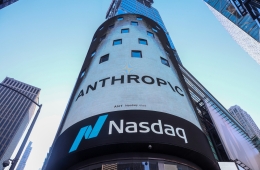
While Anthropic Is Blocked, U.S. Companies Switch to Chinese AI: "One-Twentieth the Price"
While the U.S. government has put a brake on the provision of the latest models by its own artificial intelligence (AI) companies, Chinese AI is rapidly expanding its presence. Chinese companies are absorbing demand from U.S. firms by offering affordable usage fees and openly accessible, “open” models that anyone can utilize.

On July 6, the Nikkei reported that as Anthropic suspended the provision of its advanced AI models “Mythos 5” and “Fable 5” in accordance with U.S. government directives, more U.S. companies are switching to Chinese AI. Chinese AI models are regarded as highly competitive in price, as they can be used at a much lower cost.
GLM is a model developed by Z.AI (formerly ZhifuAI), and Kimi is developed by Moonshot AI. Both models are strong in coding tasks for software development and processing work that takes a long time. The usage fee per standard token amount is reportedly only one-twentieth of that for Anthropic’s latest models.
In particular, GLM-5.2 is drawing attention for its high performance. In a test comprising about 9,000 questions measuring the practical capabilities of AI, it ranked fifth among roughly 500 models, outperforming those from Google. According to Nikkei, there are also many voices in the U.S. AI industry comparing this development to the shock that Chinese AI “DeepSeek” delivered to the world when it emerged in January last year.
Since the launch of OpenAI’s ChatGPT in 2022, the competitive landscape in AI performance has seen U.S. companies in the lead, with Chinese firms following behind. U.S. firms tend to operate “closed” models that do not disclose technical details. In contrast, Chinese AI is characterized by the prevalence of “open” models that anyone can replicate and use at a low cost.
This price competitiveness is becoming even more pronounced as AI usage fees soar. As more cases emerge of delegating complex, time-consuming tasks to AI, the number of tokens—which directly translates into cost—has surged. As a result, a significant number of U.S. companies, including Coinbase, Airbnb, and Uber, have revealed that they utilize Chinese AI internally.
Brian Armstrong, CEO of Coinbase, stated via social media last month, “We were able to cut our AI usage costs in half.” As AI usage fees soared, Coinbase shifted to increasing the use of cost-effective Chinese AI models such as “GLM” and “Kimi.”

Last month, as a result of the U.S. government’s directive, Anthropic’s Mythos 5 and Fable 5 became temporarily unavailable, further accelerating the shift toward Chinese AI. According to U.S. startup OpenRouter, at the beginning of the year, Chinese AI usage volume was less than half that of the U.S. However, since February, it began to surpass U.S. volumes multiple times. In June, Chinese AI usage surged, and during the last week of June, total usage reached 25 trillion tokens—double the amount at the end of May and 78% higher than that of U.S. AI.
In June, DeepSeek ranked first in corporate market share with 19%. While Chinese companies such as Z.AI and Xiaomi experienced significant growth, the shares of U.S. companies like Google and OpenAI declined. OpenRouter predicted, “Users are becoming more sensitive to price,” and anticipated that “Chinese AI’s advantage will continue going forward.”
Nikkei pointed out that the U.S. is growing increasingly wary of Chinese AI due to this growth. The United States and China are fiercely competing in next-generation technologies such as AI, just as they do in trade and defense. The U.S. government continues to impose export controls on Nvidia’s high-performance semiconductors to restrain China’s advanced AI development.
Additionally, suspicions of data distillation by Chinese companies have also been raised. Distillation refers to the use of output results from high-performance models in the development of other AI. While this can efficiently boost performance, many U.S. companies prohibit unauthorized distillation as misconduct.
Hot Picks Today
 "Two Spend 500,000 Won in a Flash, Yet Wait Two Hours?" ... 'Dreamland' Shunned by Kids and Foreign Tourists
- The Era of Getting 200 Million Won After 30 Years Is Over... A Japanese Bank's "Perpetual Department Head" Who Just Clocked In Cries Out
- Spain Hit by Its Worst Tragedy... Lee Kangin, Moreno and Real Madrid Join Soccer World in Mourning
- They Said, “Make It Your Home for Life” - Then Suddenly Kicked 200 Passengers Off... What Happened to the Around-the-World Cruise?
- "130 Rice Bowls Sold Out in a Day"... 'Unfiltered Face' Adds 8 Million Won to Night Market Sales: China's Bungeunwoo
In mid-June, Anthropic sent a letter to U.S. senators, demanding action and alleging that Alibaba Group of China was systematically engaging in distillation. There are concerns that if distillation becomes widespread, Chinese companies could catch up in a short period, even if U.S. companies continue investing massive amounts of money to develop cutting-edge AI.
© The Asia Business Daily. All rights reserved. Unauthorized AI training and use prohibited.