Gangnam Real Estate Loans Grow Beyond Pre-June 27 Plan Levels... Officetels in the Regulatory Blind Spot
Loan Dependence in Gangnam Area Purchases Rises Compared to Last Year
Last month, the proportion of funds sourced from external institutions such as financial institutions for purchasing collective buildings, such as apartments, in the Gangnam area of Seoul increased compared to a year ago. Despite the government maintaining strict lending regulations for about a year since the “June 27 Household Debt Management Plan” (the 6·27 Plan) announced in June 2025, reliance on borrowing to purchase real estate in this region has actually grown. During the same period, the loan ratio in other districts of Seoul decreased. Home prices in Gangnam remain relatively higher than in other regions. Considering the ongoing strength of lending restrictions, this is an unusual trend.
According to an analysis by The Asia Business Daily of court real estate registration data on July 7, the average maximum secured debt ratio for collective building ownership transfers in Gangnam-gu, Seoul last month stood at 44.31%. This figure is up by about 4 percentage points from 40.45% in June 2025. The “maximum secured debt” refers to the maximum amount to be repaid first to lenders when a property is purchased, and it is usually set at about 120–130% of the actual loan amount.

This means that, despite regulations such as caps on mortgage loans, the share of loans in the purchase price of homes has increased. For example, if a person buys a home worth 1 billion won and borrows 400 million won from a bank, the maximum secured debt would be set at about 480 million won. In Seocho-gu, this ratio surged from 35.98% in June last year to 43.50% last month. In contrast, Jungnang-gu saw only a slight rise from 59.28% to 59.83% during the same period, while the maximum secured debt ratio in the remaining 22 districts of Seoul all dropped compared to a year ago.
Real estate in the Gangnam area was also affected by last year’s lending restrictions. The maximum secured debt ratio in Gangnam-gu dropped from around 45% in September 2025 to the 20% range in January 2026, and in Seocho-gu, it plummeted from 49% in September 2025 to the 26% range in April 2026. Under the June 27 Plan last year, the mortgage loan limit for the Seoul metropolitan area was uniformly capped at 600 million won, and multi-home owners were completely barred from receiving loans for home purchases. In addition, the “October 15 Housing Market Stabilization Plan” (the 10·15 Plan) further reduced the loan cap to a maximum of 200 million won for homes priced above 2.5 billion won and 400 million won for homes above 1.5 billion won.
The rise in the maximum secured debt ratios for Gangnam and Seocho real estate is attributed to newly built officetels. A large number of officetels that were previously pre-sold were officially registered between May and June this year, resulting in a spike in secured loans. While officetels can be used for residential purposes after filing a move-in report, they are classified as quasi-residential properties and thus are eligible for general secured loans, not standard mortgage loans.

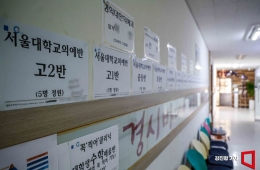
An officetel listing is posted at a real estate agency in downtown Seoul. Yonhap News
View original imageThe newly built officetel “Hillstate Samsung” in Samseong-dong, Gangnam-gu, was completed in April 2026 and began official registration in mid-May. Smaller units start at around 1.5 billion won, while larger ones reach the 4 billion won range, and loans of up to 70% loan-to-value (LTV) are possible. In just the past two months, there have been as many as 89 registrations. In Seocho-gu, “The Opera Seocho Harrington Tower,” which began occupancy around the same period in Seocho-dong, registered nearly 150 units between May and June. These officetels, with exclusive areas of 58–59 square meters, were pre-sold in 2022 for 1.3–1.5 billion won each.
Hot Picks Today
 "Why Over 100 Employees?" Samsung Electronics in Turmoil as 700,000 Won in Improper Housing Payments Uncovered: "Afraid of Losing My Job"
- "Shocking Discovery for Tuna Sashimi Lovers: 1,600 Parasites Found Crawling Inside"
- "I'm Fine Because I Don't Turn Red After Drinking"? Why You Still Can't Be Assured of Cancer Risk
- "Securing 100 Researchers by Next Year"... Samsung Electronics Invests 350 Billion Won in This Initiative
- "This Act Led to Death"... Chinese Influencer with 1 Million Followers Dies After Eating 60-70 Duck Eggs in Mukbang
Generally, when the borrowing proportion for a home purchase is in the 30–40% range, it is considered a high level of loan dependence. In the government’s recent designation of Guri, Dongtan, and Giheung as new regulated areas, one of the reasons was that the loan ratio in the financial sector exceeded 30%, indicating excessive reliance on borrowing.

Park Won-gap, Chief Real Estate Specialist at KB Kookmin Bank, said, “Due to the extremely strict loan restrictions on apartment purchases in regulated areas, demand has shifted to officetels, which offer relatively easier access to funds, resulting in a spillover effect. Since officetel investment for rental income is now less attractive than before, most of the current demand appears to be for actual residential use.”
© The Asia Business Daily. All rights reserved. Unauthorized AI training and use prohibited.