Kang Hoon-sik: "Additional Semiconductor Tax Revenue Must Not Be Wasted... Pushing for Establishment of 'Future Response Fund'"
Utilizing Funds for Three Mega-Projects and Support for Youth Housing, Startups, and Jobs
"Active Support for Corporate Demands to Boost Regional Growth in Semiconductors, Bio, and More"
Kang Hoon-sik, Secretary to the President, announced on the 25th that the government will seek to establish a "Future Response Fund" to utilize additional tax revenue generated from the semiconductor boom as an investment resource for future generations. The plan is to focus this extra revenue on supporting three major mega-projects, fostering future growth engines, responding to K-shaped polarization, and providing housing, startup, and employment support for young people in 2030.

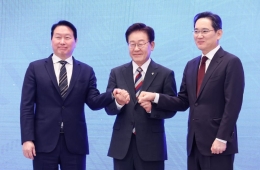
Prime Minister Han Seong-sook is taking a commemorative photo with attendees including Han Byung-do, Acting Leader and Floor Leader of the Democratic Party of Korea, and Kang Hoon-sik, Secretary to the President, at the Senior Party-Government Council held at the Prime Minister's Official Residence in Samcheong-dong, Jongno-gu, Seoul on July 5, 2026. Photo by Yonhap News Agency
View original imageIn his opening remarks at the 9th Senior Party-Government Council held at the Prime Minister's Official Residence in Seoul that afternoon, Secretary Kang stated, "At this critical juncture that will determine the future of the Republic of Korea, we must not squander the additional tax revenue generated from the semiconductor boom and other sources. The Lee Jae-myung administration intends to establish a Future Response Fund to use this extra revenue as an investment resource for future generations."
Kim added, "We want to boldly invest in the future of the Republic of Korea by creating a fund with additional tax revenue to support the three major mega-projects, foster future growth capabilities, address K-shaped polarization, and provide housing, startup, and job support for young people in 2030. The establishment of the Future Response Fund will serve as the foundation for building an irreplaceable Republic of Korea," requesting close cooperation between the party and government. This indicates an intention to allocate the additional tax revenue to mid- to long-term goals such as strengthening the competitiveness of the AI and semiconductor industries, supporting the younger generation, and easing polarization, rather than exhausting it through short-term fiscal spending.
Secretary Kang once again emphasized that the three mega-projects are the core agenda for the second year of the administration. He remarked, "If the first year was a time of normalizing abnormalities and laying the groundwork for national growth, then the second year is the time to rapidly realize an ‘irreplaceable Republic of Korea’ and deliver tangible results for the public."
He continued, "The three mega-projects we are discussing today will mark the historical starting point." Kang stated, "With the world fiercely competing in the AI revolution, this project is about designing new growth capabilities that will determine the future of Korea for the next 20 to 30 years."
The three mega-projects are the Lee Jae-myung administration's future industry strategy, centered on semiconductors, AI data centers, and physical AI. Secretary Kang described them as "a starting signal for shifting the paradigm of balanced national development through a public-private partnership." He added, "Just as the United States has Silicon Valley and the Texas Belt, we must create an AI semiconductor innovation ecosystem tailored to the industrial base and potential of each region, beyond the limits of the metropolitan area. That is how we will survive the global AI semiconductor competition and ultimately lead the world."
Kang also stressed the need for regional growth in advanced industries beyond semiconductors. He stated, "The government will actively accommodate the needs of businesses and provide full support to ensure that advanced industries such as bio and aerospace can make new leaps forward in regional areas." He went on, "If local governments devise development plans suited to the characteristics of their regions, the central government will actively respond, and we will ensure that region-led growth is realized."
He also presented cooperation between the party, government, and presidential office as a task for managing state affairs and legislative strategy in the second half of the year. Kang said, "Since policies are completed through legislation, I ask for the party’s active cooperation so that key reform and livelihood bills can be passed in a timely manner."
Hot Picks Today
 "All the Latecomers to Join In"... SK hynix to List on Nasdaq on July 10
- "I Have to Collect Scrap Metal Just to Afford a Snack"... Residents Struggling to Survive Amid Ruins with 2,900 Dead
- "Sharing Secrets Only with Mom"... In a Country Where the Average Male Height Is 170cm, Smaller Homes and Relationships Are Preferred
- Monthly Salary of 6.55 Million Won Attracts Young Koreans, But Half of Seafarers Are Still Foreign Nationals
- "Let's Meet Again in the Next Life" Malaysian Man Marries Embracing Late Fiancée's Life-Size Standee
Kang noted that this was the first Senior Party-Government Council meeting since Prime Minister Han Seong-sook took office, saying, "With her wealth of experience spanning both the private and public sectors and her outstanding capabilities, I expect her to guide the overall direction of state affairs with stability and bring about changes to the lives of the people." He also expressed appreciation to Han Byung-do, Acting Party Leader, who is leading the party during the current vacancy, saying, "He has become a reliable partner in running state affairs."
© The Asia Business Daily. All rights reserved. Unauthorized AI training and use prohibited.