Kim Yongbeom Emphasizes Immigration Policy: "Attracting Top Researchers Is Also Part of the AI Production Revolution"
Kim Yongbeom, Policy Chief, Delivers Facebook Message on the 5th
Emphasizes Investing Surplus AI Profits in the Next Generation
"Good Distribution Enables Even Greater Production"
Policy chief Kim Yongbeom stated on the 5th, "AI is not merely a technological revolution but a revolution in production," arguing for the need to secure a diverse range of human resources through immigration. He also emphasized the importance of a welfare system that reinvests surplus profits into the next generation.
On this day, Kim published a post titled "AI Production Revolution Theory" on his Facebook account, stating, "The production revolution goes beyond industrial structure, reshaping the balance of the macroeconomy and ultimately redefining the nature of the nation."

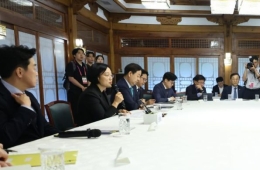
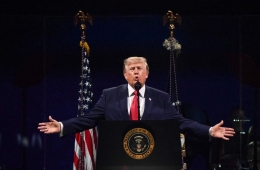
Kim Yongbum, policy chief of the Office of the President, is delivering the opening remarks at the Kwanhoon Forum held at the Press Center in Jung-gu, Seoul, on June 24, 2026. Photo by Yonhap News
View original imageKim explained, "The essence of the AI production revolution is not simply about slightly increasing output," adding, "It is about compressing the very time required for production." He further elaborated that as AI is deployed across various industries—such as research and development, design, and pharmaceuticals—the cost of failure decreases and capital begins to circulate more rapidly.
Kim also stressed, "Competitiveness in the AI era is not determined by the performance of a single model," emphasizing the need for semiconductors, manufacturing plants, electricity, water, and manufacturing capabilities. He stated, "The likely winners in the AI era are countries with production systems," and added, "As AI becomes more integrated into the real world, the center of competitiveness shifts from software to production capacity."
He continued, "The most important question going forward is not who designs the best AI. Rather, it is who can produce and operate AI at the greatest scale, with the highest stability, and for the longest duration." Kim added, "Competition is no longer just between companies but has become a race between nations. A nation is a production platform that builds power grids, develops industrial sites, and organizes supply chains."
Kim mentioned the importance of immigration policy for reproducing the AI production revolution. He said, "A new mode of production requires new people," analyzing that "attracting top researchers and engineers, as well as securing diverse human resources to maintain society, is also part of the production revolution."
He also discussed the importance of distribution policy. Kim pointed out, "A nation is not complete through production alone," and "AI increases productivity, but the market does not automatically share its fruits." He continued, "Thus, welfare is not a system opposed to production," emphasizing that "it is an investment that connects surplus profits generated by the production revolution to the next generation's production capacity and social trust."
He concluded, "Production and distribution are not in opposition. Production is the precondition for distribution, and good distribution, in turn, enables even greater production."
Hot Picks Today
 "With Better Taste, It Took the Top Spot... The Drink That Surpassed Banana Milk, the Convenience Store Powerhouse"
- "Sharing Secrets Only with Mom"... In a Country Where the Average Male Height Is 170cm, Smaller Homes and Relationships Are Preferred
- Monthly Salary of 6.55 Million Won Attracts Young Koreans, But Half of Seafarers Are Still Foreign Nationals
- "Baek Jong-won's 'First Developer of Daeppaesamgyeopsal' Claim Disputed... Court Rules 'Popular Since the 1980s'"
- "Koreans Just Won't Budge": Even with Kim Kardashian and Moon Gayoung, This Luxury Brand Has Never Turned a Profit [Luxury World]
Additionally, Kim stressed the role of the state in building production infrastructure, saying, "Data centers cannot exist without electricity, semiconductors cannot be produced without water, and physical AI cannot function in the real world without manufacturing, logistics, and urban infrastructure."
© The Asia Business Daily. All rights reserved. Unauthorized AI training and use prohibited.