SKT to Build 15GW AI Data Centers: "Aiming to Become Asia's AI Infrastructure Hub"
Expansion of Ulsan AIDC to Gigawatt Scale
5GW to Open in Phases from 2029, Targeting 15GW Expansion

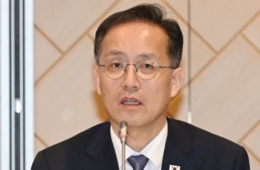
Jaeheon Jung, CEO of SK Telecom, is announcing investment plans at the National Report Meeting on the Development Vision of Advanced Industries in the Yeongnam Region, hosted by President Jae Myung Lee, in Jinju, Gyeongnam, on July 3, 2026. Photo by Cheongwadae News Photo Reporters Group, Yonhap News Agency
View original imageSK Telecom is embarking on the construction of AI data centers with a capacity of up to 15GW, aiming to become the "Asia AI Infrastructure Hub."
On July 5, SK Telecom announced that it plans to comprehensively review and establish key infrastructure elements—such as power supply, site selection, and operational systems—for its AI data centers (AIDC), connecting the government's "AI Top 3" strategy with balanced regional development initiatives. The company is moving forward with the proactive establishment of domestic AI computing infrastructure, in response to the recent surge in demand for AI model training and inference, as well as the growing importance of high-performance computing infrastructure for national competitiveness.
Due to the need for high-performance AI computing infrastructure and rising memory prices, the construction of a typical 1GW-class AI data center involves a massive project cost of approximately 70 trillion won. SK Telecom plans to finance these costs not only through its own investments, but also by securing strategic partner investments, long-term contracts with customers, and project financing.
Jaeheon Jung, CEO of SK Telecom, stated, "The construction of this AI data center is a proactive measure to prepare the computing infrastructure required for the global AI ecosystem," adding, "We will work closely with the government, industry, and local communities to help Korea grow into Asia's core AI infrastructure hub."
The reason SK Telecom is taking a leading role in building AIDC is the global supply shortage. According to global consulting firm McKinsey & Company, annual global data center demand is growing by 19–22%, but supply is lagging behind, with a projected shortfall of about 15GW in the United States alone by 2030. Furthermore, Amazon's announcement of a large-scale capital expenditure (CAPEX) plan worth about 200 billion US dollars this year is also seen as an effort to ramp up AI resource supply as quickly as possible.
Global big tech companies, which previously focused data center investments in the United States, are now expanding them worldwide, and Korea is drawing attention as an AIDC investment destination for global big tech firms. Korea has a high level of competitiveness in core AI component sectors, such as high-bandwidth memory (HBM). Additionally, Korea offers stable electricity supply conditions based on nuclear power and liquefied natural gas (LNG), as well as gigawatt-level infrastructure operation capabilities accumulated through semiconductor fabrication (Fab) operations, making it a highly attractive location for AIDC.
2GW Cluster in the Yeongnam Region... Additional 1GW to Be Built in the Southwest
SK Telecom will first establish a cluster of over 2GW across the entire Yeongnam region, starting with its first AIDC currently under construction in Ulsan, using it as a hub to attract global big tech AI infrastructure demand to Korea. Including the additional 1GW planned for the southwest, the company aims to sequentially open AIDCs totaling 5GW domestically starting in 2029.
To minimize initial investment burden and business risks, SK Telecom plans to expand in line with demand and investment conditions so that 15GW of AIDC can be sequentially developed by 2035.
The core elements of AI data center infrastructure are semiconductors, energy solutions, and the construction and operation competencies of data centers. This AI data center construction project will involve all SK Group affiliates, mobilizing the group’s full-stack AI infrastructure capabilities. Previously, SK Telecom has actively promoted its AI data center business and has maintained ongoing collaborations with global big tech companies such as NVIDIA and Amazon Web Services (AWS).
Currently in Ulsan, SK Telecom is building a hyperscale AIDC with AWS, targeting operation in the second half of next year. In particular, this facility is being equipped with specialized cooling and power systems tailored to the high technical standards demanded by AWS, a leading global cloud company.
At the "SK AI Summit 2025" held in November last year, Jaeheon Jung, CEO of SK Telecom, unveiled the AI infrastructure development roadmap and declared his commitment to leading the evolution of AI infrastructure as Korea's national AI champion. He also outlined a vision to expand the Ulsan AIDC to a total capacity exceeding 1GW, while aiming to broaden collaborations with global big tech companies over the long term.
Hot Picks Today
 "I Don't Want to Marry a Salaried Man"... Women Flock to 'This Place' to Find Husbands Amid the AI Boom
- "I thought getting into a big company was the goal"... The 'position' only 1 in 121 employees reaches
- "Jealous of Koreans" - Now a Must-Do on Every Trip... The Place Where Foreigners Spent KRW 229.8 Billion
- "'No! Dad, Run!'... Father Moved by 5-Year-Old Son Who Shielded Him from Ghost at Korean Folk Village"
- "Please Let Me Go Home"... Customers Trapped in Department Store Parking Lot for 5 Hours Vent Their Anger
Recently, SK Telecom jointly announced plans with NVIDIA to operate a next-generation AIDC called the "AI Factory." SK Telecom will begin operating the AI Factory next year and plans to expand it to the gigawatt level in the future. SK Telecom views the AIDC as Korea’s third major innovation infrastructure, following the Gyeongbu Expressway (1968) and high-speed internet (1998), and intends to take a leading role in its development.
© The Asia Business Daily. All rights reserved. Unauthorized AI training and use prohibited.


!["Please, Just Take Them Off" - They Made It All the Way to Bed... Then Fecal Bacteria Struck [Deep Scroll]](https://cwcontent.asiae.co.kr/asiaresize/307/2026101610053063338_1792112730.png)