[Weekend Game] Wemade and Kakao Games Under New Ownership... Growth Strategies Put to the Test
Wemade Focuses on Chinese Market and 'Mir' IP
Kakao Games Aims to Boost Share Price with New Releases
There is growing interest in how Wemade and Kakao Games, now under foreign ownership, will operate in the future, as well as their strategies for new title development and performance. The industry is closely watching to see what direction Wemade, which has moved beyond the image of a pure gaming company to expand into blockchain, and Kakao Games, which has grown primarily through publishing, will take under their new structures.

Wemade: Potential to Settle with 'Mir' IP Revenue and Focus on China
According to the gaming industry on July 4, Park Kwanho, founder and chairman of Wemade’s board, recently signed a share purchase agreement (SPA) to sell his entire stake—13,350,738 shares, representing 39.33% ownership—to the investment platform Neopulse. The deal is valued at approximately 920 billion won.
Neopulse is wholly owned by Shensong Investment, which has close ties to Alibaba in China. This means that after 26 years, the largest shareholder of Wemade, one of Korea's first-generation gaming companies, will become Chinese capital.
The industry was greatly shocked, especially by the sale price, which surprised the market. The per-share sale price was set at 68,910 won, about 3.6 times the market price on the day of the disclosure, reflecting a significant premium. This valuation is believed to consider the long-term success of Wemade’s intellectual property (IP) "The Legend of Mir," which has been distributed in China under the name "Hot-Blooded Legend," as well as the potential for new game development incorporating artificial intelligence (AI).
Given the high valuation, there are expectations that the new management will actively pursue global new title development, but concerns remain, drawing on the precedent of Actoz Soft. In 2004, Actoz Soft, after being sold to China's Shanda Games (now Shengqu Games), shifted its focus from developing new titles in-house to managing existing IP licenses, engaging in lawsuits, and acting as a publishing agent for China. There is speculation that Neopulse, too, may prioritize the value of "Mir" IP’s revenue generation in China, which could limit Wemade’s growth trajectory. Moreover, since the Chinese government prohibits virtual asset trading and mining, the blockchain and play-to-earn (P2E) businesses that Wemade has been cultivating may also be significantly reduced.
An industry insider commented, "While the 'Mir' IP has been a huge hit in China, its recognition in North America and Europe is relatively lower, which is why there are various possibilities being discussed. Still, it would be unfortunate if Wemade, which has in-house development capabilities, were to operate only in the Chinese market." The insider added, "For now, stabilizing the organization, which may have been unsettled by these changes, will likely be the first priority."

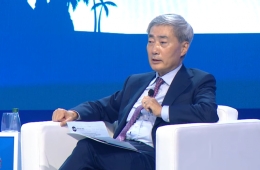
Siwoo Lee (left) and Taehwan Kim, co-CEOs of Kakao Games. Provided by Kakao Games
View original imageKakao Games Accelerates Structural Improvement to Secure Proprietary IP
Kakao Games, which welcomed Japanese capital as its largest shareholder ahead of Wemade, quickly reorganized its structure under the co-CEO leadership of Taehwan Kim and Siwoo Lee. The company is transitioning from a publishing-centric focus to placing greater emphasis on developing its own IP.
Kakao Games’ largest shareholder changed on June 19 from Kakao to LAAA Investment Limited Company. LAAA Investment is a special purpose company (SPC) funded by LY Corporation (Line Yahoo), and it secured a 33.43% stake in Kakao Games through a third-party allotment paid-in capital increase and the execution of a share purchase agreement. Under the new LY Corporation structure, Kakao Games immediately appointed new leadership and is now focused on building a new lineup of titles targeting the global market. The company plans to use the 300 billion won secured through the change in major shareholders to enhance financial stability and strengthen strategic investments for mid- to long-term growth.
In particular, with private equity funds participating as financial investors (FI), there is pressure to raise the share value quickly to facilitate investment recovery within the maturity period. Kakao Games’ stock price is currently below 8,000 won, and its market capitalization has nearly halved in the past year. Therefore, the success of new titles such as "Project C" and "Odin Q" scheduled for release in the second half of the year has become even more crucial.
Hot Picks Today
 "I Ate It Often Because It Tasted Good"... This Eating Habit Linked to 40% Higher Odds of Asymptomatic Cerebrovascular Damage
- “Dad Just Gave It to Us as a Gift”... Scratched a Lottery Ticket at a Family Gathering and Hit a 1 Billion Won Jackpot
- Anthropic Used 21 Books by Korean Authors, Including Han Kang and Kim Youngha, for Unauthorized AI Training
- Woman in Her 70s Assaults Sister in Her 80s: “She Had an Affair with My Husband”
- "We've gone this far to save on lunch"... Where office workers are flocking instead of restaurants
There is also speculation about a possible merger with Line Games. This possibility is gaining traction since Kim, who served as Executive Vice President in charge of business at Line Games in 2023, has now taken office as co-CEO of Kakao Games. However, since Line Games has suffered a series of unsuccessful releases and has fallen into complete capital impairment, a merger would make it difficult to generate synergy. Shin Kwonho, the new Chief Financial Officer (CFO) of Kakao Games, responded in a Q&A session after the shareholders' meeting last month, "There are no decisions made regarding a merger, but just as Kakao Games collaborated with SM Entertainment to create 'Sseumminis,' there will be business cooperation in certain areas."
© The Asia Business Daily. All rights reserved. Unauthorized AI training and use prohibited.

!["Please, Just Take Them Off" - They Made It All the Way to Bed... Then Fecal Bacteria Struck [Deep Scroll]](https://cwcontent.asiae.co.kr/asiaresize/307/2026101610053063338_1792112730.png)