"Found the Culprit Behind Wild Swings"... The Truth Behind 'Delta' Shaking the Stock Market [Weekend Money]
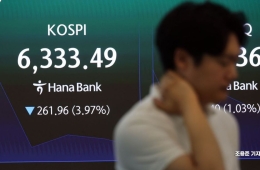
Single-stock leveraged exchange-traded funds (ETFs) are being identified as a primary driver behind the rising volatility in the Korean stock market.

On May 27, 16 single-stock leveraged ETFs were simultaneously listed. During the first month after listing, these 16 leveraged ETFs traded approximately 10 trillion won daily on average, increasing index volatility. Getty Images
View original imageAccording to Shinhan Investment Corp., when annualized for 2026, asset volatility for the KOSPI was 57%. For SK hynix and Samsung Electronics, volatility reached 90% and 78%, respectively, while the single-stock leveraged ETFs for these names recorded double that volatility at 180% and 156%.
Woo-Yeol Park, a researcher at Shinhan Investment Corp., stated, "Volatility exceeding 80% was previously observed only in ultra-high-volatility thematic stocks, such as quantum computing or alternative meat."
!["Found the Culprit Behind Wild Swings"... The Truth Behind 'Delta' Shaking the Stock Market [Weekend Money]](http://www.asiae.co.kr/news/img_view.htm?img=2026070217183932521_1782980319.png)
On May 27th, 16 single-stock leveraged ETFs were simultaneously listed. During the first month after listing, these 16 leveraged ETFs traded an average of about 10 trillion won daily, increasing index volatility.
Researcher Park explained, "Even before the single-stock leveraged ETFs were listed, the KOSPI200 Volatility Index (VKOSPI) had already entered a phase of persistent high volatility, averaging 53. However, over the past month since May 27th, VKOSPI surpassed 81. During the 2008 financial crisis, the VKOSPI peaked at 89.3, but on the 9th of last month, it hit a new record high at 91.2. Currently, it remains in a sustained high-volatility phase, averaging 88.9 per day."
Given the high weighting of Samsung Electronics and SK hynix in the KOSPI, the index impact of single-stock leveraged products is greater in Korea than overseas. Park analyzed, "Although hundreds of leveraged products are traded in the U.S., which also has a developed single-stock leveraged ETF market, even at the time when a leveraged ETF was launched for Nvidia—the stock with the largest market cap—the index weighting was only 2–3%, and even now, it is around 8%. In contrast, the combined weighting of Samsung Electronics and SK hynix in the KOSPI is about 65% relative to the KOSPI200, and nearly half compared to the MSCI KOREA ETF. Thus, the expansion of volatility in single stocks has a proportionally greater impact on the index."
Hot Picks Today
![The Shadow of Investment Failure Devours Those Closest: From Frequent Family Conflicts to Ultimate Ruin [Rosy "Debt" Investment]①](https://cwcontent.asiae.co.kr/asiaresize/93/2026080309264567025_1785716804.jpg) The Shadow of Investment Failure Devours Those Closest: From Frequent Family Conflicts to Ultimate Ruin [Rosy "Debt" Investment]①
The Shadow of Investment Failure Devours Those Closest: From Frequent Family Conflicts to Ultimate Ruin [Rosy "Debt" Investment]①
- "Sold Early Trusting President Lee, Lost Tens of Millions... Public Outrage Grows over Temporary Easing of Capital Gains Tax Surcharge"
- "Egg Prices Will Continue to Rise Until Next Lunar New Year" — The Onslaught of 10,000-Won "Golden Eggs" [Egg Supply Turmoil] ①
- "Burry From 'The Big Short' Warns of Possible Repeat of 1987 Crash Even as S&P 500 Hits Record High"
- "It's Haeundae, So What?" "But Not at the Supermarket" -- The Intensifying 'Bikini Debate'

The expansion of leveraged ETFs creates market concentration through the 'delta hedging' process of market makers (MM). Getty Images
View original imageThe pathway through which the expansion of leveraged ETFs creates market concentration occurs during the 'delta hedging' process by market makers (MMs). When stock prices rise and market makers sell swap contracts for market making, they purchase the underlying stock to build a neutral position, leading to more buying as prices increase; the reverse also holds true. Park explained, "When put option open interest accumulates consecutively at specific strike price levels, if the first strike price is breached and downward pressure arises, it can trigger breaches of subsequent levels in succession. This is called a 'gamma squeeze,' and it is more likely to occur when gamma exposure (GEX) is negative. The delta value needed to maintain a neutral position changes dynamically with the underlying asset price, and as this is adjusted in real time, market concentration can result."
© The Asia Business Daily. All rights reserved. Unauthorized AI training and use prohibited.