Discovered Urban Wind Corridors to Counter Heatwaves... Korea University Improves Wind Speed Prediction Accuracy [Reading Science]
More Precise Analysis of Airflow in Urban Building Forests
Prediction Error in High-Density Urban Areas Reduced by 18.7%
A technology capable of more accurately predicting "urban wind corridors," which are key to reducing heatwaves, urban heat island effects, and fine dust, has been developed by a South Korean research team. By incorporating actual meteorological observation data from downtown Seoul, the team improved the urban climate model, successfully reducing wind speed prediction errors in densely built-up areas by nearly 20%.
Korea University announced on July 2 that the research team led by Professor Hyun Sook Heo from the Department of Architecture, Urban and Environmental Engineering developed a new calibration technique to enhance wind speed prediction accuracy in urban climate models using real urban meteorological observation data from across Seoul. The results were published in the July issue of the international journal "Sustainable Cities and Society," which covers urban and environmental topics.

As a result of calibrating the urban climate model based on 72 urban weather observation networks across Seoul, it reflects the complex environmental conditions of the actual city while securing a higher level of prediction accuracy compared to existing urban wind speed prediction studies. The potential for use in wind corridor analysis in high-density urban areas and climate-adaptive urban design has been confirmed. Provided by the research team
View original imageHeatwaves, urban heat island effects, and fine dust are closely related to airflow within city centers. Areas where wind does not flow well tend to trap heat and pollutants, resulting in higher perceived temperatures and deteriorated air quality. On the other hand, when wind corridors are secured, heat is rapidly dissipated and stagnation of fine dust is reduced, thereby improving the urban environment.
However, in reality, cities feature high-rise buildings, narrow roads, complex building layouts, green spaces, and diverse terrains, making it difficult to accurately predict wind flow. Existing urban climate models have also been limited by their inability to sufficiently reflect this complexity, resulting in significant prediction errors.
Understanding Wind Corridors Is Key to Tackling Heatwaves
The research team calibrated the VCWG (Vertical City Weather Generator), a multi-layer urban climate model, using actual meteorological observation data from Seoul. They analyzed wind speed data from 72 weather stations across the city, including the SK Telecom Urban Weather Observation Network and Seoul's Urban Data Sensor (S-DoT), while also factoring in surrounding building heights, building coverage ratios, frontal area indices, green space distribution, and anthropogenic heat sources such as air conditioner outdoor units, vehicles, and heating systems.
In particular, a key feature of this study is that the team went beyond simply adjusting input values and also calibrated the core equations that calculate urban airflow based on observed data.
As a result, the wind speed prediction error across all observation stations decreased from 86.07% in the original model to 80.15% after input value calibration, and further down to 77.18% after calibrating both input values and equations. In the urban canopy layer—where citizens actually live—the prediction error was reduced by 10.68%, and in densely built-up high-density urban areas, it was reduced by 18.70%.

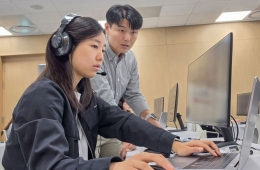
Research team photo. (From left) Yeonsook Heo, Professor in the Department of Architecture, Civil and Environmental Engineering at Korea University (corresponding author), Setianto Gigi Rahmandani, doctoral candidate (first author). Courtesy of Korea University
View original imageThe research team explained that, given the highly variable nature of urban wind, where prediction errors in conventional urban climate models typically range from 80% to 100%, this represents a meaningful improvement.
This study also boasts higher applicability than previous overseas research, as it reflects actual urban environments using 72 observation networks throughout Seoul. It is expected to be used in future urban planning, architectural design, park development, wind corridor policies, as well as in establishing measures to cope with heatwaves and reduce fine dust.
Hot Picks Today
![Selling Like Crazy Every Year... 30-Year-Old Hetbahn Takes on a New Challenge: Tastes Better Than "Mom's Home Cooking" [On-Site Report]](https://cwcontent.asiae.co.kr/asiaresize/93/2026102216175071025_1792653470.jpg) Selling Like Crazy Every Year... 30-Year-Old Hetbahn Takes on a New Challenge: Tastes Better Than "Mom's Home Cooking" [On-Site Report]
Selling Like Crazy Every Year... 30-Year-Old Hetbahn Takes on a New Challenge: Tastes Better Than "Mom's Home Cooking" [On-Site Report]
- "Please Pay Me at Least 3 Million Won a Month": More Than Half of Young People Today Prioritize "Working Conditions" Over Company Size
- A 12-Year-Old Girl Went to the Hospital After Her Blood Pressure Hit 225 and Was Stunned: "What Is This Coral Reef-Like Thing in Her Aorta?"
- "Hey, Lady, Teach Your Kids to Behave!" ... 300,000 Won in Cash and a Bodily Injury Claim Demanded Over Child's Door Ding
- Beachgoer Finds 'Plastic' That Turns Out to Be Perfume Ingredient Worth More Than Twice as Much as Gold
Professor Hyun Sook Heo stated, "The significance of this research lies in not only adjusting the input values of the urban climate model, but also improving the method of calculating urban airflow itself using actual observation data. It can serve as a scientific foundation for designing cities that are cooler and healthier in the era of the climate crisis."
© The Asia Business Daily. All rights reserved. Unauthorized AI training and use prohibited.