KT’s Quantum Cryptography Technology Spanning Public and Private Sectors: “Building a Domestic Ecosystem”
KT Unveils Equipment and Technology Status at 'Quantum Korea'
"Quantum Technology Is a Strategic Technology... Domestic Technology Transfer"
"Considering Business Expansion into Quantum Sensing and Computing"
KT is simultaneously pursuing the development and commercialization of quantum cryptography communication technology in line with national policies and security frameworks. In this process, the company has achieved localization of equipment and is building an ecosystem through the transfer of domestic technology. At "Quantum Korea 2026," held for three days from July 2 at Dongdaemun Design Plaza (DDP) in Jung-gu, Seoul, visitors can experience KT's cutting-edge quantum cryptography communication technology.

Quantum technology researcher Jeong-Hwan Shin from KT is presenting at the quantum cryptography technology media study held on the 1st in the Gwanghwamun area of Seoul. Photo by Kyungjo Noh
View original imageAt a media study session held in the Gwanghwamun area of Seoul the previous day, KT announced that it has independently secured and demonstrated its "Quantum Safe Network" technology, which combines Quantum Key Distribution (QKD) and Post-Quantum Cryptography (PQC). The architecture applies QKD to the network transmission section to protect cryptographic key delivery, while PQC is applied to the access and service sections to strengthen the security of the encryption itself.
Through this integrated structure, KT has built an end-to-end (E2E) quantum security system that secures the entire network and maintains compatibility with existing communication networks. Compatibility between heterogeneous equipment has also been verified. At last year's Quantum Korea event, KT introduced a demonstration case of the Seoul-Busan quantum cryptography communication network built in partnership with Toshiba Japan. This network, covering approximately 490 km—setting the record for the longest such segment in Korea—drew attention for connecting equipment from different manufacturers.
KT emphasized that it has localized quantum cryptography communication equipment. According to KT, it currently holds 28 key patents related to quantum cryptography communication. To enable production based on its proprietary technology, the company has completed 12 technology transfers to eight companies to date. Shin Jung-hwan, Quantum Technology Researcher at KT, explained, "We consider quantum technology a strategic technology and have transferred technology only domestically," adding, "We do not intend to incorporate Chinese cryptography equipment into the backbone network, so we aimed to develop everything with domestic technology."

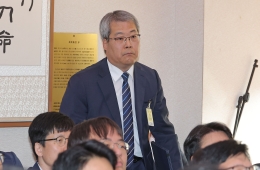
Jin-Kyun Cho, Team Leader of KT Dedicated Line Service Team, is presenting at the Quantum Cryptography Technology Press Study held on the 1st in the Gwanghwamun area of Seoul. Photo by Gyoengjo Noh
View original imageThe scope of business spans both public and private sectors, including defense and finance. KT reported that it has accumulated service experience through projects such as winning public business based on the national research network, upgrading the judiciary's communication network, and conducting quantum cryptography pilot projects. The company has also confirmed the applicability of quantum cryptography communication in a wide range of environments—including closed-circuit (CC) TV, drones, autonomous vehicles, robots, telemedicine, blockchain, and artificial intelligence (AI) medical data protection.
Specifically, in 2023, KT carried out a project to establish a quantum cryptography system for Air Force operational vehicles. In 2024, the company participated in the construction of an open quantum testbed, taking charge of the development and operation of an integrated control platform necessary for operating long- and short-distance quantum communication networks and PQC network testbeds. Recently, KT developed technology to transmit quantum cryptography even in wireless environments. Last year, the company verified normal operation over a distance of about 4.8 km in a real-world environment near the Daejeon Daedeok 2 Research Center and is currently developing technology to extend the operational range to over 10 km.
This year, through the PQC pilot transition project, KT is applying a PQC-based security system to key defense sector systems. Jin-Kyun Cho, Team Leader of the Dedicated Line Service Team at KT, stated, "We are advancing quantum cryptography communication from mere technology development to practical security services applicable to various industries," adding, "In the long term, we are also considering expanding our business scope to encompass all aspects of quantum technology, including quantum sensing and quantum computing."
Hot Picks Today
 "ByteDance Employee in His 20s Quits After 'Earning $30 Million from Stocks'... But Here's the Truth"
- What Makes "Chinese Air Conditioners" So Special? Europeans Pay a Premium, Begging for Just One
- "Quitting Delivery Was the Right Move" $30,000 Monthly Windfall... Young Americans Leave Jobs to Start Businesses
- "I Thought My Life Would Change After Getting Hired at SK Hynix, But After Starting Work, My Salary Was..." The Reason Behind the Disappointment
- "Japanese Tourists Once Shouted 'I Want to Go to Korea'... Now They Say 'No Thanks' — Here’s Why"
Meanwhile, at KT's booth at Quantum Korea this year, attendees can see the QKD equipment produced by domestic manufacturers through technology transfer, the demonstration of heterogeneous quantum cryptography communication connectivity between Seoul and Busan, Shinhan Bank's hybrid quantum security network, and the National Cancer Center's AI medical data encryption project.
© The Asia Business Daily. All rights reserved. Unauthorized AI training and use prohibited.