Taewon Chey: "In the AI Era, Those Who Ask Good Questions Will Surpass Those Who Simply Know the Answers"
Presenting Thinking, Adaptability, and Empathy as Unique Human Strengths
"The Future Is Not for Prediction, but for Preparation"
"In the future, it will not be those who know all the answers, but those who discover new problems and ask good questions, who will become more important."

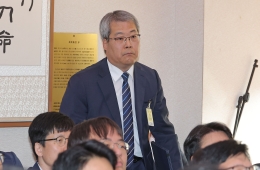
On the 22nd of last month, at the recording site of the YouTube channel "Professel" held at the Korea Foundation for Advanced Studies building in Gangnam-gu, Seoul, Taewon Choi, Chairman of SK Group and Chairman of the Korea Foundation for Advanced Studies (left), is having a conversation with scholars of the Korea Foundation for Advanced Studies. Photo by Jonghyeon Choi
View original imageTaewon Chey, Chairman of SK Group and Chairman of the Korea Foundation for Advanced Studies, emphasized that the standards for future talent are fundamentally changing with the advent of the artificial intelligence (AI) era.
On June 22, at the conference hall of the Korea Foundation for Advanced Studies in Gangnam-gu, Seoul, Chairman Chey met with scholarship students from the Injaerim and Munurim programs to discuss the changes brought by AI and the image of future talent. The purpose of this conversation was to reflect together on the abilities that future generations should possess amid rapid technological changes, as well as the unique human values that will remain unchanged even in the AI era. The discussion was released on July 1 through the YouTube channel "Professul," which is jointly operated by the Korea Foundation for Advanced Studies and the Chey Institute for Advanced Studies.
Chairman Chey stated, "In the future, it will be more important to ask the right questions than to simply know a lot," and added, "The faster AI provides knowledge, the more critical thinking required to discover new problems and suggest directions will become the core competitive edge of humans."
He cited "the production of intelligence" as the reason why the AI revolution is different from past industrial revolutions. "While past technological revolutions increased human labor and productivity, AI is a technology that supplements human intelligence and creates new forms of intelligence," he explained. "Going forward, it will not just be about using AI, but about working alongside your own AI agents."
However, he stressed, "Even if AI provides all the answers, what ultimately matters is what questions humans ask and which direction they set," and added, "More than just the ability to use technology, the insight to design and lead society will become even more important."
Chairman Chey suggested "the power to think," "the power to adapt," and "the power to empathize" as the competitive strengths of humans in the AI era. He said, "AI may be better at solving math problems, but defining which problems need to be solved is still the domain of humans," and added, "What matters is not never failing, but having the strength to rise again."
He also noted, "AI can pretend to empathize, but only humans can understand others’ difficulties and turn that understanding into action," and emphasized, "Empathy will become an even more essential competency for leaders of organizations in the future."
To the scholarship students, he advised cultivating critical thinking and empathy through diverse experiences. "Since it’s impossible to experience everything firsthand, it’s important to develop the ability to make others’ experiences your own," he said. "Asking good questions is not simply about obtaining information, but about the process of making someone else’s experience your own."
Regarding business decisions such as the acquisition of SK hynix, he explained, "No one can predict the future with certainty," and continued, "The important thing is to ask yourself why you need to do this and to prepare for multiple possibilities." He added, "In business, you should always assume the worst-case scenario and prepare accordingly," and emphasized, "The future is not about guessing correctly, but about being prepared."
Chairman Chey also introduced how the Korea Foundation for Advanced Studies' approach to nurturing talent is evolving in the AI era. "Now, the standard for talent will not be how much knowledge you possess, but how many unresolved problems of our society you can solve," he said, adding, "Through the Injaerim and Munurim programs, we are nurturing talent capable of creating new questions and solving social issues."
"Injaerim" is a program where young people from diverse backgrounds develop the ability to ask new questions and solve social problems through lectures, discussions, and projects. "Munurim" is a course that expands understanding of history and civilization through studies of East Asian classics and both domestic and overseas academic field trips, cultivating insight into the times and the ability to think from a humanities perspective.
Hot Picks Today
 "ByteDance Employee in His 20s Quits After 'Earning $30 Million from Stocks'... But Here's the Truth"
- What Makes "Chinese Air Conditioners" So Special? Europeans Pay a Premium, Begging for Just One
- "Quitting Delivery Was the Right Move" $30,000 Monthly Windfall... Young Americans Leave Jobs to Start Businesses
- "I Thought My Life Would Change After Getting Hired at SK Hynix, But After Starting Work, My Salary Was..." The Reason Behind the Disappointment
- "Japanese Tourists Once Shouted 'I Want to Go to Korea'... Now They Say 'No Thanks' — Here’s Why"
Chairman Chey concluded by saying, "Rather than following predetermined answers, I hope you will seek your own questions and values, not fear failure, and continue to challenge yourself to find your own answers."
© The Asia Business Daily. All rights reserved. Unauthorized AI training and use prohibited.