Anti-Corruption Commission Chair: "Closing Kim Keon Hee Luxury Bag Case Did Not Meet Public Expectations"
"Anti-Corruption Act Passed by Cabinet Meeting
Investigative Authority Strengthened"
Jil-Yeon Jeong, Chairman of the Anti-Corruption and Civil Rights Commission, pointed out that closing the case regarding former President Yoon Suk Yeol's spouse, Kim Keon Hee, who was accused of receiving a luxury bag, without finding a violation, was "a decision that did not meet public expectations."
At a press corps meeting held at Sejong Center for the Performing Arts in Jongno-gu, Seoul, on July 1, Chairman Jeong mentioned that Kim was recently sentenced to seven years in prison in the first trial on charges of receiving bribes under the Act on the Aggravated Punishment of Specific Crimes. He stated, "This shows that the previous decision by the Commission to close the case was wrong," adding, "Currently, Commission staff are also under investigation, and we are awaiting subsequent procedures."

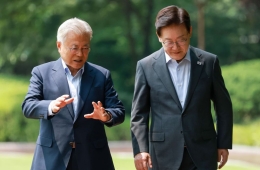
Jung Ilyeon, Chairman of the Anti-Corruption and Civil Rights Commission, is delivering a greeting at the luncheon meeting for the press corps held at Sejong Center for the Performing Arts in Jongno-gu, Seoul on the 1st. Anti-Corruption and Civil Rights Commission
View original imagePreviously, the Task Force for Normalization of the Commission concluded that there were procedural problems with the handling of Kim's luxury bag case. The Commission determined that the case could constitute a violation of the Improper Solicitation and Graft Act and requested an investigation by the National Office of Investigation at the Korean National Police Agency.
Regarding concerns that the formation of the Normalization Task Force and other measures had lowered morale within the organization, Chairman Jeong commented, "The very fact that the Normalization Task Force was established means that, although the Commission has done much work, it has reached conclusions that did not meet public expectations. While there is a saying that public officials have no soul, from now on, we will work with soul, according to principles and conscience, to restore public trust."
Hot Picks Today
 "I Want to Make Some Money Too"... Soaring Home Prices and KOSPI Ignite 'Debt Investment' Boom
- Stock Rally Creates 1,200 New Millionaires Daily... 440,000 More in the U.S. Alone
- "Baejaego Suspended for 6 Months Over 'Let's Go to Starbucks' Chant... Individual Player Review to Follow"
- "An Ideal Match for 13,700,000 Won? Turns Out She Was a 10,000 Won Part-Time Actress: Marriage Scam Shakes Shanghai"
- "Why Pay So Much for This?" 10 Billion Won Bill... Hong Myungbo’s Salary Double Bento’s, Plus Klinsmann’s Termination Fee
He also shared the current status of efforts to amend the law to address the Commission's chronic limitation of lacking investigative authority. Under current law, the Commission does not have compulsory investigative powers, making comprehensive investigations impossible without the consent of those under investigation to use their personal information. Chairman Jeong explained, "At the Cabinet meeting on June 30, the amendment to the Anti-Corruption and Civil Rights Commission Act was passed," noting, "The amendment includes two main points: imposing a fine on institutions that refuse to submit materials without a valid reason, and granting the authority (investigative power) to request statements from those reported."
© The Asia Business Daily. All rights reserved. Unauthorized AI training and use prohibited.