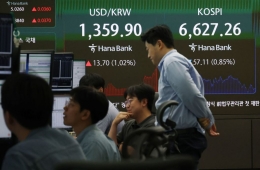
"Samsung-Hynix ETFs and SpaceX Inflows Signal It... The Stock Market Is in Full Overheat" [Economic Policy Zoom-In]
Interview with Hong Chunwook, CEO of Prism Investment Advisory
"End of National Pension Fund's Rebalancing Deferral Unlikely to Shock Market"
"Raising Domestic Stock Allocation in the National Pension Fund Breaks Principles"
"Even wit
Although there are growing concerns about an overheated stock market due to the recent sharp rise in the KOSPI Index, the number of new individual investors entering the market continues to increase, and the amount of investment is also growing.
Hong Chunwook, CEO of Prism Investment Advisory, is among those who are concerned about market overheating. He points out that even people who have stayed away from stock investing for a long time, or have never invested at all, are jumping into the market due to a sense of FOMO (Fear of Missing Out). Hong advises that, first and foremost, investors should determine whether their investment style is momentum-based or mean-reversion before taking any action.
For the millennial and Gen Z generations, he emphasized, "It is basic investment common sense that younger people should allocate a higher proportion of their assets to stocks." He added, "To ensure that the generation profiting from the current stock market boom can continue to invest in stocks in the long term, there should be tax benefits for long-term stock holding."
Bae Jaehyun, Executive Director (CIO) at Prism Investment Advisory, commented on the end of the National Pension Fund’s rebalancing deferment: "The National Pension Fund's principle is to sell over an extended period in order not to shock the market," he said. "It is extremely unlikely that tens of trillions of won worth of shares will be offloaded all at once due to mechanical selling, and the rebalancing deferment could be extended further."
Hong previously served as Chief Economist at KB Kookmin Bank and as Head of the Investment Management Team at the National Pension Fund. He is now the founder and CEO of Prism Investment Advisory. Bae, over approximately 12 years since 2013, worked in the Asset Allocation Division at the National Pension Fund, handling asset allocation work and serving in both the Investment Management Team and Investment Strategy Team.

Hong Chunwook, CEO of Prism Investment Advisory (left), and Executive Director Bae Jaehyun are being interviewed by The Asia Business Daily at their office in Gangnam-gu, Seoul. Photo by Jo Yongjun
View original imageDuring the interview, Bae mainly addressed the National Pension Fund questions, while Hong answered most of the others.
-The KOSPI Index has surged rapidly, and there is even talk of a "KOSPI 10,000." What is your view of the current situation?
▲It is a complete overheating. There are several indicators of overheating, but I focus mainly on two. First, since the end of May, leveraged ETFs that offer double exposure to individual stocks like Samsung Electronics and SK hynix have been launched. It is said that around 8 to 9 trillion won has flowed into these products. The mere fact that such massive leveraged funds are pouring into the market shows that participants are excessively optimistic. There is a one-way expectation that the market will inevitably rise. Second, the recently listed SpaceX has a PSR (price-to-sales ratio) of 100. This means its market capitalization is 100 times its sales—a truly absurd valuation—yet there is a global IPO boom. SpaceX also issued an additional $20 billion (about 30 trillion won) in corporate bonds.
-What does this signify?
▲There is a limit to the amount of money entering the market, but as the supply of new shares increases, the total amount of new stock issued in the U.S. this year exceeds $300 billion. This is a classic sign of market overheating. Whether in Korea or the U.S., the market has become so hot that warning voices are drowned out. When someone says, "The market is risky," people respond, "This time is different." They claim it's not like previous bubbles. Of course, no one can know the exact market peak, but the risk has definitely increased. If the U.S. had raised its base rate, it would have been extremely dangerous. For now, many seem to think the rate will remain on hold for the foreseeable future, even though there is a possibility of an increase.
-The recent rally is largely thanks to Samsung Electronics and SK hynix, but aren't earnings expectations already priced in?
▲They are, but the earnings outlook continues to rise. Semiconductor margins are already high, and with the won-dollar exchange rate also increasing, earnings forecasts are being revised upward. In such a trend, there is a possibility of overshooting. Many classic signs of overheating can be seen. When the market gains momentum, it absorbs all the bad news, but if, for example, this year’s earnings growth is 300% and next year’s is projected at 200%, the momentum could shift.
-Could you elaborate on the risks of double-leveraged ETFs?
▲There is what is called a "negative compounding effect." If Samsung Electronics’ stock price falls by 10%, this product will drop by 20%. If you invest 10 million won and it falls to 8 million, even if the stock price rises by 10% and the ETF increases by 20%, you only get back to 9.6 million won. Another issue is that leveraged ETFs incur annual costs of about 5%, since you have to borrow money to buy stocks. If the Bank of Korea raises the base rate in July, the implicit cost could range from 4% to as much as 6% per year. Despite this, people are flocking to these products like moths to a flame. To invest, you have to complete two hours of online training and pass a test on the Korea Financial Investment Association website. So many people have flocked to it that the server reportedly crashed. Unfortunately, what this means is that people with no prior experience investing in such high-risk products are rushing in en masse.
-Despite concerns of overheating, both the number of investors and the total invested capital seem to be increasing.
▲There are undoubtedly those who make huge profits by "averaging down" during market dips, which makes investing seem too easy. Even if only one in 10,000 people makes a big gain, they tend to boast about it on social media: "I made this much, what are you all doing?"
-I've heard people around me say, "Why aren't you buying Samsung or SK hynix? It's not too late."
▲The scariest thing in the market is not failing together, but being the only one who doesn't make money.
-Foreign investors are selling off Korean stocks as part of automatic rebalancing because their allocation to Korean equities has grown, and it seems that individual investors are buying up those stocks.
▲As of 2024, Korean individuals hold 1,300 trillion won in net assets (including real estate and deposits). By 2025, this will likely increase by about 10%, reaching around 1,500 trillion won. If just 10% of that moves into stocks, that's 150 trillion won. There is still ample buying power. It’s hard to say that buying power will become depleted and the market will end. However, the worrying sign is that many people entering the market now have never invested in stocks before—in other words, stocks are shifting from professional to amateur hands, which is not a good sign.
-Government policies such as amendments to the Commercial Act seem to have also played a role. In your view, what is the split in influence between the semiconductor supercycle and policy changes?
▲I think government policy had an impact up to KOSPI 3000, but the semiconductor supercycle has been driving the market since then. Semiconductor prices have quintupled since last summer. There are two key government policies: first, the Commercial Act amendment, and second, the inauguration of the new administration itself. From the imposition of emergency rule at the end of 2024 through impeachment and the presidential election, there was a great deal of uncertainty.
-If there is an inflection point in the KOSPI Index going forward, what could trigger it?
▲The biggest concern is a decline in semiconductor demand, though that doesn’t seem imminent. In the 2000s dot-com bubble, Cisco, which dominated network equipment, was the world’s most valuable company, but when its sales suddenly dropped by 90%, its share price fell 93%. Why did sales fall? Because demand far exceeded supply, buyers placed fake orders—ordering 500 routers when they only needed 100. As the economy worsened, orders were canceled en masse, and some telecom operators went bankrupt, leaving no one to absorb the supply.
-Are you suggesting that even big tech companies heavily invested in AI could collapse?
▲Not necessarily collapse, but some might decide to withdraw from the competition, saying, "We’re stepping back." Apple, for example, might say, "We’ll wait and buy in after the dust settles." Even though they’ve built massive data centers, if a few AI models disappear, those centers could become excess capacity, and the company that buys them at a discount could emerge as the winner. That’s how Tesla succeeded—when GM and Mitsubishi had to withdraw from U.S. factories due to the global financial crisis, Tesla bought them. It’s hard to say this couldn’t happen in the AI ecosystem.
Another possibility is the development of a workaround that consumes less memory. Nvidia has built an AI training system ecosystem that is typically configured with several HBM (high-bandwidth memory) units per Blackwell chip, but if someone finds a cheaper or more efficient alternative, sudden oversupply could result. Google’s TPU (Tensor Processing Unit) is currently underrated, but should it make a breakthrough that allows for effective training at a much lower cost compared to Nvidia, the need for massive data center investments could be questioned. Anthropic has already succeeded in training AI at much lower costs and with fewer tokens compared to OpenAI. If OpenAI were to shift from a spendthrift development approach to a more efficiency-focused strategy, the need for so many data centers would also be called into question.

Hong Chunwook, CEO of Prism Investment Advisory (left), and Executive Director Bae Jaehyun are being interviewed by The Asia Business Daily at their office in Gangnam-gu, Seoul. Photo by Jo Yongjun
View original image-There are concerns that, with the National Pension Fund’s domestic stock rebalancing deferment ending in June this year, a flood of shares will hit the market in July.
▲The National Pension Fund will not sell in a way that shocks the market. While actual selling may be necessary, I believe measures have already been taken to mitigate market impact. The policy is to sell gradually over an extended period. The chance of tens of trillions of won worth of shares hitting the market at once due to mechanical selling is extremely low. They will sell slowly, and the rebalancing deferment could be extended further.
-Isn’t the rebalancing deferment something that must be decided at a Fund Management Committee meeting?
▲The Fund Management Committee can meet as needed, so it is certainly possible. For reference, the allowable range for investment allocation is decided by the committee, but the actual monthly trading is determined by the fund management headquarters, which creates a monthly fund operation plan.
-At the end of May, the National Pension Fund raised its domestic equity allocation from 14.9% to 20.8%. Some say this was a mistake.
▲The domestic equity allocation was around 20% a decade ago and was very gradually reduced to 14.9%. Since reducing the allocation of such a large fund can affect the market, it was done slowly. However, suddenly increasing it again, despite the fund’s size, seems contradictory and a disregard for principles. The share of Korean stocks in the global stock market has rarely exceeded 2%, which is why the allocation had been steadily reduced. Now, within the fund's equity portfolio, the domestic share is reportedly over 30%.
-Still, stock investors must be happy the National Pension Fund isn’t dumping a flood of shares on the market, right?
▲Since stock prices have soared, not selling and raising the domestic allocation may seem to prevent market distortion, but changes in asset allocation should be based on long-term macroeconomic paradigm shifts and the projected timing of fund depletion—not just in response to market conditions. Only then can long-term returns be secured. It’s unfortunate that this seems to be just a way to avoid selling.
Japan’s Government Pension Investment Fund (GPIF), in line with the “Abenomics” policy of escaping deflation in 2014, completely overhauled its portfolio from ultra-safe assets (Japanese government bonds) to risk assets (stocks), sharply reducing its domestic bond allocation and increasing its domestic and overseas equity and bond holdings. In 2020, it made a second overhaul to increase overseas asset allocation further in response to deepening negative rates. Since then, it has faithfully adhered to its principles.
-If Korea is increasing its domestic stock allocation just to avoid selling amid soaring stock prices, could this cause a bigger shock in the future?
▲Market shocks are one issue, but returns are another. In 2021, the allowable range for asset allocation was expanded. In 2022, the National Pension Fund posted a negative return—the third time ever, excluding 2008 and 2018. Unless stock prices keep rising, if they start to fall, the fund will have to bear the consequences.
-The National Pension Fund’s returns are reportedly very high this year, but it doesn’t seem to be something to celebrate unconditionally.
▲That’s why it’s so important to stick to principles.
-There is a strong FOMO sentiment in the stock market. Should people jump in now? Personally, I think everyone’s style is different, so it’s best to find and stick to your own wealth management style.
▲You should always ask yourself what kind of investor you are. Looking at Korean retail investors’ funds, it’s about half and half, but in terms of numbers, momentum investors—those who follow trends—are overwhelmingly the majority. The approach is to "jump on the bandwagon." They question why you would care about expensive valuations when market momentum and earnings are strong. Their strategy is to judge only whether the market is bullish or not. If the 20-day, 60-day, 120-day, and 240-day moving averages are all in a long-term uptrend, it means the market is strong.
On the other hand, while it’s clear Korea is a momentum market, some people—mean-reversion investors—wonder why they should risk entering such a dangerous market when things could turn around sharply. In terms of fund size, these investors account for half. In fact, pension funds and global funds fall into this category. Their hallmark is contrarian investing—trading against the market’s direction, believing that’s how to make money. They sell when the market surges and buy when panic sets in. To do this, they maintain asset allocation so that if Korean stocks drop far below their target allocation, they buy at low prices. The National Pension Fund is a mean-reversion investor, but is currently acting like a momentum investor. If they are now declaring a change in investment philosophy, that’s one thing, but the fund has always been mean-reversion oriented, and now, suddenly, it is behaving like a momentum investor. Abandoning your investment principles in this way can lead to crisis and risk.
-What about from the perspective of individual investors?
▲Mean-reversion investors need to have patience, while momentum investors need to know when to exit quickly—but in Korea, it’s the opposite. Momentum investors should be able to flee when the uptrend breaks, but they hang on, averaging down and holding on. Conversely, mean-reversion investors, who buy because a stock seems cheap enough, should be willing to buy even more if prices fall further, but instead, they panic and sell at a loss. This is why it’s so hard for retail investors to succeed. It’s nearly impossible. Being a good investor is not about delivering high returns, but about being able to sleep well at night. Prism Investment Advisory is a mean-reversion investor—we sleep well at night.
-Many ordinary people don’t invest in stocks at all and only have savings, but even those people are now entering the stock market.
▲That’s when it is most dangerous. So, if you’re thinking of trying stock investing, I suggest starting as a mean-reversion investor. You may not even know your own investment temperament or whether you have an aptitude for stocks. Aptitude is psychological.
-You have to be able to withstand the psychological pressure, right? You can only make money by going against the crowd.
▲People with thick skin are the best investors. You shouldn’t be swayed by others, but is that really possible? Warren Buffett famously said, "Do you know what’s hardest in investing? Doing nothing and staying put." Even if you believe you have a good position, you’ll hear all sorts of things from people around you, like, "Warren Buffett is finished now, he doesn’t understand IT." You have to be able to say, "Yes, I don’t know much, but I believe in the market," and wait. That’s the hardest thing in the world, he said at a shareholders’ meeting. The biggest challenge in investing is waiting, so if you can’t do that, maybe direct stock investing isn’t for you.
-If you were to advise people with FOMO, dividing them into millennials & Gen Z and those in their 40s and 50s, what would you say?
▲There’s a rule of thumb that your stock allocation should be 100 minus your age. For millennials & Gen Z, I think the stock proportion should be relatively high, especially since their principal won’t be large. If you have a large amount of principal and a high stock allocation, you’ll have trouble sleeping at night. If you’ve saved 10 million won after getting a job, even if the market falls 10%, that’s only down to 9 million won. When you’re young and your future income prospects are bright, it’s right to have a high allocation to risk assets. Conversely, those in their 40s and 50s should start focusing on risk management and shift from aggressive to more neutral or defensive strategies. However, it’s not ideal to see people in this age group flocking to leveraged single-stock products. Apparently, the largest age group among the 80,000 who completed the online course was in their 50s.
-According to Mirae Asset Securities’ customer return analysis, those in their 70s and older who held stocks long-term had the highest returns, while those in their 20s and 30s who traded frequently had lower returns. Does this mean long-term holding is the answer?
▲Younger men reportedly have the highest trading turnover rates. A report by the Korea Capital Market Institute, which studied retail investors during COVID-19, found that the average holding period for men in their 20s was 9.3 days—they would sell just nine days after buying. Even in a strong bull market, they keep buying and selling, making it hard to earn returns. Moreover, Korea has a transaction tax, so trading costs are significant. People in their 70s tend to be more relaxed, wanting to pass on their assets to children and grandchildren. They also have less energy to check the market every day and more experience, so it all comes together. Among ourselves, we always say that accounts held by minors and those in their 70s have the best returns. If it’s hard to choose blue-chip stocks, just buy a KOSPI200 tracking ETF. The index is constantly refreshed with surviving stocks, so long-term investing in the index makes losing much harder.
-There are reports that profits from the stock surge are being used to purchase homes. In Korea, it seems to be an unwritten rule that everyone should save up to buy a house first, no matter what.
▲It’s a sad reality. Although a rare window has opened where both policy and the semiconductor boom have aligned, and there is an opportunity to shift from real estate to stocks, people are using their stock gains to buy real estate. That’s why this cycle is hard to break. Our market volatility is especially high. Circuit breakers are triggered twice a week. Measured by the standard deviation of returns, Korea’s market volatility is reportedly four times higher than the global average.
-Is the heavy focus on real estate undesirable for the broader economy, but simply an unavoidable reality?
▲I believe policy should move toward providing incentives for long-term stock holding—such as exemptions or reductions in dividend income tax for long-term holders, similar to the long-term real estate holding special deduction. In the past, such measures were not possible due to concerns about tax revenue shortfalls or the perception that most stockholders were wealthy, so it was seen as a tax cut for the rich. But now, the conditions are more favorable. Expanding the ISA (Individual Savings Account) limit was a campaign pledge, but it fell through at the end of last year.
-Recently, people in their 20s and 30s seem to be weighing real estate and stocks equally as investment options.
▲It’s said that experiences in youth last a lifetime. If we can instill the idea that long-term investing in stocks during a stock market boom will yield steady results, this generation could become like America’s baby boomers—wealthy in retirement and with a high proportion of assets in stocks. We need to consider such incentives.
Hot Picks Today
 "Don't Say 'Americano' Anymore" After the Uproar... Now a Surge in 'Patriotic Spending' Sweeps Canada
- "Weight Dropped Rapidly... Anyone Can Get It Easily": Why a Woman in Her 20s Quit Mountzaro After Losing 6kg in a Month
- "Jay Y. Lee Must Be Pleased"... Jensen Huang Takes Trump's Call on Galaxy Z Fold8
- "That Teacher Is from Harvard"... Surge of Master's and PhD Holders in Chinese Schools as Monthly Pay Tops 1 Million Won
- 'Pronounced Dead,' Now Boiling Again... Chinese Millennials and Gen Z Seek 'Premium Ramen'
-What do you think of a strategy where someone lives in a rental (jeonse or monthly lease), continuously makes tax-deductible contributions to a private pension or Individual Retirement Pension (IRP) up to the annual limit of 9 million won, and invests long-term until retirement?
▲It’s an excellent strategy, but as I mentioned earlier, you have to be able to invest and wait patiently, as Buffett did. In Korea, it’s extremely difficult to ignore the people around you asking, "Why do you live like that?" Personally, I think renting and investing is much better. Korea’s rental yield compared to home prices is less than 3%. For a 1 billion won home, it’s hard to get 30 million won in annual rent. If you can achieve a higher return than that, it makes sense to rent and invest the rest. There are two risks, though. First, the social pressure—"Why do you live like that?" Second, concerns about home prices rising sharply. While I know many areas don’t see big gains, hearing about places like One Bailey rising by tens of billions of won can cause self-doubt. Currently, apartments in Seoul priced below 1.5 billion won are rallying—even in Nowon, Dobong, and Gangbuk—which makes people anxious. Since 2006, when actual transaction reporting began, there is now 20 years of meaningful real estate data. The average annual return on Seoul apartment transactions is only about 4%. When you consider that, there are many assets that can yield higher returns. Nevertheless, we focus only on stories of certain districts where apartments have reportedly risen more than 10% per year.
© The Asia Business Daily. All rights reserved. Unauthorized AI training and use prohibited.