Kisses Blankets Appear Amid Deadly 40-Degree Heat Wave... How Extreme Heat Is Changing Daily Life in Europe
Europe Gripped by Deadly 40-Degree Heat Wave
Parasols and Air Conditioners Become Part of Daily Life

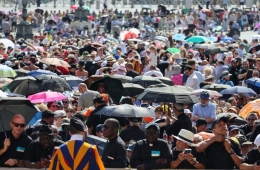
On the 28th (local time), as the temperature in Berlin, the capital of Germany, rose to around 40 degrees Celsius, people gathered at the Berlin Olympic Stadium to see Bruno Mars' concert covered themselves with foil blankets to escape the heat. Photo by AFP Yonhap News
View original imageFoil blankets flutter in the windows, and citizens carrying parasols walk the streets. The record-breaking heat wave of around 40 degrees Celsius that has swept across Europe is transforming the continent’s daily scenery in unfamiliar ways. In particular, in Europe—where “summers without air conditioning” have long been the norm—there are now reports of people scrambling to buy air conditioners, signaling that established lifestyles are being shaken to their core.
Heat Dome Surpasses 40 Degrees... Spreading Even to Eastern Europe
According to AFP and other foreign media on June 30 (local time), Europe has recently been trapped under a so-called “Omega Heat Dome,” where hot air is stagnating under high pressure, resulting in record-high temperatures being broken day after day in various regions.
Following Western Europe—including France, the United Kingdom, and Germany—thermometers in Eastern Europe, such as the Czech Republic, Slovakia, and Hungary, have now also soared past 40 degrees. Doksany in northwest Czechia reached 41.9 degrees, Szécsény in Hungary hit 42 degrees, and Turňa nad Bodvou in Slovakia recorded 41 degrees.

On the 22nd (local time), people cooling off at the Trocadero Fountain next to the Eiffel Tower in Paris. Photo by Reuters-Yonhap News
View original imageThe intensity of the heat wave is escalating from a mere inconvenience to a disaster that threatens the safety net of society as a whole. In Southern Italy, five people died from heat-related illnesses in just the past 24 hours, and 25 out of the country’s 27 major cities have been placed under the highest-level “red alert.” In France, in addition, the excess death toll for last month and this month combined has already surpassed 1,000 compared to average years, prompting public health authorities to go on high alert.
Widespread power outages and infrastructure failures are also paralyzing the functioning of urban areas. In the United Kingdom, concerns that railway tracks might warp due to the highest temperatures on record led to a complete suspension of train services, and hundreds of schools have announced temporary closures.
Using Parasols, Blocking Windows... Daily Life Transformed
As the heat wave persists, Europeans’ lifestyles are changing noticeably. In the past, Europeans often looked with puzzlement at East Asians from countries like Korea or Japan using parasols in the summer, wondering why people would deliberately avoid sunlight. However, there has recently been a dramatic increase in the number of local citizens opening parasols on the streets of major European cities to block out the intense UV rays. In order to lower the perceived temperature, long-standing cultural resistance has been cast aside.

On the 25th (local time), the windows of a residential building in Paris, France, were covered with aluminum foil blankets to block out the sunlight. Photo by Reuters and Yonhap News Agency
View original imageMore and more households are attaching foil blankets or aluminum foil to their windows to reflect sunlight. In addition, it is becoming common to keep shutters and windows closed during the day to prevent indoor temperatures from rising, and to ventilate at night to cool down the heat. In some regions, swimming in rivers and canals is being permitted, and public bodies of water are being used as places to escape the heat.
Scramble for Air Conditioners... Asian Appliance Makers See Booming Sales
Europeans, who have long been accustomed to life without air conditioning due to its limited adoption, are now scrambling to purchase air conditioners. In particular, portable air conditioners made in China—which face relatively few installation regulations—have become so popular that shortages are emerging.
Hot Picks Today
![[Exclusive] "650,000 Tons a Day, They Said": Juam Dam, Lifeline for Semiconductors, Rated Most Vulnerable to Drought](https://cwcontent.asiae.co.kr/asiaresize/93/2026070112460830202_1782877569.png) [Exclusive] "650,000 Tons a Day, They Said": Juam Dam, Lifeline for Semiconductors, Rated Most Vulnerable to Drought
[Exclusive] "650,000 Tons a Day, They Said": Juam Dam, Lifeline for Semiconductors, Rated Most Vulnerable to Drought
- "Come Back, Bento"... Bento Expresses Unwavering Trust in Son Heung-min: "Korean Football Needs Consistency"
- "An Ideal Match for 13,700,000 Won? Turns Out She Was a 10,000 Won Part-Time Actress: Marriage Scam Shakes Shanghai"
- "Not Envious of Samsung or SK Hynix" - Average Salary of 130 Million Won Plus Stock Bonuses... Voluntary Turnover Rate at 3.2% at This Company
- "Why Pay So Much for This?" 10 Billion Won Bill... Hong Myungbo’s Salary Double Bento’s, Plus Klinsmann’s Termination Fee

On the 24th (local time), a street vendor was selling a parasol with the British flag printed on it in London, England. Photo by AP Yonhap News
View original imageIn fact, sales of products from Chinese appliance manufacturers in the European market have surged, and for some models, secondhand prices are even surpassing those of brand-new units. Korean and Japanese companies are also reportedly enjoying increased sales, benefiting from the heat wave. Market observers see this as more than just a seasonal rise in demand—it's being interpreted as a sign that air conditioners are shifting from a “luxury choice” to a “necessity” in Europe.
© The Asia Business Daily. All rights reserved. Unauthorized AI training and use prohibited.





![[Why&Next]"June Average at 1,528 Won"...Year-End Exchange Rate '1,430 vs 1,530 Won', Key Variables at Play](https://cwcontent.asiae.co.kr/asiaresize/307/2026070109184129573_1782865121.jpg)