"AI Simulation on Hormuz Supply Disruption: Korea Can Manage Well Through August"
"Political Friction If Crisis Extends Into Fall"
"Concerns Over Securing Helium, a Key Semiconductor Material"

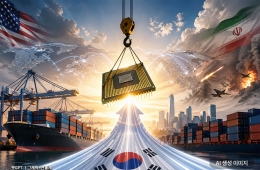
The Asia Group, a U.S.-based consulting firm, projected through an artificial intelligence (AI) simulation that, even if transportation disruptions in the Strait of Hormuz persist, South Korea would be able to manage supply issues effectively through August. However, it predicted that from that point on, South Korea’s economy would be impacted, and this would eventually affect the U.S. economy as well.
In a report published on June 30 (local time), The Asia Group stated, “Based on June 11, we ran about 50 predictive simulations covering various scenarios in the Strait of Hormuz over the next 180 days, and this was the result.” The firm added, “In 40 out of the 50 simulations, the president’s approval rating remained relatively stable. However, if severe supply disruptions in the Strait of Hormuz continue into the fall, the approval rating could drop to the mid-40% range at its lowest point.”
The Asia Group also noted, “In 43 out of the 50 simulations, South Korean companies’ semiconductor production levels were maintained through December. However, in the remaining seven simulations, production was reduced due to issues in securing helium.” The report continued, “There is a possibility that helium reserves could drop suddenly rather than gradually, at which point companies may scale back existing chip production and focus on manufacturing high-value-added products such as high-bandwidth memory (HBM).” Currently, South Korea imports the majority of its helium from Qatar.
If the crisis in the Strait of Hormuz continues beyond the fall, concerns were raised that the South Korean government could face fiscal pressure caused by exchange rate volatility and rising electricity costs. The Asia Group stated, “In most simulations, higher crude oil and liquefied natural gas (LNG) import costs led to increased outflows of dollars and a partial depreciation of the Korean won. Additionally, as Korea Electric Power Corporation’s cumulative losses grow, South Korea’s fiscal debt is highly likely to increase.”
The report also anticipated that a decrease in South Korea’s aviation fuel exports could negatively impact the U.S. economy. The Asia Group explained, “There was an 80% probability in the simulations that South Korea’s aviation fuel exports would plummet, resulting in a significant blow to the U.S., as 70% of U.S. aviation fuel imports are supplied by South Korea.”
Hot Picks Today
 NPS: "'74 Trillion Won Sell-Off Bomb' Is Absurd"... Easing Fears Over Domestic Equity Rebalancing
- Prices Jump Overnight on July 1: "My Morning Soft-Boiled Eggs Now 3,000 Won for 2" — Convenience Store Price Hikes Make Summer Hotter
- [Report] "This Is Like the Answers Being Leaked"... Asking Prices in Dasan, Byeollae, and Manan, Anyang Jump by 50 Million Won After New Regulations
- [Exclusive] Kim Eo-jun Opens Restaurant in Paris: First Guest Shares "How Was the Food..." Experience
- 'Suspect Still at Large' on 21st Day of Tongyeong Murder... Identity of 'Man's Face' Circulating on SNS
This AI simulation model was developed by The Asia Group to assess the impact of a Strait of Hormuz closure on the Asian market, with the Office of the President, the Bank of Korea, the National Assembly, and major conglomerates reflected as key stakeholders.
© The Asia Business Daily. All rights reserved. Unauthorized AI training and use prohibited.