"It Is Now Time for Growth"... Min Hyung-bae-led Integrated Metropolitan City of Jeollanam-do and Gwangju Officially Launched
Five Core Administrative Principles: Growth, Balance, Basic Income, Green City, and Civic Sovereignty
"Creating a New Axis of Growth for Korea by Combining Semiconductors, AI, and Renewable Energy"
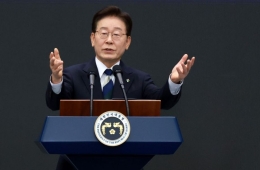
On July 1, the Integrated Metropolitan City of Jeollanam-do and Gwangju was officially launched, with its first mayor, Min Hyung-bae, embarking on the inaugural journey of the integrated era under the banner of "Overwhelming Growth, A City Where We Live Together."
At the opening ceremony and inauguration held early that morning at the Muan City Hall, Mayor Min laid out his vision for city administration, stating, "Jeollanam-do and Gwangju have come together again, seizing a golden opportunity to rise as a massive growth axis that will shake up the Republic of Korea."
In his inaugural address, Mayor Min emphasized the historical significance of the integration of Jeollanam-do and Gwangju.

Min Hyungbae, Mayor of the Integrated Special City of Gwangju, Jeonnam, is delivering his inaugural address at the general assembly hall of the Integrated Special City Council of Gwangju, Jeonnam, on the 1st. Photo by Shim Jinseok
View original imageHe stated, "Jeollanam-do and Gwangju have long suffered social, economic, and political marginalization. In May 1980, we defended democracy in Korea in the face of military force by the new military regime, yet have not received the respect we deserve. Since being administratively separated, we have wasted our strength through competition and conflict."
He went on to say, "Based on President Lee Jaemyung's vision for balanced national development and region-led growth strategies, Jeollanam-do and Gwangju have united once more. The recently announced three national leap mega-projects and the great national spatial transformation initiative represent a historic challenge, redrawing the industrial and growth map of Korea."
Mayor Min also presented a blueprint to establish a new axis of growth in Korea by combining Jeollanam-do's energy and agricultural bio resources with Gwangju's strengths in artificial intelligence (AI), culture, and education. He proposed five core administrative principles as alternatives: Overwhelming Growth, Balanced Development, Basic Income, Green City, and Civic Sovereignty.
In particular, he prioritized "Overwhelming Growth" as the top agenda. Mayor Min declared his intention to fundamentally transform the framework for growth by combining government support, special privileges under the special law, and enhanced administrative capacity resulting from the integration.
He referred to the recently announced 800 trillion won Jeollanam-do and Gwangju semiconductor cluster initiative by the government and private sector, emphasizing, "Since the Integrated City Council has swiftly enacted relevant support ordinances, we will design a package of talent and infrastructure to make Jeollanam-do and Gwangju an irresistible choice for companies."
He also set out a concrete strategy for balanced development. His plan is to achieve specialized regional development and mutual growth by linking Gwangju's AI and cultural industries, the eastern region's materials and port industries, the western region's offshore wind and energy industries, and the central-southern region's agricultural bio and biotech industries.
Regarding the basic income policy, he announced his intention to create a representative Korean model that revitalizes the local economy by establishing a virtuous cycle of consumption and economic activity within the region.
He also presented the vision of a green city.
Mayor Min said, "The sunlight, wind, sea, and forests of Jeollanam-do and Gwangju are our future competitiveness," and added, "We will build an RE100 industrial ecosystem by linking offshore wind, solar energy, energy storage, and the power grid."
He further added, "We will create a structure in which renewable energy becomes a source of regional income and corporate competitiveness, and leap forward as a leading global carbon-neutral city."
He also highlighted his commitment to realizing civic sovereignty.
Mayor Min stated, "The starting point of policy and the standard for administration must be the lives of our citizens. If citizens propose, discuss, and decide, the administration will establish a system to support this process."
Concluding his inaugural address, Mayor Min said, "Without being swayed by the capital region, Jeollanam-do and Gwangju will grow together, creating a place where young people no longer have to leave their hometowns. Together with our special citizens, we will take on the bold challenge of transforming the lives of our citizens, the future of our region, and ultimately the future of Korea."
Hot Picks Today
 "I'm Afraid of Being Invited"... In This Country, Attending a Wedding Costs 640,000 Won
- "All 104 Petitions from Supporters Requesting Air Conditioning in Yoon Seok-yeol's Solitary Cell Dismissed"
- "Mockery of 5.18 Cannot Be Tolerated"... Kim Daejung Expresses Regret to Paichai High School Baseball Team
- [Exclusive] Kim Eo-jun Opens Restaurant in Paris: First Guest Shares "How Was the Food..." Experience
- 'Suwon Drug Zombie' Video Man Tests Negative for Drugs in Detailed Urine Analysis
Meanwhile, with its official launch on this day, the Integrated Metropolitan City of Jeollanam-do and Gwangju began full-fledged administrative operations as the country's first metropolitan integrated autonomous municipality.
© The Asia Business Daily. All rights reserved. Unauthorized AI training and use prohibited.
![[Urgent Survey] Lessons from the World Cup... What Should the Football Association Reform First?](https://cwcontent.asiae.co.kr/asiaresize/307/2026063013521728513_1782795137.jpg)